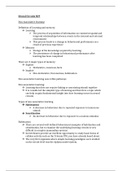
Neural Circuits NC9
Non-Associative learning
Definition of Learning and memory
Learning
The process of acquisition of information on consistent spatial and
temporal relationships between events in the internal and external
environment
This process leads to a change in behavioural performance as a
result of previous experience
Memory
Storage of the knowledge acquired by learning
The persistence of change in behavioural performance after
learning has been completed
There are 2 major types of memory:
Explicit
Declarative, conscious, facts
Implicit
Non-declarative, Unconscious, habituation
Non-associative learning uses reflex pathways
Non-associative learning:
Learning that does not require linking or associating stimuli together
It is considered the simplest type of learning and therefore a topic which
can help us gain fundamental insight into how learning occurs in neural
circuits
Types of non-associative learning
Habituation
A decrease in behaviour due to repeated exposure to innocuous
stimuli
Sensitization
An increase in behaviour due to exposure to a noxious stimulus
Habituation
There are several well-defined behavioural examples of habituation and
sensitization, but to examine the underlying learning circuits is very
difficult in complex mammalian systems.
Invertebrates provide an excellent opportunity to study basic forms of
cellular activity such as the Tritonia CPG, you have already heard about.
The very first organism where simple learning paradigms were studied
on the circuit level was the Aplysia model system.
Non-Associative learning
Definition of Learning and memory
Learning
The process of acquisition of information on consistent spatial and
temporal relationships between events in the internal and external
environment
This process leads to a change in behavioural performance as a
result of previous experience
Memory
Storage of the knowledge acquired by learning
The persistence of change in behavioural performance after
learning has been completed
There are 2 major types of memory:
Explicit
Declarative, conscious, facts
Implicit
Non-declarative, Unconscious, habituation
Non-associative learning uses reflex pathways
Non-associative learning:
Learning that does not require linking or associating stimuli together
It is considered the simplest type of learning and therefore a topic which
can help us gain fundamental insight into how learning occurs in neural
circuits
Types of non-associative learning
Habituation
A decrease in behaviour due to repeated exposure to innocuous
stimuli
Sensitization
An increase in behaviour due to exposure to a noxious stimulus
Habituation
There are several well-defined behavioural examples of habituation and
sensitization, but to examine the underlying learning circuits is very
difficult in complex mammalian systems.
Invertebrates provide an excellent opportunity to study basic forms of
cellular activity such as the Tritonia CPG, you have already heard about.
The very first organism where simple learning paradigms were studied
on the circuit level was the Aplysia model system.