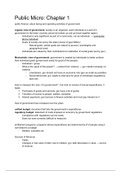
Public Micro: Chapter 1
public finance: about taxing and spending activities of government
organic view of government: society is an organism, each individual is a part of it,
government is the heart. (society cannot be broken up and put back together again)
- Individual is only significant as part of a community, not as individual. → community
above individual
- Goals of society are set by the state (choice of goal differs)
- Natural goals: certain goals are natural to pursue ( sovereignty over
geographical area)
- Individuals are valued by their contributions to realization of social goals (set by gov)
Mechanistic view of government: government is created by individuals to better achieve
their individual goals (government exists for good of the people).
- Individual > group
- What is the ‘good of the people’? → protect from violence → gov needs monopoly on
violence
- Libertarians: gov should not have an economic role (gov as small as possible)
- Social democrats: gov needs to intervene for good of individuals (regulations,
laws etc)
How to measure the ‘size’ of a government? Can look at volume of annual expenditures, 3
types:
1. Purchases of goods and services: gov buys a lot of goods
2. Transfers of income to people: welfare, subsidies
3. Interest payments: gov borrows to finance activities and must pay interest on it
Size of government has increased over the years.
unified budget: document that lists the government’s expenditures
regulatory budget: statement of costs imposed on economy by government regulations
- Compliance with regulations can be costly
- Does not exist currently (difficult to measure)
entitlement programs: programs whose expenditures are determined by # of people using it,
not limited to a budget
- Welfare, subsidies etc
Sources of Revenue
- Taxes
- Changes in real value of debt: due to inflation, gov debt decreases in value → source
of revenue
,Chapter 2: Tools of Positive Analysis
Economic theory is useful starting point for analyzing impact of government policy
- Model does not have to be 100% true, but should be plausible, informative and have
testable implications
- Utility should be maximized
- important function of economic theory: to generate hypotheses whose validity can be
assessed through empirical work.
- Seat Belts: reduces cost of crashes → expect people to drive more recklessly.
Is the additional safety worth the increase in reckless driving? → need
empirical data
substitution effect: if relative prices of a good increases → consume less of that good and
more of the other good
income effect: tendency to consume more / less of a good if your income increases
- Normal good: income increases → buy more of that good & vice versa
Income taxes: ambiguous effect (as income and substitution effect work in opposite
direction)
1. Substitution effect: tax reduces income → substitute from work to more leisure
2. Income effect: real income decreases due to tax → would expect to work more (/less
leisure as leisure is normal good)
Causal effects: three conditions
1. Cause must precede effect
2. Cause & effect must be correlated (move together)
3. Other explanations for any observed correlation must be eliminated
a. Use treatment group & control group to establish causation
Correlation does NOT equal causation
- Can be confounding factors
biased estimate: an estimate that inflates the true causal impact with the impact of outside
factors
- Other factors also influence it, must control for that otherwise you will inflate the
impact of what you are looking for
Counterfactual: what happens to members of treatment group if they had not received the
treatment
- True holy grail for testing, but would need to time travel → not possible
Experimental study: randomly assign persons to treatment or control group & observe the
differences in outcomes → difference may be due to treatment
- People in treatment and control will have same characteristics → control group works
as kind of ‘counterfactual’.
, - Pitfalls:
- Ethical issues
- Technical issues: people in experiments are not passive objects and their
behavior may undo effects of randomization (they may not keep to rules of
experiment for example)
- People may not respond to follow-up surveys. Could be that people
with lower wages are less likely to respond to follow up surveys about
their wages → results not good
- Entire society may not respond the same was as the people in the experiment
- If experiment of free healthcare lasts one year → people may use
health care way more in that year because they know that after the
year they will have to pay again → biased estimate
Observational studies: empirical study that uses observed data (not from experimental
setting)
- Can use regression (best fit through scatter of data points)
- Standard error: how much est. regression coefficient may vary from true value
- Types of Data:
- Cross-sectional data: contains info on entities at given point in time
(not grouped by individual)
- Time series data: contains data on single entity at different points in
time (grouped)
- Panel / longitudinal data: info about individual entities at different
points in time (combines cross sectional with time series)
- Pitfalls:
- Correlation =/= causation
- Use control variables
- Omitted variable bias: when you leave out relevant variables
quasi-experimental studies: relies on circumstances outside of the researcher’s control to
mimic random assignment.
- Uses observational data but relies on circumstances to naturally get random
assignment
- Difference-in-difference analysis: compares changes over time in an outcome of
the treatment group to changes over the same time period in the outcome of the
control group
- Instrumental variables analysis: relies on finding some variable that affects entry
into the treatment group, but in itself is not correlated with the outcome variable.
- A third variable may have affected entry into treatment group (so not random
anymore), but that variable in itself is not correlated with outcome
- Parents that want the best education for their children put their
children in schools with smaller class sizes → assignment of children
not random anymore → cannot infer whether small class sizes are
better for grades
, - Would be better to look at fluctuation in class sizes between years
(instr. variable) to find the effect of class sizes on grades, as then the
parent’s decision is not affecting the outcome
- Regression-discontinuity analysis: relies on a strict cut-off criterion for eligibility of
the intervention under study in order to approximate an experimental design.
- People that just missed the criteria must do summer school → compare
people that just missed criteria with people that just made it (very similar) →
you can then compare the results of the summer school
- Pitfalls:
- Natural experiment may not be random
- Can only be applied to limited number of research questions
- May not explain why changes occured → difficult to predict impact of other
policies
Chapter 3: Tools of Normative Analysis
welfare economics: branch of econ. about
desirability of alternative economic states
- When do markets well and when do they
fail to produce desirable results
Edgeworth box: shows possible distributions of
two products over two people
- Lengths of the sides: # that specific
product in total
- Where Adam and Eve’s IC are tangent is
the Pareto Efficient Distribution as it is
not possible to increase one person better
off without making the other worse off.
- There is an infinite set of pareto
efficient distributions possible →
contract curve
contract curve: set of all Pareto efficient points
Pareto improvement: when you can reallocate
resources and at least one person is better off
while the others are not worse off.
Marginal rate of substitution (MRS): absolute
slope of indifference curve
- rate at which you are willing to trade one good for another
- MRS = MUX / MUY
public finance: about taxing and spending activities of government
organic view of government: society is an organism, each individual is a part of it,
government is the heart. (society cannot be broken up and put back together again)
- Individual is only significant as part of a community, not as individual. → community
above individual
- Goals of society are set by the state (choice of goal differs)
- Natural goals: certain goals are natural to pursue ( sovereignty over
geographical area)
- Individuals are valued by their contributions to realization of social goals (set by gov)
Mechanistic view of government: government is created by individuals to better achieve
their individual goals (government exists for good of the people).
- Individual > group
- What is the ‘good of the people’? → protect from violence → gov needs monopoly on
violence
- Libertarians: gov should not have an economic role (gov as small as possible)
- Social democrats: gov needs to intervene for good of individuals (regulations,
laws etc)
How to measure the ‘size’ of a government? Can look at volume of annual expenditures, 3
types:
1. Purchases of goods and services: gov buys a lot of goods
2. Transfers of income to people: welfare, subsidies
3. Interest payments: gov borrows to finance activities and must pay interest on it
Size of government has increased over the years.
unified budget: document that lists the government’s expenditures
regulatory budget: statement of costs imposed on economy by government regulations
- Compliance with regulations can be costly
- Does not exist currently (difficult to measure)
entitlement programs: programs whose expenditures are determined by # of people using it,
not limited to a budget
- Welfare, subsidies etc
Sources of Revenue
- Taxes
- Changes in real value of debt: due to inflation, gov debt decreases in value → source
of revenue
,Chapter 2: Tools of Positive Analysis
Economic theory is useful starting point for analyzing impact of government policy
- Model does not have to be 100% true, but should be plausible, informative and have
testable implications
- Utility should be maximized
- important function of economic theory: to generate hypotheses whose validity can be
assessed through empirical work.
- Seat Belts: reduces cost of crashes → expect people to drive more recklessly.
Is the additional safety worth the increase in reckless driving? → need
empirical data
substitution effect: if relative prices of a good increases → consume less of that good and
more of the other good
income effect: tendency to consume more / less of a good if your income increases
- Normal good: income increases → buy more of that good & vice versa
Income taxes: ambiguous effect (as income and substitution effect work in opposite
direction)
1. Substitution effect: tax reduces income → substitute from work to more leisure
2. Income effect: real income decreases due to tax → would expect to work more (/less
leisure as leisure is normal good)
Causal effects: three conditions
1. Cause must precede effect
2. Cause & effect must be correlated (move together)
3. Other explanations for any observed correlation must be eliminated
a. Use treatment group & control group to establish causation
Correlation does NOT equal causation
- Can be confounding factors
biased estimate: an estimate that inflates the true causal impact with the impact of outside
factors
- Other factors also influence it, must control for that otherwise you will inflate the
impact of what you are looking for
Counterfactual: what happens to members of treatment group if they had not received the
treatment
- True holy grail for testing, but would need to time travel → not possible
Experimental study: randomly assign persons to treatment or control group & observe the
differences in outcomes → difference may be due to treatment
- People in treatment and control will have same characteristics → control group works
as kind of ‘counterfactual’.
, - Pitfalls:
- Ethical issues
- Technical issues: people in experiments are not passive objects and their
behavior may undo effects of randomization (they may not keep to rules of
experiment for example)
- People may not respond to follow-up surveys. Could be that people
with lower wages are less likely to respond to follow up surveys about
their wages → results not good
- Entire society may not respond the same was as the people in the experiment
- If experiment of free healthcare lasts one year → people may use
health care way more in that year because they know that after the
year they will have to pay again → biased estimate
Observational studies: empirical study that uses observed data (not from experimental
setting)
- Can use regression (best fit through scatter of data points)
- Standard error: how much est. regression coefficient may vary from true value
- Types of Data:
- Cross-sectional data: contains info on entities at given point in time
(not grouped by individual)
- Time series data: contains data on single entity at different points in
time (grouped)
- Panel / longitudinal data: info about individual entities at different
points in time (combines cross sectional with time series)
- Pitfalls:
- Correlation =/= causation
- Use control variables
- Omitted variable bias: when you leave out relevant variables
quasi-experimental studies: relies on circumstances outside of the researcher’s control to
mimic random assignment.
- Uses observational data but relies on circumstances to naturally get random
assignment
- Difference-in-difference analysis: compares changes over time in an outcome of
the treatment group to changes over the same time period in the outcome of the
control group
- Instrumental variables analysis: relies on finding some variable that affects entry
into the treatment group, but in itself is not correlated with the outcome variable.
- A third variable may have affected entry into treatment group (so not random
anymore), but that variable in itself is not correlated with outcome
- Parents that want the best education for their children put their
children in schools with smaller class sizes → assignment of children
not random anymore → cannot infer whether small class sizes are
better for grades
, - Would be better to look at fluctuation in class sizes between years
(instr. variable) to find the effect of class sizes on grades, as then the
parent’s decision is not affecting the outcome
- Regression-discontinuity analysis: relies on a strict cut-off criterion for eligibility of
the intervention under study in order to approximate an experimental design.
- People that just missed the criteria must do summer school → compare
people that just missed criteria with people that just made it (very similar) →
you can then compare the results of the summer school
- Pitfalls:
- Natural experiment may not be random
- Can only be applied to limited number of research questions
- May not explain why changes occured → difficult to predict impact of other
policies
Chapter 3: Tools of Normative Analysis
welfare economics: branch of econ. about
desirability of alternative economic states
- When do markets well and when do they
fail to produce desirable results
Edgeworth box: shows possible distributions of
two products over two people
- Lengths of the sides: # that specific
product in total
- Where Adam and Eve’s IC are tangent is
the Pareto Efficient Distribution as it is
not possible to increase one person better
off without making the other worse off.
- There is an infinite set of pareto
efficient distributions possible →
contract curve
contract curve: set of all Pareto efficient points
Pareto improvement: when you can reallocate
resources and at least one person is better off
while the others are not worse off.
Marginal rate of substitution (MRS): absolute
slope of indifference curve
- rate at which you are willing to trade one good for another
- MRS = MUX / MUY