EKN 110 Notes
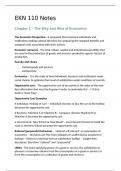
Chapter 1 – The Why and Who of Economics
The Economic Perspective - A viewpoint that envisions individuals and
institutions making rational decisions by comparing the marginal benefits and
marginal costs associated with their actions.
Economic resources - The land, labour, capital and entrepreneurial ability that
are used in the production of goods and services; productive agents; factors of
production.
Scarcity and choice -
- Limited goods and services
- Limited time
Economics - It is the study of how individuals, business and institutions make
social choices to optimize their level of satisfaction under conditions of scarcity.
Opportunity cost - The opportunity cost of an activity is the value of the next
best alternative that must be forgone in order to undertake this – (“A free
lunch is never free)
Opportunity Cost Examples
• Individual- Holiday or Car? – Individual chooses to buy the car so the holiday
becomes the opportunity cost
• Business- Machine A or Machine B – Company chooses Machine B so
Machine A becomes the opportunity cost
• Government- New School or New Road? – Government chooses to build the
road so the New School becomes the opportunity cost
Rational (purposeful) behaviour – ‘rational self-interest’ an assumption of
economics – Decisions not free from mistakes or unaffected by emotions or
feelings – Desire to maximize level of satisfaction (utility) – weight their
descisions, therefore “rational” and “purposeful”
Utility - The want-satisfying power of a good or service; the satisfaction or
pleasure a consumer obtains from the consumption of a good or service (or
from the consumption of a collection of goods and services).
,Concepts of utility (Allocation of time, energy and money)
- Cardinal (measurable) - a utility that determines the satisfaction of a
commodity used by an individual and can be supported with a numeric
value.
- Ordinal (comparative) – defines that satisfaction of user goods can be
ranked in order of preference but cannot be evaluated numerically.
Rational Consumers – Someone who maximizes Utility with unlimited
wants/needs and certain budget constraints.
Rational Producers – Seeks to maximize profit with cost constraints and
certain production techniques.
Marginal analysis - The comparison of marginal (‘extra’ or ‘additional’) benefits
and marginal costs, usually for decision making.
Marginal costs and benefits – Decision to obtain the marginal benefit
associated with some specific option always includes the marginal cost of
forgoing something else (i.e. opportunity costs present!).
Theories, Principles and Models
• Scientific method - The procedure for the systematic pursuit of knowledge
involving the observation of facts and the formulation and testing of
hypotheses to obtain theories, principles and laws.
• Economic principles and models - A widely accepted generalization about
the economic behaviour of individuals or institutions:
- Generalizations - Tendencies of typical or average consumers, workers
or business firms
- Other-things-equal assumption - The assumption that factors other than
those being considered are held constant; ceteris paribus assumption.
- Graphical expression
Macro and Micro economics
Macroeconomics - The part of economics concerned with the economy as a
whole; with such major aggregates as the household, business and
government sectors; and with measures of the total economy.
, Aggregate - A collection of specific economic units treated as if they were one,
For example, all prices of individual goods and services are combined into
a price level, or all units of output are aggregated into gross domestic product.
Using the aggregate, macroeconomics seeks to obtain an overview of the
structure of the economy and the relationships of its major aggregates.
Microeconomics - The part of economics concerned with decision making by
individual units such as a household, a firm or an industry and with individual
markets, specific goods and services, and product and resource prices.
Note: Many topics of study are rooted in both Micro and Macro economics.
Positive and Normative economics
positive economics - The analysis of facts or data to establish scientific
generalizations about economic behaviour.
- It focuses on facts and cause-and-effect relationships.
- Description, theory development and theory testing
normative economics - The part of economics involving value judgements
about what the economy should be like; focused on which economic goals and
policies should be implemented; policy economics.
- Expressions of support for particular policies.
- Incorporates value judgments about what the economy should be like
Positive Statement = “What is” – E.g: “The unemployment rate in South Africa
is higher than in Botswana.”
Normative Statement = “What ought to be” – E.g: “South Africa should
undertake certain policies to decreses its unemployment rate.”
Chapter 2 – Economic Systems
economic system - A particular set of institutional arrangements and a
coordinating mechanism for solving the economizing problem; a method of
Chapter 1 – The Why and Who of Economics
The Economic Perspective - A viewpoint that envisions individuals and
institutions making rational decisions by comparing the marginal benefits and
marginal costs associated with their actions.
Economic resources - The land, labour, capital and entrepreneurial ability that
are used in the production of goods and services; productive agents; factors of
production.
Scarcity and choice -
- Limited goods and services
- Limited time
Economics - It is the study of how individuals, business and institutions make
social choices to optimize their level of satisfaction under conditions of scarcity.
Opportunity cost - The opportunity cost of an activity is the value of the next
best alternative that must be forgone in order to undertake this – (“A free
lunch is never free)
Opportunity Cost Examples
• Individual- Holiday or Car? – Individual chooses to buy the car so the holiday
becomes the opportunity cost
• Business- Machine A or Machine B – Company chooses Machine B so
Machine A becomes the opportunity cost
• Government- New School or New Road? – Government chooses to build the
road so the New School becomes the opportunity cost
Rational (purposeful) behaviour – ‘rational self-interest’ an assumption of
economics – Decisions not free from mistakes or unaffected by emotions or
feelings – Desire to maximize level of satisfaction (utility) – weight their
descisions, therefore “rational” and “purposeful”
Utility - The want-satisfying power of a good or service; the satisfaction or
pleasure a consumer obtains from the consumption of a good or service (or
from the consumption of a collection of goods and services).
,Concepts of utility (Allocation of time, energy and money)
- Cardinal (measurable) - a utility that determines the satisfaction of a
commodity used by an individual and can be supported with a numeric
value.
- Ordinal (comparative) – defines that satisfaction of user goods can be
ranked in order of preference but cannot be evaluated numerically.
Rational Consumers – Someone who maximizes Utility with unlimited
wants/needs and certain budget constraints.
Rational Producers – Seeks to maximize profit with cost constraints and
certain production techniques.
Marginal analysis - The comparison of marginal (‘extra’ or ‘additional’) benefits
and marginal costs, usually for decision making.
Marginal costs and benefits – Decision to obtain the marginal benefit
associated with some specific option always includes the marginal cost of
forgoing something else (i.e. opportunity costs present!).
Theories, Principles and Models
• Scientific method - The procedure for the systematic pursuit of knowledge
involving the observation of facts and the formulation and testing of
hypotheses to obtain theories, principles and laws.
• Economic principles and models - A widely accepted generalization about
the economic behaviour of individuals or institutions:
- Generalizations - Tendencies of typical or average consumers, workers
or business firms
- Other-things-equal assumption - The assumption that factors other than
those being considered are held constant; ceteris paribus assumption.
- Graphical expression
Macro and Micro economics
Macroeconomics - The part of economics concerned with the economy as a
whole; with such major aggregates as the household, business and
government sectors; and with measures of the total economy.
, Aggregate - A collection of specific economic units treated as if they were one,
For example, all prices of individual goods and services are combined into
a price level, or all units of output are aggregated into gross domestic product.
Using the aggregate, macroeconomics seeks to obtain an overview of the
structure of the economy and the relationships of its major aggregates.
Microeconomics - The part of economics concerned with decision making by
individual units such as a household, a firm or an industry and with individual
markets, specific goods and services, and product and resource prices.
Note: Many topics of study are rooted in both Micro and Macro economics.
Positive and Normative economics
positive economics - The analysis of facts or data to establish scientific
generalizations about economic behaviour.
- It focuses on facts and cause-and-effect relationships.
- Description, theory development and theory testing
normative economics - The part of economics involving value judgements
about what the economy should be like; focused on which economic goals and
policies should be implemented; policy economics.
- Expressions of support for particular policies.
- Incorporates value judgments about what the economy should be like
Positive Statement = “What is” – E.g: “The unemployment rate in South Africa
is higher than in Botswana.”
Normative Statement = “What ought to be” – E.g: “South Africa should
undertake certain policies to decreses its unemployment rate.”
Chapter 2 – Economic Systems
economic system - A particular set of institutional arrangements and a
coordinating mechanism for solving the economizing problem; a method of