Summary #5 shakespeare to be
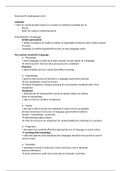
Language
= form of communication based on a system of symbols consisting out of
- Words
- Rules for using & combining words
Characteristics of language
- Infinite generativity
= ability to produce an endless number of meaningful sentences with a finite amount
of words
- Language is orderly/organized/has rules on how language works
Five systems involved in language:
o Phonology
= every language is made up of basic sounds/ sound system of a language
which sounds? how are they pronounced & combined?
Phoneme
= basic/smallest unit of a sound that affects meaning
o Morphology
= governs how words are formed in a language (past tenses/plurals)
free morpheme: word on its own
bound morpheme: changes meaning of a word when combined with a free
morpheme
Morpheme
= minimal unit of meaning that cannot be broken down any further
Rules of morphology
= rules on how to combine morphemes
o Syntax
= the way in which words are combined in order to form acceptable
phrases/sentences & structure of language (grammatical markers)
[syntax + morphology = grammar]
determining subject/object
rules for structure are important for understanding the meaning of a sentence
o Pragmatics
= principles that underlie effective/appropriate use of language in social contex
sociolinguistic knowledge
= culturally specific rules specifying how language should be structured & used in
social context
o Semantics
= meaning of words & sentences. Every word has a set of semantic
features/attributes.
some sentences could never exist due to semantic restriction
, Theories of language development
Learning/empiricist perspective
Main focus on imitation (bandura) & reinforcement (skinner)
Skinner:
Parent reinforces babbling + probability of repetition words
Combination of words are reinforced + production of sentences
Bandura:
Parents speak and children imitate the sounds and eventually imitate parents words/word
use/sentences
Language is for communication between people; social act; influenced by social
interaction
Absence of social environment (wild boy of Aveyron) = no speech
x Does not account for acquiring syntax (grammar is barely reinforced/praised)
x If modelling... why do children make grammar mistakes/ do not use adult speech
The nativist perspective
Biological programmed to acquire language
1968: Noam Chomsky
people have a inborn language processor which contains the foundations/universals of
grammars (which is activated by verbal input) = language acquisition device (LAD)
1985: Dan Slobin
people have a set of specialized processing skills that allow the child to analyze
speech/infer phonology (sounds)/understand meaning (semantics)/rules (syntax) =
Language making capacity (LMC)
Thus; children construct language (for) themselves to guide communication
Crosscultural/universal linguistic milestones
Language is species specific
Language centers in the brain (broca’s & wernicke’s)
Discrimination in phonetics arises in 1st few days of life
Kids produce their ‘own’ language
The wild boy of averyon couldn’t talk
Descriptive rather than explanative
Overlook environmental factors
Language
= form of communication based on a system of symbols consisting out of
- Words
- Rules for using & combining words
Characteristics of language
- Infinite generativity
= ability to produce an endless number of meaningful sentences with a finite amount
of words
- Language is orderly/organized/has rules on how language works
Five systems involved in language:
o Phonology
= every language is made up of basic sounds/ sound system of a language
which sounds? how are they pronounced & combined?
Phoneme
= basic/smallest unit of a sound that affects meaning
o Morphology
= governs how words are formed in a language (past tenses/plurals)
free morpheme: word on its own
bound morpheme: changes meaning of a word when combined with a free
morpheme
Morpheme
= minimal unit of meaning that cannot be broken down any further
Rules of morphology
= rules on how to combine morphemes
o Syntax
= the way in which words are combined in order to form acceptable
phrases/sentences & structure of language (grammatical markers)
[syntax + morphology = grammar]
determining subject/object
rules for structure are important for understanding the meaning of a sentence
o Pragmatics
= principles that underlie effective/appropriate use of language in social contex
sociolinguistic knowledge
= culturally specific rules specifying how language should be structured & used in
social context
o Semantics
= meaning of words & sentences. Every word has a set of semantic
features/attributes.
some sentences could never exist due to semantic restriction
, Theories of language development
Learning/empiricist perspective
Main focus on imitation (bandura) & reinforcement (skinner)
Skinner:
Parent reinforces babbling + probability of repetition words
Combination of words are reinforced + production of sentences
Bandura:
Parents speak and children imitate the sounds and eventually imitate parents words/word
use/sentences
Language is for communication between people; social act; influenced by social
interaction
Absence of social environment (wild boy of Aveyron) = no speech
x Does not account for acquiring syntax (grammar is barely reinforced/praised)
x If modelling... why do children make grammar mistakes/ do not use adult speech
The nativist perspective
Biological programmed to acquire language
1968: Noam Chomsky
people have a inborn language processor which contains the foundations/universals of
grammars (which is activated by verbal input) = language acquisition device (LAD)
1985: Dan Slobin
people have a set of specialized processing skills that allow the child to analyze
speech/infer phonology (sounds)/understand meaning (semantics)/rules (syntax) =
Language making capacity (LMC)
Thus; children construct language (for) themselves to guide communication
Crosscultural/universal linguistic milestones
Language is species specific
Language centers in the brain (broca’s & wernicke’s)
Discrimination in phonetics arises in 1st few days of life
Kids produce their ‘own’ language
The wild boy of averyon couldn’t talk
Descriptive rather than explanative
Overlook environmental factors