Summary #3 Reflexes & attachment
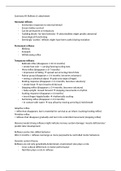
Neonatal reflexes
- Involuntary responses to external stimuli
- Ensure babies survival
- Can be permanent or temporary
- ‘building blocks’ for later behavior abnormalities might predict abnormal
(neurological) functioning
- Seemingly ‘useless’ reflexes might have been useful during evolution
Permanent reflexes
- Blinking
- Kneejerk
- Withdrawing reflex
Temporary reflexes
- Babinski reflex (disappears ± 10-12 months)
= stroke foot sole -> curving/fanning/curling toes
- Moro reflex (disappears ± 6-7 months)
= impression of falling spread out arms/leg/clench fists
- Palmar grasp (disappears ± 3-4 months, becomes voluntary)
= seeing a cylindrical object grab onto object (finger)
- Rooting response (disappears ± 3-4 months, becomes voluntary)
= stroke head turn head to drink/suck
- Stepping reflex (disappears ± 3-4 months, becomes voluntary)
= baby upright, moved forward stepping movements in rhythm
- Sucking response (disappears ± 6 months)
= insert finger/nipple/bottle rhythmically sucking
- Swimming reflex (disappears ± 4-6 months)
= in contact with water stay afloat by moving arms/leg & hold breath
Adaptive reflex
= reflex that disappears; but is essential for survival as an infant. (sucking/rooting reflex)
Primitive reflex
= reflexes that disappear gradually and turn into controlled movement (stepping reflex)
Absence/weak/strong reflexes might indicate nervous system damage/ muscle deficiencies/
predict later development
Reflexes evolve into skilled behavior
After 2 months + reflexes reemerge as more purposeful & controlled motor behaviors.
Dynamic system theory:
Reflexes are not only genetically determined, environment also plays a role.
- Cross cultural differences in motor performance
- Nutrition plays a role in reflexes
, Article: ethology
Innate behavior
- Stereotyped across all individuals (of species)
- Present without previous experience
- Universal for the species
- Relatively unchanged
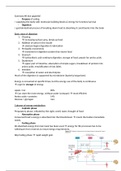
2 types of innate behaviors
Reflexes:
simple responses to stimuli
Fixed actions patterns:
complex innate behavior that promotes the survival of the individual because the usually
end in feeding, reproducing or protecting. (genetically programmed sequence of coordinated
motor actions)
fixed action patterns are elicited by sign stimuli
if the sign stimulus is removed but the behavior continues: complex innate behavior
fit between innate behaviors and fixed action patterns are the result of long evolutionary
history.
Learning predisposition:
Biology enable and restricts learning abilities
A critical period in which an animal is biologically prone to acquire new abilities; if it does not
happen then it will never happen again.
e.g.; imprinting happens right after birth (in ducklings) and has an effect on sexual behavior.
humans have more a sensitive period for attachment as opposed to a critical period, since
we can change our attachment behavior throughout life.
General learning skills:
General ability to learn complex and executive behavior from experience is determined by
biology
Specific learning skills:
an organism doesn’t learn everything equally easy (bias towards learning language in
humans)
Attachment
= strong emotional bond between mother and infant
Theories:
Psychoanalytic theory of attachment (freud)
= attachment is because caregivers are associated with gratification of innate drive to obtain
pleasure through (oral) stimulation. Particularly attachment with mother (breasts)
Accounts for inner needs and feeling & promoted research into attachment
Not supported by empirical evidence
Neonatal reflexes
- Involuntary responses to external stimuli
- Ensure babies survival
- Can be permanent or temporary
- ‘building blocks’ for later behavior abnormalities might predict abnormal
(neurological) functioning
- Seemingly ‘useless’ reflexes might have been useful during evolution
Permanent reflexes
- Blinking
- Kneejerk
- Withdrawing reflex
Temporary reflexes
- Babinski reflex (disappears ± 10-12 months)
= stroke foot sole -> curving/fanning/curling toes
- Moro reflex (disappears ± 6-7 months)
= impression of falling spread out arms/leg/clench fists
- Palmar grasp (disappears ± 3-4 months, becomes voluntary)
= seeing a cylindrical object grab onto object (finger)
- Rooting response (disappears ± 3-4 months, becomes voluntary)
= stroke head turn head to drink/suck
- Stepping reflex (disappears ± 3-4 months, becomes voluntary)
= baby upright, moved forward stepping movements in rhythm
- Sucking response (disappears ± 6 months)
= insert finger/nipple/bottle rhythmically sucking
- Swimming reflex (disappears ± 4-6 months)
= in contact with water stay afloat by moving arms/leg & hold breath
Adaptive reflex
= reflex that disappears; but is essential for survival as an infant. (sucking/rooting reflex)
Primitive reflex
= reflexes that disappear gradually and turn into controlled movement (stepping reflex)
Absence/weak/strong reflexes might indicate nervous system damage/ muscle deficiencies/
predict later development
Reflexes evolve into skilled behavior
After 2 months + reflexes reemerge as more purposeful & controlled motor behaviors.
Dynamic system theory:
Reflexes are not only genetically determined, environment also plays a role.
- Cross cultural differences in motor performance
- Nutrition plays a role in reflexes
, Article: ethology
Innate behavior
- Stereotyped across all individuals (of species)
- Present without previous experience
- Universal for the species
- Relatively unchanged
2 types of innate behaviors
Reflexes:
simple responses to stimuli
Fixed actions patterns:
complex innate behavior that promotes the survival of the individual because the usually
end in feeding, reproducing or protecting. (genetically programmed sequence of coordinated
motor actions)
fixed action patterns are elicited by sign stimuli
if the sign stimulus is removed but the behavior continues: complex innate behavior
fit between innate behaviors and fixed action patterns are the result of long evolutionary
history.
Learning predisposition:
Biology enable and restricts learning abilities
A critical period in which an animal is biologically prone to acquire new abilities; if it does not
happen then it will never happen again.
e.g.; imprinting happens right after birth (in ducklings) and has an effect on sexual behavior.
humans have more a sensitive period for attachment as opposed to a critical period, since
we can change our attachment behavior throughout life.
General learning skills:
General ability to learn complex and executive behavior from experience is determined by
biology
Specific learning skills:
an organism doesn’t learn everything equally easy (bias towards learning language in
humans)
Attachment
= strong emotional bond between mother and infant
Theories:
Psychoanalytic theory of attachment (freud)
= attachment is because caregivers are associated with gratification of innate drive to obtain
pleasure through (oral) stimulation. Particularly attachment with mother (breasts)
Accounts for inner needs and feeling & promoted research into attachment
Not supported by empirical evidence