Summary #5 gender issues
Mama Wawa
false assumption that female and male are
discrete, mutually exclusive, opposite.
Hormones influence
- Development (conception/maturation
related)
- Activation (reproduction related)
Endocrine gland
= release of hormones WITHIN body
Exocrine gland
= release of substances targeted to leave (body surface)
Gonads
testes & ovaries
- Produce sperm/ova (=gametes)
- Release hormones
Hormones
- Amino acid (adrenaline)
- Peptide (oxytocin) hydrophilic
- Protein
- Steroid hydrophobic (fatty)
= able to pass through membrane nucleus receptor
influence gene expression
Diverse, long-lasting effects
Sex hormones are steroids
- Androgens (e.g., testosterone; mainly in testes)
- Estrogens (e.g., estradiol; mainly in ovaries)
- Progestins (e.g., progesterone)
Important gonadal gland = adrenal gland (cortex/medulla)
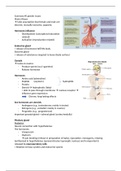
Pituitary gland
Posterior
Neural connection with hypothalamus
The hormones:
- Vasopressin
- Oxytocin
pair bonding (release in preparation of baby), ejaculation, monogamy, relaxing
Synthesized in hypothalamus (paraventricular/supraoptic nucleus) and transported &
released by neurosecretory cells
= Relation nervous system and endocrine system
, Anterior
Produces many tropic hormones influence other glands to produce a specific
hormone
hypothalamus produces releasing hormones (cause release of tropic hormones in
ant. Pit.)
Hypothalamus is connected to anterior pituitary by a vascular network
(=hypothalamopituitary portal system)
Releasing (or release-inhibiting) hormones are transported to anterior pituitary
Production or inhibition tropic hormone in anterior pituitary
Example: FSH (follicle stimul. Horm.)
Gonadotropin RH stimulates gonadal hormone production
LH
(luteinizing hormone)
Women go through a hormonal (=menstrual) cycle. FSH promotes
the follicle growth. Lining of uterus slowly begin. FSH combined
with a burst of LH; ovulation.
= Periovulatory period: max fertility
The leftover follicle becomes corpus luteum
Produces progesterone to line the uterus for implantation of
fertilized egg.
no fertilization? = menstruation (shedding of lining)
When a woman is fertile, she often is more receptive/proceptive/sexually attractive/prefers
masculinity.
Development
Sperm and ova (produced in gonads) are haploid (contain only 23 chromosomes, not pairs)
Fuse together and form diploid zygote a pairing of chromosomes.
Sex chromosomes are either X or Y, each gamete contains one of these.
Male: XY
Female: XX
Gonads (6 weeks)
The Y in the male chromosome pair produces the SRY protein testes
Absence of SRY? ovaries
Ducts (3rd month)
The developed testes start to shed testosterone influences development of ‘ducts’
Wolffian = male (presence)
2 systems
Mama Wawa
false assumption that female and male are
discrete, mutually exclusive, opposite.
Hormones influence
- Development (conception/maturation
related)
- Activation (reproduction related)
Endocrine gland
= release of hormones WITHIN body
Exocrine gland
= release of substances targeted to leave (body surface)
Gonads
testes & ovaries
- Produce sperm/ova (=gametes)
- Release hormones
Hormones
- Amino acid (adrenaline)
- Peptide (oxytocin) hydrophilic
- Protein
- Steroid hydrophobic (fatty)
= able to pass through membrane nucleus receptor
influence gene expression
Diverse, long-lasting effects
Sex hormones are steroids
- Androgens (e.g., testosterone; mainly in testes)
- Estrogens (e.g., estradiol; mainly in ovaries)
- Progestins (e.g., progesterone)
Important gonadal gland = adrenal gland (cortex/medulla)
Pituitary gland
Posterior
Neural connection with hypothalamus
The hormones:
- Vasopressin
- Oxytocin
pair bonding (release in preparation of baby), ejaculation, monogamy, relaxing
Synthesized in hypothalamus (paraventricular/supraoptic nucleus) and transported &
released by neurosecretory cells
= Relation nervous system and endocrine system
, Anterior
Produces many tropic hormones influence other glands to produce a specific
hormone
hypothalamus produces releasing hormones (cause release of tropic hormones in
ant. Pit.)
Hypothalamus is connected to anterior pituitary by a vascular network
(=hypothalamopituitary portal system)
Releasing (or release-inhibiting) hormones are transported to anterior pituitary
Production or inhibition tropic hormone in anterior pituitary
Example: FSH (follicle stimul. Horm.)
Gonadotropin RH stimulates gonadal hormone production
LH
(luteinizing hormone)
Women go through a hormonal (=menstrual) cycle. FSH promotes
the follicle growth. Lining of uterus slowly begin. FSH combined
with a burst of LH; ovulation.
= Periovulatory period: max fertility
The leftover follicle becomes corpus luteum
Produces progesterone to line the uterus for implantation of
fertilized egg.
no fertilization? = menstruation (shedding of lining)
When a woman is fertile, she often is more receptive/proceptive/sexually attractive/prefers
masculinity.
Development
Sperm and ova (produced in gonads) are haploid (contain only 23 chromosomes, not pairs)
Fuse together and form diploid zygote a pairing of chromosomes.
Sex chromosomes are either X or Y, each gamete contains one of these.
Male: XY
Female: XX
Gonads (6 weeks)
The Y in the male chromosome pair produces the SRY protein testes
Absence of SRY? ovaries
Ducts (3rd month)
The developed testes start to shed testosterone influences development of ‘ducts’
Wolffian = male (presence)
2 systems