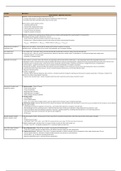
Concepts Description
Equity Valuation : Application and Process
Valuation Definition : Process of determining the value of an assets, by :
(1) using model, based on variables that influence the findamental value of the asset
(2) compare with other observable market value of similar assets
General steps in equity valuation process :
1. Understand the business
2. Forecast the company performance
3. Select appropriate valuation model
4. Convert forecast into valuation
5. Apply the valuation conclusions
Intrinsic value Definition : valuation of an asset/security by individual who has complete understanding of the asset/issuing firm's characteristics
Mispricing perceived by analyst is divided into 2 sources:
‐ Actual mispricing : difference between market price and intrinsic value
‐ Valuation error : difference between actual intrinsic value and intrinsic value estimated by analyst
Going concern assumption / Going concern assumption : assume that the company will continue to operate as a business
Liquidation value Liquidation value : estimated value of firm's assets if sold separately, net of company's liabilities
Fair market value / 1. Fair market value : price that a willing, informed and able seller would trade an asset to a willing, informed and able buyer
Investment value 2. Investment value : value of a stock to a particular buyer, depend on the buyer's specific needs / or expectations / or perceived synergies with existing assets
‐ Investment decision → intrinsic value
‐ Acquisition → Investment value
Applications of valuation 1. Stock selection : purchase / hold / sale of stocks, by comparing (1) intrinsic value with its market price ; or (2) comparing its price with comparable stocks' price
2. Reading the market : estimate the future value of variables that influence stock price (earnings growth ; expected return) by comparing market price with stock's intrinsic value
3. Projecting value of corporate actions : determine the value of proposed corporate mergers, acquisitions, divestitures, management buyouts, recapitalisations
4. Fairness options : support for the fairness of price received by minority shareholders in a merger or acquisition
5. Planning and consulting : evaluate the effects of proposed corporate strategies on firm's stock price, to pursue those that have greatest value to shareholders
6. Communication with analysts and investors : discuss / evaluate company's performance, current state and future plans
7. Valuation of private business
8. Portfolio management
‐ Planning : define investment objectives and constraints ; articulate investment strategy for selecting securities based on valuation parameters / techniques ; implied in the
selection of an index / preset basket of securities
‐ Execution the investment plan : results of valuation determine which investments will be made, and which to avoid
Assessment of industry and 1. Industry analysis ‐ Porter's 5 forces :
competitive analysis ‐ Threat of new entrants
‐ Threat of substitutes
‐ Bargaining power of buyers
‐ Bargaining power of suppliers
‐ Rivalry amongst existing competitors
2. Strategy analysis :
‐ Cost leadership
‐ Product differentiation
‐ Focus : Use 1 of the above strategies within a particular segment of the industry to gain competitive advantage
3. Performance analysis : based on the info from fim's reports and releases. Check the quality of FS information to ensure the accuracy and detail of firm's disclosure. Issues related to
earning quality includes:
‐ Accelerating or premature recognition of income (e.g.: record sales before shipment / acceptance ; bill and hold)
‐ Reclassifying gain and non‐operating income → distort the financial result of con nuance opera ons, hiding underperformance/decline in sales
‐ Expense recognition and losses (delaying recognition of expenses, capitalising expenses, classifying operating expenses as non‐operating expenses)
‐ Amortisation, depreciation and discount rates (pension plan obligation)
‐ Off‐BS issues
Absolute valuation model / 1. Absolute valuation model : estimate asset's intrinsic value from its investment characteristics, rather than value of other similar assets, including:
Relative valuation model ‐ DCF,
‐ Dividend discount model,
‐ asset‐based model : firm's value = sum of MV of its assets (common use to value firm that own natural resources)
2. Relative valuation mdel : estmiate value on an asset in relation to values of other similar assets, e.g.:
‐ P/E ratio : Firm's P/E > Comparable companies P/E → overvalued rela ve to other firms
Sum‐of‐ther‐parts valuation / 1. Sum‐of‐the‐parts value : Value of firm as a whole = sum of value of all individual parts
Conglomerate discount ‐ Useful when company operates multiple divisions, with different business models and risks characteristics
2. Conglomerate discount : Markdown to the value of a company operating in multiple unrelated industries (compared to other single‐industry peers). Due to:
‐ Internal capital inefficiency : allocation of capital to different divisions may not base on sound decisions
‐ Internal factors, e.g.: to hide poor operating performance
‐ Research measurement errors : result of incorrect measurement
,Criteria for choosing valuation 1. Whether the model fits the characteristics of the company (does it pay dividends? Is earnings growth estimatable? Does it have significant intangible assets?)
method 2. Whether the model is appropriate, based on the quality and availability of input data
3. Whether the model suitable, given the purpose of the analysis
(*) Using multiple models and examining the differences in valuation could reveal the impact of assumptions and the perspective of the analysis on the estimated value
, Concepts Description
Return concepts
Holding period return
Realised return / Realised return : historical return, based on past observed prices and CFs
Expected return Expected return : return based on forecasts of future prices and CFs
Required return Minimum return required by an investor, given the asset's risks
Riskier assets → Higher required return
Price convergence Price convergence : If expected return ≠ required return → addi onal return from convergence of price to intrinsic value
Discount rate Rate used to find the PV of investment. Discount rate is determined by the market
IRR Rate that equates the value of DCF to the current price of the security
Equity risk premium 1. Definition : return in excess of risk‐free rate that investors requires for holding equity securities
Equity risk premium = Required return on equity indes ‐ Risk‐free rate
2. Steps to estimate future equity risk premium :
‐ Step 1 : Select an equity index
‐ Select a time period
‐ Calculate mean return on the index
‐ Select a proxy for risk free rate (should correspond the time horizon for the investment, e.g.: T‐bills for shorter term ; T‐bonds for longer term)
Types of estimates of equity risk Historical estimates Forward‐looking estimates
premium : Historical estimates /
Forward‐looking estimates Definition : ‐ difference between historical mean return for a broad‐based equity‐market ‐ Use current info and expectations concerning economics and financial
index vs. risk‐free rate over time variables
Strength : ‐ Objective ‐ Does not rely on assumption of stationarity
‐ Simple ‐ Less subject to survivorship bias
‐ If investors are rational → historical es mates is unbiased
Weakness : ‐ Assumption of constant mean and variance over time
‐ Subject to survivorship bias, if only surviving form are included in the
sample → upward bias
Example: ‐ Gordon growth model
‐ Supply‐side model
‐ Estimates from surveys
Gordon growth model GGM equity‐risk premium = (1‐year forecasted dividend yield on market index) + (LT earning growth rate) ‐ (LT government bond yield)
Weakness:
‐ estimates change over time → need to be updated. Economic boom → low dividend yield + high growth expecta ons ; Economic bust → high dividend yield + low growth
expectations
‐ Assumption of stable growth rate → not appropriate in rapid growth economies. In case of mul ple growth stage, required rate of returm = IRR from this equa on :
Equity index price = PV‐rapid + PV‐transition + PV‐mature
Supply‐side estimates 1. Definition : Based on the relationship between macroeconomic variables and financial variables
1 1 1 1
In which:
20 20 )
/
PEg > o → market is believed to be overvalued → P/E is expected to decrease
PEg < 0 → Market is believed to be undervalued → P/E is expected to increase
PEg = 0 → Market is correctly valued
2. Strength : Use proven and current info
3. Weakness : only appropriate for developed economies, where public equities represent a large share of the economy
Survey estimates 1. Definiton : use the opinion from a sasmple of people. If sample is experts in equity valuation only → more reliable
2. Strength : easy to obtain
3. Weakness : different result from different group sample
Capital asset pricing model
(CAPM)
Multifactor models ⋯
In which:
Factor risk premium : expected return above risk‐free rate from 1 unit sensitivity to the factor and 0 sensitivity to all other factors
3 multifactor models : Farma‐French model , Pastor‐Stambaugh model , Macro multifactor model
Equity Valuation : Application and Process
Valuation Definition : Process of determining the value of an assets, by :
(1) using model, based on variables that influence the findamental value of the asset
(2) compare with other observable market value of similar assets
General steps in equity valuation process :
1. Understand the business
2. Forecast the company performance
3. Select appropriate valuation model
4. Convert forecast into valuation
5. Apply the valuation conclusions
Intrinsic value Definition : valuation of an asset/security by individual who has complete understanding of the asset/issuing firm's characteristics
Mispricing perceived by analyst is divided into 2 sources:
‐ Actual mispricing : difference between market price and intrinsic value
‐ Valuation error : difference between actual intrinsic value and intrinsic value estimated by analyst
Going concern assumption / Going concern assumption : assume that the company will continue to operate as a business
Liquidation value Liquidation value : estimated value of firm's assets if sold separately, net of company's liabilities
Fair market value / 1. Fair market value : price that a willing, informed and able seller would trade an asset to a willing, informed and able buyer
Investment value 2. Investment value : value of a stock to a particular buyer, depend on the buyer's specific needs / or expectations / or perceived synergies with existing assets
‐ Investment decision → intrinsic value
‐ Acquisition → Investment value
Applications of valuation 1. Stock selection : purchase / hold / sale of stocks, by comparing (1) intrinsic value with its market price ; or (2) comparing its price with comparable stocks' price
2. Reading the market : estimate the future value of variables that influence stock price (earnings growth ; expected return) by comparing market price with stock's intrinsic value
3. Projecting value of corporate actions : determine the value of proposed corporate mergers, acquisitions, divestitures, management buyouts, recapitalisations
4. Fairness options : support for the fairness of price received by minority shareholders in a merger or acquisition
5. Planning and consulting : evaluate the effects of proposed corporate strategies on firm's stock price, to pursue those that have greatest value to shareholders
6. Communication with analysts and investors : discuss / evaluate company's performance, current state and future plans
7. Valuation of private business
8. Portfolio management
‐ Planning : define investment objectives and constraints ; articulate investment strategy for selecting securities based on valuation parameters / techniques ; implied in the
selection of an index / preset basket of securities
‐ Execution the investment plan : results of valuation determine which investments will be made, and which to avoid
Assessment of industry and 1. Industry analysis ‐ Porter's 5 forces :
competitive analysis ‐ Threat of new entrants
‐ Threat of substitutes
‐ Bargaining power of buyers
‐ Bargaining power of suppliers
‐ Rivalry amongst existing competitors
2. Strategy analysis :
‐ Cost leadership
‐ Product differentiation
‐ Focus : Use 1 of the above strategies within a particular segment of the industry to gain competitive advantage
3. Performance analysis : based on the info from fim's reports and releases. Check the quality of FS information to ensure the accuracy and detail of firm's disclosure. Issues related to
earning quality includes:
‐ Accelerating or premature recognition of income (e.g.: record sales before shipment / acceptance ; bill and hold)
‐ Reclassifying gain and non‐operating income → distort the financial result of con nuance opera ons, hiding underperformance/decline in sales
‐ Expense recognition and losses (delaying recognition of expenses, capitalising expenses, classifying operating expenses as non‐operating expenses)
‐ Amortisation, depreciation and discount rates (pension plan obligation)
‐ Off‐BS issues
Absolute valuation model / 1. Absolute valuation model : estimate asset's intrinsic value from its investment characteristics, rather than value of other similar assets, including:
Relative valuation model ‐ DCF,
‐ Dividend discount model,
‐ asset‐based model : firm's value = sum of MV of its assets (common use to value firm that own natural resources)
2. Relative valuation mdel : estmiate value on an asset in relation to values of other similar assets, e.g.:
‐ P/E ratio : Firm's P/E > Comparable companies P/E → overvalued rela ve to other firms
Sum‐of‐ther‐parts valuation / 1. Sum‐of‐the‐parts value : Value of firm as a whole = sum of value of all individual parts
Conglomerate discount ‐ Useful when company operates multiple divisions, with different business models and risks characteristics
2. Conglomerate discount : Markdown to the value of a company operating in multiple unrelated industries (compared to other single‐industry peers). Due to:
‐ Internal capital inefficiency : allocation of capital to different divisions may not base on sound decisions
‐ Internal factors, e.g.: to hide poor operating performance
‐ Research measurement errors : result of incorrect measurement
,Criteria for choosing valuation 1. Whether the model fits the characteristics of the company (does it pay dividends? Is earnings growth estimatable? Does it have significant intangible assets?)
method 2. Whether the model is appropriate, based on the quality and availability of input data
3. Whether the model suitable, given the purpose of the analysis
(*) Using multiple models and examining the differences in valuation could reveal the impact of assumptions and the perspective of the analysis on the estimated value
, Concepts Description
Return concepts
Holding period return
Realised return / Realised return : historical return, based on past observed prices and CFs
Expected return Expected return : return based on forecasts of future prices and CFs
Required return Minimum return required by an investor, given the asset's risks
Riskier assets → Higher required return
Price convergence Price convergence : If expected return ≠ required return → addi onal return from convergence of price to intrinsic value
Discount rate Rate used to find the PV of investment. Discount rate is determined by the market
IRR Rate that equates the value of DCF to the current price of the security
Equity risk premium 1. Definition : return in excess of risk‐free rate that investors requires for holding equity securities
Equity risk premium = Required return on equity indes ‐ Risk‐free rate
2. Steps to estimate future equity risk premium :
‐ Step 1 : Select an equity index
‐ Select a time period
‐ Calculate mean return on the index
‐ Select a proxy for risk free rate (should correspond the time horizon for the investment, e.g.: T‐bills for shorter term ; T‐bonds for longer term)
Types of estimates of equity risk Historical estimates Forward‐looking estimates
premium : Historical estimates /
Forward‐looking estimates Definition : ‐ difference between historical mean return for a broad‐based equity‐market ‐ Use current info and expectations concerning economics and financial
index vs. risk‐free rate over time variables
Strength : ‐ Objective ‐ Does not rely on assumption of stationarity
‐ Simple ‐ Less subject to survivorship bias
‐ If investors are rational → historical es mates is unbiased
Weakness : ‐ Assumption of constant mean and variance over time
‐ Subject to survivorship bias, if only surviving form are included in the
sample → upward bias
Example: ‐ Gordon growth model
‐ Supply‐side model
‐ Estimates from surveys
Gordon growth model GGM equity‐risk premium = (1‐year forecasted dividend yield on market index) + (LT earning growth rate) ‐ (LT government bond yield)
Weakness:
‐ estimates change over time → need to be updated. Economic boom → low dividend yield + high growth expecta ons ; Economic bust → high dividend yield + low growth
expectations
‐ Assumption of stable growth rate → not appropriate in rapid growth economies. In case of mul ple growth stage, required rate of returm = IRR from this equa on :
Equity index price = PV‐rapid + PV‐transition + PV‐mature
Supply‐side estimates 1. Definition : Based on the relationship between macroeconomic variables and financial variables
1 1 1 1
In which:
20 20 )
/
PEg > o → market is believed to be overvalued → P/E is expected to decrease
PEg < 0 → Market is believed to be undervalued → P/E is expected to increase
PEg = 0 → Market is correctly valued
2. Strength : Use proven and current info
3. Weakness : only appropriate for developed economies, where public equities represent a large share of the economy
Survey estimates 1. Definiton : use the opinion from a sasmple of people. If sample is experts in equity valuation only → more reliable
2. Strength : easy to obtain
3. Weakness : different result from different group sample
Capital asset pricing model
(CAPM)
Multifactor models ⋯
In which:
Factor risk premium : expected return above risk‐free rate from 1 unit sensitivity to the factor and 0 sensitivity to all other factors
3 multifactor models : Farma‐French model , Pastor‐Stambaugh model , Macro multifactor model