Dieetleer
samenvatting
Manual of Dietetic Practice
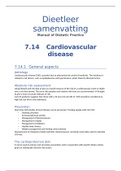
7.14 Cardiovascular
disease
7.14.1 General aspects
Aetiology
Cardiovascular disease (CVD) causation due to atherosclerosis and/or thrombosis. The incidence is
related to risk factors, such as dyslipidaemia and hypertension, which linked to lifestyle factors.
Absolute risk assessment
Using lifestyle and risk data to give an overall measure of the risk of a cardiovascular event or death
over a set time period. The score risk equation and relative risk chart are recommended thought
to give a more accurate estimate of risk.
Current guidance suggests that those with a 10-year risk od CVD of >20% should be considered as
high risk, but this is only estimated.
Prevention
More than 50% deaths of heart disease can be prevented. Treating people with risk CVD:
- Smoking cessation
- Increased physical activity
- Management of blood pressure
- Management of lipids
- Management of diabetes
- Healthy food choices
- Weight management and limiting central obesity
Measurement of cholesterol (total and HDL), blood pressure, and body mass index used to calculate
CVD risk.
The cardioprotective diet
It can be used in primary and secondary prevention and in conjunction with specific dietary advice
given on individually relevant risk factors.
,Effectivenesst
The cardioprotective diet (Mediterranean diet) is very similar to the proposed cancer protective diet
and so may confer other health benefits over those seen in CVD.
,Influence on cardiovascular disease
Diets focus on risk factors, effects on:
- Blood pressure, lipid oxidation and inflammation
- Lipid profile, homocysteine levels and insulin resistance
- Platelet aggregation, clotting factors and arrhythmias
Several guideline and additional information the main elements of the cardioprotective diet have
been summarized as discussed below
Fats
- Saturated fats <10en%. Replacing saturated for unsaturated reduce the risk of vascular
disease and coronary heart disease (CHD), tips for this replacement:
Remove fat from meat and avoid processed meat
Remove skin from poultry
Avoid deep fried snacks and dishes
Replace butter, ghee and lard with a vegetable oil such as ilive or rapeseed oil; replace
full fat dairy products with low fat alternatives or soya products
Replace high fat snacks such as crisps, chocolates and biscuits with fruit and nuts.
Read food labels – aim for >1.5g of saturates per 100g.
- Trans saturated fats <2en%. Trans fatty acids raise low density lipoprotein (LDL)
cholesterol whilst lowering HDL.
- Omega-3 fatty acids eicosapentaenoic acid (EPA) and docosahexaenoic (DHA). They do
not have a cholesterol lowering effect; however, they are thought to be protective by
improving endothelial function and have anti-inflammatory and antithrombotic effects.
Primary prevention advice one portion white fish and oily fish per week.
Secondary prevention advice two-four portions.
Dietitians should also note that levels of dioxin and PCBs are higher in fish liver oil
supplements than in fish body oils.
Salt
Decrease intake to 6g/day. Advice to lower salt:
- Discourage adding salt when cooking or at the table
- Discourage consumption of food with high salt content
- Encourage the use of alternatives such as herbs and spices
- Look for food containing <0.3 of salt per 100g.
Stanols and sterols
Lower LDL by interfering with biliary and dietary cholesterol absorption from the gut. They are
naturally occurring in the diet; however, a dose of 1.5-2.4g/day (20-30g of margarine or one yoghurt
drink) is seen as an optimal intake. They have been shown to lower cholesterol by at least 10%.
Fruit and vegetables
Recommendation 400g/day 80g fresh fruit or vegetables, 30g dried fruit or 150ml unsweetened
fruit or vegetable juice. Fruit and vegetables contribute to soluble fibre and antioxidants, giving them
a protective effect. Also rich in folic acid.
Nuts
Cardioprotective diet, with almonds, walnuts and pecans seen to be most beneficial.
, Soluble fibre
The high viscosity of soluble fibre reduces cholesterol levels by interfering with cholesterol
absorption in the gut. Recommended intake 15-20g/day. Wholegrain foods should be encouraged to
prevent constipation and help with weight control, high intakes have protective effect on CDH risk,
reducing risk of both CVD and diabetes by 30%.
Carbohydrates
50-55en%. Refined carbohydrates should be avoided. Low glycaemia index (GI) food reduces CVD.
However, low GI diets may be beneficial with diabetes or metabolic syndrome and those with high
triglycerides.
Soya protein
15-25g/day (soya milk, yoghurts, desserts, spreads, tofu). Lower LDL by interfering with liver LDL
synthesis, and slightly to raise HDL.
Dietary cholesterol
No more than 300mg/day should be consumed. Increase blood cholesterol, however it is unlikely to
have any significant impact on blood cholesterol. Shell fish, eggs and offal are rich in cholesterol (but
low in saturated fats).
Folic acid
Elevated levels of homocysteine have been linked with CVD. Folic acid and B-vitamins have been
shown to lower these levels, but not supplemented. Dietary folate 400mcg/day.
Practical aspects
The low fat diet will allow weight loss (similar to cardioprotective diet) but will not provide the
protective effects (no fruit and vegetables, lacking in fibre, n-3 and higher in salt).
Specific considerations
Alcohol
For those at medium or high cardiovascular risk, a modest amount of alcohol is protective. For those
with increased cardiovascular risk, a regular intake of 1-2 units/day of any alcohol probably confers
maximal protection without adverse effect on triglycerides or blood pressure.
Gout
Some people at high cardiovascular risk will also have gout and may need to avoid intakes of purine (oily
fish, capsules do not contain purines).
Lifestyle
Always context healthy lifestyle. Recommendations for physical activity:
- Primary prevention all patients should be encouraged to increase physical activity to 30
minutes/day at moderate intensity for most days of the week.
- Secondary prevention regular exercise building up to 20-30 minutes/day to the point of
slight breathlessness; it is important to encourage cardiac rehabilitation.
Weight and waist circumference
Patients should aim for healthy weight and waist circumference.
samenvatting
Manual of Dietetic Practice
7.14 Cardiovascular
disease
7.14.1 General aspects
Aetiology
Cardiovascular disease (CVD) causation due to atherosclerosis and/or thrombosis. The incidence is
related to risk factors, such as dyslipidaemia and hypertension, which linked to lifestyle factors.
Absolute risk assessment
Using lifestyle and risk data to give an overall measure of the risk of a cardiovascular event or death
over a set time period. The score risk equation and relative risk chart are recommended thought
to give a more accurate estimate of risk.
Current guidance suggests that those with a 10-year risk od CVD of >20% should be considered as
high risk, but this is only estimated.
Prevention
More than 50% deaths of heart disease can be prevented. Treating people with risk CVD:
- Smoking cessation
- Increased physical activity
- Management of blood pressure
- Management of lipids
- Management of diabetes
- Healthy food choices
- Weight management and limiting central obesity
Measurement of cholesterol (total and HDL), blood pressure, and body mass index used to calculate
CVD risk.
The cardioprotective diet
It can be used in primary and secondary prevention and in conjunction with specific dietary advice
given on individually relevant risk factors.
,Effectivenesst
The cardioprotective diet (Mediterranean diet) is very similar to the proposed cancer protective diet
and so may confer other health benefits over those seen in CVD.
,Influence on cardiovascular disease
Diets focus on risk factors, effects on:
- Blood pressure, lipid oxidation and inflammation
- Lipid profile, homocysteine levels and insulin resistance
- Platelet aggregation, clotting factors and arrhythmias
Several guideline and additional information the main elements of the cardioprotective diet have
been summarized as discussed below
Fats
- Saturated fats <10en%. Replacing saturated for unsaturated reduce the risk of vascular
disease and coronary heart disease (CHD), tips for this replacement:
Remove fat from meat and avoid processed meat
Remove skin from poultry
Avoid deep fried snacks and dishes
Replace butter, ghee and lard with a vegetable oil such as ilive or rapeseed oil; replace
full fat dairy products with low fat alternatives or soya products
Replace high fat snacks such as crisps, chocolates and biscuits with fruit and nuts.
Read food labels – aim for >1.5g of saturates per 100g.
- Trans saturated fats <2en%. Trans fatty acids raise low density lipoprotein (LDL)
cholesterol whilst lowering HDL.
- Omega-3 fatty acids eicosapentaenoic acid (EPA) and docosahexaenoic (DHA). They do
not have a cholesterol lowering effect; however, they are thought to be protective by
improving endothelial function and have anti-inflammatory and antithrombotic effects.
Primary prevention advice one portion white fish and oily fish per week.
Secondary prevention advice two-four portions.
Dietitians should also note that levels of dioxin and PCBs are higher in fish liver oil
supplements than in fish body oils.
Salt
Decrease intake to 6g/day. Advice to lower salt:
- Discourage adding salt when cooking or at the table
- Discourage consumption of food with high salt content
- Encourage the use of alternatives such as herbs and spices
- Look for food containing <0.3 of salt per 100g.
Stanols and sterols
Lower LDL by interfering with biliary and dietary cholesterol absorption from the gut. They are
naturally occurring in the diet; however, a dose of 1.5-2.4g/day (20-30g of margarine or one yoghurt
drink) is seen as an optimal intake. They have been shown to lower cholesterol by at least 10%.
Fruit and vegetables
Recommendation 400g/day 80g fresh fruit or vegetables, 30g dried fruit or 150ml unsweetened
fruit or vegetable juice. Fruit and vegetables contribute to soluble fibre and antioxidants, giving them
a protective effect. Also rich in folic acid.
Nuts
Cardioprotective diet, with almonds, walnuts and pecans seen to be most beneficial.
, Soluble fibre
The high viscosity of soluble fibre reduces cholesterol levels by interfering with cholesterol
absorption in the gut. Recommended intake 15-20g/day. Wholegrain foods should be encouraged to
prevent constipation and help with weight control, high intakes have protective effect on CDH risk,
reducing risk of both CVD and diabetes by 30%.
Carbohydrates
50-55en%. Refined carbohydrates should be avoided. Low glycaemia index (GI) food reduces CVD.
However, low GI diets may be beneficial with diabetes or metabolic syndrome and those with high
triglycerides.
Soya protein
15-25g/day (soya milk, yoghurts, desserts, spreads, tofu). Lower LDL by interfering with liver LDL
synthesis, and slightly to raise HDL.
Dietary cholesterol
No more than 300mg/day should be consumed. Increase blood cholesterol, however it is unlikely to
have any significant impact on blood cholesterol. Shell fish, eggs and offal are rich in cholesterol (but
low in saturated fats).
Folic acid
Elevated levels of homocysteine have been linked with CVD. Folic acid and B-vitamins have been
shown to lower these levels, but not supplemented. Dietary folate 400mcg/day.
Practical aspects
The low fat diet will allow weight loss (similar to cardioprotective diet) but will not provide the
protective effects (no fruit and vegetables, lacking in fibre, n-3 and higher in salt).
Specific considerations
Alcohol
For those at medium or high cardiovascular risk, a modest amount of alcohol is protective. For those
with increased cardiovascular risk, a regular intake of 1-2 units/day of any alcohol probably confers
maximal protection without adverse effect on triglycerides or blood pressure.
Gout
Some people at high cardiovascular risk will also have gout and may need to avoid intakes of purine (oily
fish, capsules do not contain purines).
Lifestyle
Always context healthy lifestyle. Recommendations for physical activity:
- Primary prevention all patients should be encouraged to increase physical activity to 30
minutes/day at moderate intensity for most days of the week.
- Secondary prevention regular exercise building up to 20-30 minutes/day to the point of
slight breathlessness; it is important to encourage cardiac rehabilitation.
Weight and waist circumference
Patients should aim for healthy weight and waist circumference.