Biomedical Sciences PLTW EOC Questions And Answers With Latest Updates
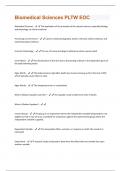
Biomedical Sciences - The application of the principles of the natural sciences, especially biology and physiology, to clinical medicine. Processing a Crime Scene - 5 parts include photography, sketch, interview, collect evidence, and examine/analyze evidence. Forensic Entemology - The use of insects and bugs to determine when a person died Livor Mortis - The dsicoloration of the skin due to the pooling of blood in the dependent parts of the body following death. Rigor Mortis - The body becomes rigid after death due muscles tensing up from the lack of ATP, which typically causes them to relax Algor Mortis - The temperature lost in a dead body What is Glaister Equation used for? - The equation used to determine time of death. What is Glaister Equation? - Control Group - The group in an experiment where the independent variable being tested is not applied so that it may serve as a standard for comparison against the experimental group where the independent variable is applied. Dependent Variable - The measurable effect, outcome, or response in which the research is interested Experiment - A research study conducted to determine the effect that one variable has upon another variableForensic Science - The application of scientific knowledge to questions of civil and criminal law Hypothesis - Clear prediction of the anticipated results of an experiment Independent Variable - The variable that is varied or manipulated by the researcher Negative Control - Control group where conditions produce a negative outcome. Negative control groups help identify outside influences which may be present that were not accounted for when the procedure was created. Personal Protective Equipment (PPE) - Specialized clothing or equipment, worn by an employee for protection against infectious materials (as defined by OSHA) Positive Control - Group expected to have a positive result, allowing the researcher to show that the experimental setup was capable of being produced Adenine - A component of nucleic acids that carries hereditary information in DNA and RNA in cells. Chemically, it is a purine base. Bonds with Thymine. Chromsome - Any of the usually linear bodies in the cell nucleus that contain the genetic material. Cytosine - A component of nucleic acids that carries hereditary information in DNA and RNA in cells. Chemically, it is a pyrimidine base. Bonds with Guanine. Deoxyribonucleic Acid (DNA) - A double-stranded, helical nucleic acid molecule capable of replicating and determining the inherited structure of a cell's proteins. Gel Electrophoresis - The separation of nucleic acids or proteins, on the basis of their size and electrical charge, by measuring their rate of movement through an electrical field in a gelGene - A discrete unit of hereditary information consisting of a specific nucleotide sequence in DNA (or RNA, in some viruses Guanine - A component of nucleic acids that carries hereditary information in DNA and RNA in cells. Chemically, it is a purine base. Bonds with Cytosine Helix - Something spiral in form Model - A simplified version of something complex used, for example, to analyze and solve problems or make predictions Nucleotide - A building block of DNA, consisting of a five-carbon sugar covalently bonded to a nitrogenous base and a phosphate group. Restriction Enzyme - A degradative enzyme that recognizes specific nucleotide sequences and cuts up DNA Restriction Fragment Length Polymorphisms (RFLPs) - Differences in DNA sequence on homologous chromosomes that can result in different patterns of restriction fragment lengths (DNA segments resulting from treatment with restriction enzymes). Thymine - A component of nucleic acid that carries hereditary information in DNA in cells. Chemically, it is a pyrimidine base. Bonds with Adenine Autopsy - An examination of the body after death usually with such dissection as will expose the vital organs for determining the cause of death Bibliography - A document showing all the sources used to research information Citation - A written reference to a specific work (book, article, dissertation, report, musical composition, etc.) by a particular author or creator which identifies the document in which the work may be found.Documentation - The act of creating citations to identify resources used in writing a work Health Insurance Portability and Accountability Act (HIPAA) - A comprehensive set of standards and practices designed to give patients specific rights regarding their personal health information. Medical Examiner - A physician who performs an autopsy when death may be accidental or violent. He or she may also serve in some jurisdictions as the coroner. Glucagon - A protein hormone secreted by pancreatic endocrine cells that raises blood glucose levels; an antagonistic hormone to insulin Glucose Tolerance Test - A test of the body's ability to metabolize glucose that involves the administration of a measured dose of glucose to the fasting stomach and the determination of blood glucose levels in the blood or urine at intervals thereafter and that is used especially to detect diabetes Homeostasis - The maintenance of relatively stable internal physiological conditions (as body temperature or the pH of blood) in higher animals under fluctuating environmental conditions Hormone - A product of living cells that circulates in blood and produces a specific, often stimulatory, effect on the activity of cells that are often far from the source of the hormone.; hormones are part of the endocrine system. Insulin - A protein hormone secreted by the pancreas that is essential for the metabolism of carbohydrates and the regulation of glucose levels in the blood. Negative Feedback - A primary mechanism of homeostasis, whereby a change in a physiological variable that is being monitored triggers a response that counteracts the initial fluctuation. Positive Feedback - Feedback that tends to magnify a process or increase its output.Type 1 Diabetes - Diabetes of a form that usually develops during childhood or adolescence and is characterized by a severe deficiency of insulin, leading to high blood glucose levels. Type 2 Diabetes - Diabetes of a form that develops especially in adults and most often obese individuals and that is characterized by high blood glucose resulting from impaired insulin utilization coupled with the body's inability to compensate with increased insulin production. Adenosine Tri-Phosphate (ATP) - A compound composed of adenosine and three phosphate groups that supplies energy for many biochemical cellular processes by undergoing enzymatic hydrolysis. Amino Acid - An organic monomer which serves as a building block of proteins. Calorie - The amount of heat energy required to raise the temperature of 1 g of water by 1°C; also the amount of heat energy that 1 g of water releases when it cools by 1°C. The Calorie (with a capital C), usually used to indicate the energy content of food, is a kilocalorie. Carbohydrate - A sugar in the form of a monosaccharide, disaccharide or polysaccharide. Chemical Bond - An attractive force that holds together the atoms, ions, or groups of atoms in a molecule or compound. Chemical Indicator - A substance (as a dye) used to show visually usually by its capacity for color change, the condition of a solution with respect to the presence of free acid or alkali or some other substance Chemical Reaction - Chemical transformation or change; the interaction of chemical entities. Compound - A substance consisting of two or more elements in a fixed ratio Covalent Bond - A type of strong chemical bond in which two atoms share one or more pairs of valence electrons.Dehydration Synthesis - A chemical reaction in which two molecules are bonded together with the removal of a water molecule. Dissaccharide - A double sugar molecule made of two monosaccharides bonded together through dehydration synthesis. Element - The smallest particle of a substance that retains all the properties of the substance and is composed of one or more atoms Glucose - A monomer of carbohydrate, simple sugar. Hydrolysis - A chemical process that splits a molecule by adding water Ionic Bond - A chemical bond resulting from the attraction between oppositely charged ions Lipid - One of a family of compounds including fats, phospholipids, and steroids that is insoluble in water Macromolecule - A type of giant molecule formed by joining smaller molecules which includes proteins, polysaccharides, lipids, and nucleic acids Molecule - Two or more atoms held together by covalent bonds Monomer - The subunit that serves as the building block of a polymer Monosaccharide - A single sugar molecule such as glucose or fructose, the simplest type of sugar Nutrient - A substance that is needed by the body to maintain life and healthPolymer - A large molecule consisting of many repeating chemical units or molecules linked together Polysaccharide - A polymer of thousands of simple sugars formed by dehydration synthesis Protein - A three dimensional polymer made of monomers of amino acids Hemoglobin A1c - A test that measures the level of hemoglobin A1c in the blood as a means of determining the average blood sugar concentrations for the preceding two to three months. Hyperglycemia - An excess of sugar in the blood Hypertonic - In comparing two solutions, referring to the one with a greater solute concentration. Isotonic - Having the same solute concentration as another solution

Geschreven voor
- Instelling
- Biomedical Sciences PLTW EOC
- Vak
- Biomedical Sciences PLTW EOC
Documentinformatie
- Geüpload op
- 3 juni 2024
- Aantal pagina's
- 8
- Geschreven in
- 2023/2024
- Type
- Tentamen (uitwerkingen)
- Bevat
- Vragen en antwoorden
Onderwerpen
-
biomedical sciences pltw eoc

Ook beschikbaar in voordeelbundel