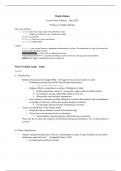
World Politics
Course Notes February – May 2024
Professor: Jonathan Holslag
Each week includes:
- Lecture notes from slides and own handwritten notes
o Graphs and other relevant visuals from slides
- Readings summaries
- Reflections, takeaways, and conclusions
- Questions (if applicable)
Legend:
- Grey text: own research done to supplement information on slides. Not mentioned in class, but to provide
context/understanding of slides.
- Grey highlighting: on slides, but not discussed in class.
- **EXAM QUESTION**: to point out Holslag’s points of interest and specific exam-testables
- Bolded text: highly emphasised points/conclusions
Week 6 Global South – India
Lecture:
6. 1 Introduction:
- Rashtriya Swayamsevak Sangh (RSS) – the biggest boy scout movement on earth
o Of Bharatiya Janata Party (BJP) main Hindu political party
Right-wing Hindu nationalist
o Displays Modi’s commitment to return of Hinduism to India
Hindu nationalism returns as “social glue” again central to Indian politics
In contrast to secular, multi-ethnic India it once was
Historically used inclusive nationalism
o Now a threat to minorities in India Difficult to reconcile this position with commitments
to opening its economy to the much-needed foreign investment
Exclusionary policies become off-putting to investors
- “Lotus in a Mud Pond” of the Global South
o Image that the government asserts on the global stage
o Not an easy environment, but not yet looming
Surrounded by regional tensions and nuclear power tensions
- Thus, how do we assess the capacity of this Hindu national government to rise to the position of
a power?
6.1 Policy Organisation
- “Merely saying that democracy will solve all problems is utterly wrong. Problems are solved by
intelligence and hard work." – Jawaharlal Nehru (1947)
o Founding prime minister of India
, o Aware of benefits of democracy, but thought that it requires more than just having it
institutionally, to preserve it and let it be helpful
o Today, some practical issues with Indian elections
Dispersed rural and unconnected societies without infrastructure
1.4 million people
Fragmented and paternalistic society
Women can vote, but often only in theory
o Overall, Indians are proud and take democracy seriously
Historical culture of debate
- Historically, many of the states of India have been quite autonomous
o Unconnected and divided regions
o Clear north-south divide, where the BGB is much less influential in the south
North = Hinduism and high population
South = Muslim
o Modi works towards more centralisation today
- Draupadi Murmu
o President of India (2022-current)
Largely symbolic role
In charge of state protocol
Head of State, head of executive
Constitutionally must sign off on things
Historically, presidents can act independently or as more of a rubber
stamp
o First Indigenous political leader
Modi called this a “watershed moment for the poor, marginalised, and
downtrodden”
- Narendra Modi
o Prime Minister (2014-current)
Holds real power
For example, would hold the control over a nuclear power
Leader of parliament, representative in executive
Legislative
Executive authority despite president as nominal head
- Foreign policy organisation:
o President
Murmu: symbolic power
o Prime Minister
Modi: significant power
Heads Cabinet (Executive)
Advised by
o National Security Council (NSC)
NSA Board
National Security Advisor (NSA) is chairman
o Joint Economic Council (says JEIC on slides but internet tells
me there is no such thing)
o In principle, must hold confidence of the lower house
Cabinet ministers head ministries/committees:
, o Ministry of External Affairs (MEA) and Committee on
Economic Affairs
Both follow strong bureaucratic culture
Strong diplomatic power in world
Powerful entities
o Ministry of Commerce (MOC)
o Ministry of Defence (MOD)
o Committee on Security
Parliament (Legislature)
Two levels
o Rajya Sabha – upper house
Appointed by president and elected by the people
Permanent, with six-year terms
o Lok Sabha – lower house
Elected by the people
Can be dissolved
Standing Committees
on External Affairs
on Defence
Both have significant influence
o Because of press and the importance of
the public image
Think tanks, industry, and
public opinion
o Desire to project hard stances to public
sets tones of the debate
o Press is still largely free, but Modi is
lessening that
Think Tanks have much less
voice and access than
historically
o Is a less industrialised country, so the
few conglomerate companies are very
powerful
5-10 wealth families
Increasingly incorporated into
the BJP
States
Have own powers, including over external affairs
6.2 History
Graph showing degree of
dynastic control over
Indian land throughout
history
, - Interesting for two reasons: who was in power? And how much power did they have?
o Dynastic control:
Maurya: Indigenous dynasty which provided the origin of a lot of Indian
mindset/thought
Kushan: imperial dynasty, non-native
Delhi Sultanate: central Asian and native dynasty
Mughal: central Asian dynasty
Aurangzeb (1658-1707) as emperor
o “Conqueror of the World”
All alien control in India’s history is being ignored
in today’s view
They focus on Maurya
o Indian unity is not a given
Fragmented and competing states
Even during height of Maurya dynasty
Rival city states
- Need for strategic thinking and understanding of India as a geopolitical axis of insecurity
o Khyber-Karakoram Pass is the most vulnerable place
Most important focus strategically
Big existential threats to India come through here from the North
E.g. central Asian conquerors
Most populous region
Horseshoe of India: northern plateau
Because of these threats, we can understand India’s focus to this region,
Kashmir, and Afghanistan in its policies today
o Arabian Sea
Competition with trading states from the west
Because existential in the 15th and 16th centuries
Threat from Portuguese, Dutch, and British
o Bay of Bengal
Centre of two huge economic blocs
Natural bridge between subcontinent and eastern regions and coast of China
Historical movements of people, goods, and ideas
o Natu La Pass
NE cluster of independent states, historically
Now a threat from China
Arunashel Pradesh as contested territory, now in Indian control
o Palk
Tamil population borders here
India and Sri Lanka
During Sri Lankan civil war, Tamil’s struggled and traded here
o Laccadive Sea
Was very important for British trade
Course Notes February – May 2024
Professor: Jonathan Holslag
Each week includes:
- Lecture notes from slides and own handwritten notes
o Graphs and other relevant visuals from slides
- Readings summaries
- Reflections, takeaways, and conclusions
- Questions (if applicable)
Legend:
- Grey text: own research done to supplement information on slides. Not mentioned in class, but to provide
context/understanding of slides.
- Grey highlighting: on slides, but not discussed in class.
- **EXAM QUESTION**: to point out Holslag’s points of interest and specific exam-testables
- Bolded text: highly emphasised points/conclusions
Week 6 Global South – India
Lecture:
6. 1 Introduction:
- Rashtriya Swayamsevak Sangh (RSS) – the biggest boy scout movement on earth
o Of Bharatiya Janata Party (BJP) main Hindu political party
Right-wing Hindu nationalist
o Displays Modi’s commitment to return of Hinduism to India
Hindu nationalism returns as “social glue” again central to Indian politics
In contrast to secular, multi-ethnic India it once was
Historically used inclusive nationalism
o Now a threat to minorities in India Difficult to reconcile this position with commitments
to opening its economy to the much-needed foreign investment
Exclusionary policies become off-putting to investors
- “Lotus in a Mud Pond” of the Global South
o Image that the government asserts on the global stage
o Not an easy environment, but not yet looming
Surrounded by regional tensions and nuclear power tensions
- Thus, how do we assess the capacity of this Hindu national government to rise to the position of
a power?
6.1 Policy Organisation
- “Merely saying that democracy will solve all problems is utterly wrong. Problems are solved by
intelligence and hard work." – Jawaharlal Nehru (1947)
o Founding prime minister of India
, o Aware of benefits of democracy, but thought that it requires more than just having it
institutionally, to preserve it and let it be helpful
o Today, some practical issues with Indian elections
Dispersed rural and unconnected societies without infrastructure
1.4 million people
Fragmented and paternalistic society
Women can vote, but often only in theory
o Overall, Indians are proud and take democracy seriously
Historical culture of debate
- Historically, many of the states of India have been quite autonomous
o Unconnected and divided regions
o Clear north-south divide, where the BGB is much less influential in the south
North = Hinduism and high population
South = Muslim
o Modi works towards more centralisation today
- Draupadi Murmu
o President of India (2022-current)
Largely symbolic role
In charge of state protocol
Head of State, head of executive
Constitutionally must sign off on things
Historically, presidents can act independently or as more of a rubber
stamp
o First Indigenous political leader
Modi called this a “watershed moment for the poor, marginalised, and
downtrodden”
- Narendra Modi
o Prime Minister (2014-current)
Holds real power
For example, would hold the control over a nuclear power
Leader of parliament, representative in executive
Legislative
Executive authority despite president as nominal head
- Foreign policy organisation:
o President
Murmu: symbolic power
o Prime Minister
Modi: significant power
Heads Cabinet (Executive)
Advised by
o National Security Council (NSC)
NSA Board
National Security Advisor (NSA) is chairman
o Joint Economic Council (says JEIC on slides but internet tells
me there is no such thing)
o In principle, must hold confidence of the lower house
Cabinet ministers head ministries/committees:
, o Ministry of External Affairs (MEA) and Committee on
Economic Affairs
Both follow strong bureaucratic culture
Strong diplomatic power in world
Powerful entities
o Ministry of Commerce (MOC)
o Ministry of Defence (MOD)
o Committee on Security
Parliament (Legislature)
Two levels
o Rajya Sabha – upper house
Appointed by president and elected by the people
Permanent, with six-year terms
o Lok Sabha – lower house
Elected by the people
Can be dissolved
Standing Committees
on External Affairs
on Defence
Both have significant influence
o Because of press and the importance of
the public image
Think tanks, industry, and
public opinion
o Desire to project hard stances to public
sets tones of the debate
o Press is still largely free, but Modi is
lessening that
Think Tanks have much less
voice and access than
historically
o Is a less industrialised country, so the
few conglomerate companies are very
powerful
5-10 wealth families
Increasingly incorporated into
the BJP
States
Have own powers, including over external affairs
6.2 History
Graph showing degree of
dynastic control over
Indian land throughout
history
, - Interesting for two reasons: who was in power? And how much power did they have?
o Dynastic control:
Maurya: Indigenous dynasty which provided the origin of a lot of Indian
mindset/thought
Kushan: imperial dynasty, non-native
Delhi Sultanate: central Asian and native dynasty
Mughal: central Asian dynasty
Aurangzeb (1658-1707) as emperor
o “Conqueror of the World”
All alien control in India’s history is being ignored
in today’s view
They focus on Maurya
o Indian unity is not a given
Fragmented and competing states
Even during height of Maurya dynasty
Rival city states
- Need for strategic thinking and understanding of India as a geopolitical axis of insecurity
o Khyber-Karakoram Pass is the most vulnerable place
Most important focus strategically
Big existential threats to India come through here from the North
E.g. central Asian conquerors
Most populous region
Horseshoe of India: northern plateau
Because of these threats, we can understand India’s focus to this region,
Kashmir, and Afghanistan in its policies today
o Arabian Sea
Competition with trading states from the west
Because existential in the 15th and 16th centuries
Threat from Portuguese, Dutch, and British
o Bay of Bengal
Centre of two huge economic blocs
Natural bridge between subcontinent and eastern regions and coast of China
Historical movements of people, goods, and ideas
o Natu La Pass
NE cluster of independent states, historically
Now a threat from China
Arunashel Pradesh as contested territory, now in Indian control
o Palk
Tamil population borders here
India and Sri Lanka
During Sri Lankan civil war, Tamil’s struggled and traded here
o Laccadive Sea
Was very important for British trade