International Finance Managment
Chapter 1
Risk and return
- Risk refers to the possibility that actual return may be different from expected return.
- Risk can be measured by standard deviation.
- Investors require increasing compensation (return) for taking on increasing risk.
- Return on an investment can be measured over a standard period such as 1 year.
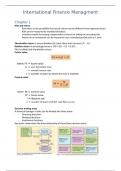
Shareholder return is annual dividend (D1) plus share price increase (P1 – P0).
Relative return in percentage terms is 100 × [(P1 – P0) + D1]/P0.
This is called total shareholder return.
Future value
Present value
Decision making areas
A financial manager’s tasks can be divided into three areas:
- Financing decisions
- Dividend decisions
- Investment decisions
Key point: understand the interrelationship of these three decision areas.
,SHWM= Share Holder Wealth Maximisation
Shareholders want both dividends and capital gains.
Capital gains reflect future dividends.
Current and future dividends depend on future cash flows:
- Their magnitude or size
- Their timing
- Their associated risk
Making big loses but still everyone still expects future dividends
Cash flow= real cash in company
The closer the cash flow gets the better
Link NPV to SHWM
Divergence of Ownership and Control:
= divergence occurs when shareholders own a company, but managers control its day-to-
day operations.
Agency Problem
= The agency problem arises when managers' goals differ from shareholders', creating a
conflict of interest.
Consequences:
1. Shareholder Wealth: may not be maximized due to conflicting objectives.
2. Corporate Governance: becomes crucial to align managerial actions with shareholder
interests.
, Difference between Ownership and Control:
- Shareholders: own the company through shares.
- Management: controls day-to-day operations.
Mitigation:
1. Aligning Incentives: compensation tied to shareholder interests.
2. Transparent Reporting: reducing information asymmetry.
3. Effective Corporate Governance: independent boards and mechanisms to monitor
management.
In essence, the challenge is ensuring that managerial actions align with shareholder interests
to maximize wealth and maintaining effective corporate governance to address the
divergence between ownership and control.
Beyond Shareholders: Agency Problems with Creditors and Employees
Creditors vs. Managers:
- Crisis: differing interests between suppliers and managers.
- Resolution: contracts with clear payment terms to align interests.
Employees vs. Management:
- Challenge: salary-related agency problem.
- Resolution: transparent communication, fair evaluation, and clear salary structures for
harmony.
The consequences of the agency problem
- Managers will follow their own objectives increasing their power, job security and
pay & rewards
- Shareholders need to ensure that their own wealth is maximized
Signs of an agency problem
- Managers mainly finance company with equity finance, accept low risk, short-
payback investment projects, diversify business operations follow ‘pet projects’ and
are rewarded for performance that is ‘below average’.
Solutions to the agency problem
- is to design managerial contracts that minimize the sum of the following costs:
financial contracting, monitoring and divergent behavior (= goal congruence between
shareholders and managers)
- Bpost problem: government is one of the shareholders’, bpost is overcharging rent
and distribution of their shareholders’
Option 1 : do nothing
Option 2: monitoring (= racking and analyzing a business' performance over a certain
period of time)
Option 3: reward good behaviour
- Rewarding is more common than monitoring
Chapter 1
Risk and return
- Risk refers to the possibility that actual return may be different from expected return.
- Risk can be measured by standard deviation.
- Investors require increasing compensation (return) for taking on increasing risk.
- Return on an investment can be measured over a standard period such as 1 year.
Shareholder return is annual dividend (D1) plus share price increase (P1 – P0).
Relative return in percentage terms is 100 × [(P1 – P0) + D1]/P0.
This is called total shareholder return.
Future value
Present value
Decision making areas
A financial manager’s tasks can be divided into three areas:
- Financing decisions
- Dividend decisions
- Investment decisions
Key point: understand the interrelationship of these three decision areas.
,SHWM= Share Holder Wealth Maximisation
Shareholders want both dividends and capital gains.
Capital gains reflect future dividends.
Current and future dividends depend on future cash flows:
- Their magnitude or size
- Their timing
- Their associated risk
Making big loses but still everyone still expects future dividends
Cash flow= real cash in company
The closer the cash flow gets the better
Link NPV to SHWM
Divergence of Ownership and Control:
= divergence occurs when shareholders own a company, but managers control its day-to-
day operations.
Agency Problem
= The agency problem arises when managers' goals differ from shareholders', creating a
conflict of interest.
Consequences:
1. Shareholder Wealth: may not be maximized due to conflicting objectives.
2. Corporate Governance: becomes crucial to align managerial actions with shareholder
interests.
, Difference between Ownership and Control:
- Shareholders: own the company through shares.
- Management: controls day-to-day operations.
Mitigation:
1. Aligning Incentives: compensation tied to shareholder interests.
2. Transparent Reporting: reducing information asymmetry.
3. Effective Corporate Governance: independent boards and mechanisms to monitor
management.
In essence, the challenge is ensuring that managerial actions align with shareholder interests
to maximize wealth and maintaining effective corporate governance to address the
divergence between ownership and control.
Beyond Shareholders: Agency Problems with Creditors and Employees
Creditors vs. Managers:
- Crisis: differing interests between suppliers and managers.
- Resolution: contracts with clear payment terms to align interests.
Employees vs. Management:
- Challenge: salary-related agency problem.
- Resolution: transparent communication, fair evaluation, and clear salary structures for
harmony.
The consequences of the agency problem
- Managers will follow their own objectives increasing their power, job security and
pay & rewards
- Shareholders need to ensure that their own wealth is maximized
Signs of an agency problem
- Managers mainly finance company with equity finance, accept low risk, short-
payback investment projects, diversify business operations follow ‘pet projects’ and
are rewarded for performance that is ‘below average’.
Solutions to the agency problem
- is to design managerial contracts that minimize the sum of the following costs:
financial contracting, monitoring and divergent behavior (= goal congruence between
shareholders and managers)
- Bpost problem: government is one of the shareholders’, bpost is overcharging rent
and distribution of their shareholders’
Option 1 : do nothing
Option 2: monitoring (= racking and analyzing a business' performance over a certain
period of time)
Option 3: reward good behaviour
- Rewarding is more common than monitoring