

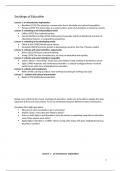
Sociology of Education
Lecture 1: an introductory explanation
Bourdieu (1976) The school as a conservative force: scholastic and cultural inequalities
Parsons (1959) The school class as a social system: some of its functions in American society
Lecture 2: schooling in the industrialized world
Collins (1979) The credential society
Van de Werfhorst & Mijs (2010) Achievement inequality and the institutional structure of
educational systems: a comparative perspective
Lecture 3: schooling in the developing world
Chirot & Hall (1982) World-system theory
Hanushek (2013) Economic growth in developing countries: the role of human capital
Lecture 4: schools and social selection: opportunity
Rivera (2012) Hiring as cultural matching
Young (1994) The rise of meritocracy: an essay on education and equality
Lecture 5: schools and social selection: inequality
Calarco (2011) ‘I need help!’ Social class and children’s help-seeking in elementary school
Ogbu (1998) Voluntary and involuntary minorities: a cultural-ecological theory of school
performance with some implications for education
Lecture 6: schools and socialization
Willis (1978) Learning to labour: how working class kids get working class jobs
Lecture 7 – schools and cultural transmission
Banks (1993) Multicultural education
Relate every article to the course ‘sociology of education’. Make sure to be able to explain the main
argument & theory of every article. Try to see similarities between different articles and lectures.
Questions that might get asked:
Why do we want everybody to go to university?
Explain Calarco. How does this relate to policy?
How can both Ogbu’s and Bourdieu’s views be correct in explaining inequality in education,
even if they oppose each other?
Apply Ogbu’s, Bourdieu’s or Willis’ theory on big cities today with poor neighborhoods (e.g.
Brussels or London).
Lecture 1 – an introductory explanation
1
, Bourdieu (1976) The school as conservative force: scholastic and cultural inequalities
Social power theory
Main argument
Educational institutions perpetuate social inequalities by reproducing the cultural capital of the
dominant class. The structure and practices of schools favor those who already possess cultural
capital, thus reinforcing existing social hierarchies rather than challenging them.
Society impacts schooling.
Key concepts
Cultural reproduction
Social mobility: inter-generational mobility vs. intra-generational mobility
Cultural capital
Habitus
Problem
Bourdieu can explain inequality, but not upward mobility.
Parsons (1959) The school class as a social system: some of its functions in American society
Structural-functioning theory
Main argument
The school class functions as a microcosm of American society, serving not only to impart academic
knowledge but also to socialize individuals into the norms and values of the larger society. The
emphasis is on the role of the teacher as a facilitator of this socialization process, guiding students
toward conformity with societal expectations while also fostering individual achievement and
meritocracy.
Schooling serves society.
Key concepts
Allocation
Socialization
Selection
Problem
Parsons can explain upward mobility, but cannot explain why there is inequality.
Comparison Bourdieu - Parsons
Similarity Difference
Both recognize the significance of education in Bourdieu is more critical of how education may
shaping individuals and society. perpetuate existing inequalities.
Educational institutions are not neutral but have Parsons sees education as a stabilizing force in
a profound impact on social structures. society.
Lecture 2 – schooling in the industrialized world
2
Lecture 1: an introductory explanation
Bourdieu (1976) The school as a conservative force: scholastic and cultural inequalities
Parsons (1959) The school class as a social system: some of its functions in American society
Lecture 2: schooling in the industrialized world
Collins (1979) The credential society
Van de Werfhorst & Mijs (2010) Achievement inequality and the institutional structure of
educational systems: a comparative perspective
Lecture 3: schooling in the developing world
Chirot & Hall (1982) World-system theory
Hanushek (2013) Economic growth in developing countries: the role of human capital
Lecture 4: schools and social selection: opportunity
Rivera (2012) Hiring as cultural matching
Young (1994) The rise of meritocracy: an essay on education and equality
Lecture 5: schools and social selection: inequality
Calarco (2011) ‘I need help!’ Social class and children’s help-seeking in elementary school
Ogbu (1998) Voluntary and involuntary minorities: a cultural-ecological theory of school
performance with some implications for education
Lecture 6: schools and socialization
Willis (1978) Learning to labour: how working class kids get working class jobs
Lecture 7 – schools and cultural transmission
Banks (1993) Multicultural education
Relate every article to the course ‘sociology of education’. Make sure to be able to explain the main
argument & theory of every article. Try to see similarities between different articles and lectures.
Questions that might get asked:
Why do we want everybody to go to university?
Explain Calarco. How does this relate to policy?
How can both Ogbu’s and Bourdieu’s views be correct in explaining inequality in education,
even if they oppose each other?
Apply Ogbu’s, Bourdieu’s or Willis’ theory on big cities today with poor neighborhoods (e.g.
Brussels or London).
Lecture 1 – an introductory explanation
1
, Bourdieu (1976) The school as conservative force: scholastic and cultural inequalities
Social power theory
Main argument
Educational institutions perpetuate social inequalities by reproducing the cultural capital of the
dominant class. The structure and practices of schools favor those who already possess cultural
capital, thus reinforcing existing social hierarchies rather than challenging them.
Society impacts schooling.
Key concepts
Cultural reproduction
Social mobility: inter-generational mobility vs. intra-generational mobility
Cultural capital
Habitus
Problem
Bourdieu can explain inequality, but not upward mobility.
Parsons (1959) The school class as a social system: some of its functions in American society
Structural-functioning theory
Main argument
The school class functions as a microcosm of American society, serving not only to impart academic
knowledge but also to socialize individuals into the norms and values of the larger society. The
emphasis is on the role of the teacher as a facilitator of this socialization process, guiding students
toward conformity with societal expectations while also fostering individual achievement and
meritocracy.
Schooling serves society.
Key concepts
Allocation
Socialization
Selection
Problem
Parsons can explain upward mobility, but cannot explain why there is inequality.
Comparison Bourdieu - Parsons
Similarity Difference
Both recognize the significance of education in Bourdieu is more critical of how education may
shaping individuals and society. perpetuate existing inequalities.
Educational institutions are not neutral but have Parsons sees education as a stabilizing force in
a profound impact on social structures. society.
Lecture 2 – schooling in the industrialized world
2



