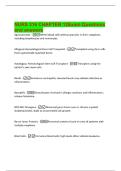
ISSA Transformation Specialist Exam Expected Questions and Answers
ATP stands for - ANSWERS Adenosine Triphosphate Our muscles can produce ATP by which of the following pathways - ANSWERS All of the above (ATP/CP, Glycolytic, Oxidative pathway) BMR stands for - ANSWERS Basal metabolic rate The primary fuel during endurance exercise is - ANSWERS Fatty acids The ATP/CP pathway is sufficient for over four mintues of ATP Production (T/F) - ANSWERS False Non-oxidative glycolysis is reliable - ANSWERS 2 minutes of ATP production Catabolism and anabolism are the two phases of metabolism (T/F) - ANSWERS True Excretion is one function of the digestive system (T/F) - ANSWERS True The nervous system is made up of the - ANSWERS A and B - Peripheral nervous system and Central nervous system Hemoglobin is an oxygen transporting protein in blood cells (T/F) - ANSWERS True The main purpose of hormones is to - ANSWERS All of the above - Alter the rate of synthesis of your cellular protein, Change the rate enzyme activity, Change the rate of transport of nutrients through the cell wall About 98% of human body is composed of only 6 elements: oxygen, carbon, hydrogen, nitrogen, calcium, and phosphorous (T/F) - ANSWERS True The main purpose of the respiratory system is - ANSWERS A, B, C - To supply oxygen to the body, To eliminate carbon dioxide in the body, to regulate the body's PH balance Hormones are classified as - ANSWERS All of the above - Steroids, Amino Acid derivatives, Peptides The circulatory system consists of - ANSWERS Heart, arteries, and veins Tendons connect bone to bone (T/F) - ANSWERS False Muscular hypertrophy is an - ANSWERS Increase in muscle fiber size Tendons are - ANSWERS A and C - Extension of muscles fibers, connect bone to muscle The average human adult skeleton has - ANSWERS 206 Bones Cardiovascular exercise results in - ANSWERS B and C: Mitochondrial adaptations, capillary capacity adaptations Type II muscle fibers are aerobic (T/F) - ANSWERS False Type I muscle fibers are aerobic (T/F) - ANSWERS True The anatomical terms for front and back are - ANSWERS Anterior and Posterior Kinesiology is - ANSWERS The science or study of movement, and the active and passive structures invovled An isometric contraction is - ANSWERS A contraction in which a muscle experts a force but does not change its length True synergy occurs when a muscle contracts to stop the secondary action of another muscle (T/F) - ANSWERS True An example of an antagonist muscle is - ANSWERS Triceps during a biceps curl An example of a prime mover is - ANSWERS The biceps muscle during a biceps curl Adduction is movement of a body part away from the midline of the body (T/F) - ANSWERS False An example of flexion is the - ANSWERS Concentric action of a bicep curl In a concentric contraction the muscles shorten to produce movements (T/F) - ANSWERS True A second-class lever is similar to a wheelbar-row (T/F) - ANSWERS True Biomechanics is the study of - ANSWERS Movement Newton's second law of motion deals with force and it's relationship to mass and acceleration - ANSWERS True A third class lever is - ANSWERS One in which the force is applied between the axis and the resistanc

Geschreven voor
- Instelling
- ISSA Transformation
- Vak
- ISSA Transformation
Documentinformatie
- Geüpload op
- 23 mei 2024
- Aantal pagina's
- 13
- Geschreven in
- 2023/2024
- Type
- Tentamen (uitwerkingen)
- Bevat
- Vragen en antwoorden
Onderwerpen
-
issa transformation specialist exam expected q