Fundamentals of Insurance (BC) - Self-Examination Chapter Questions and correct answers
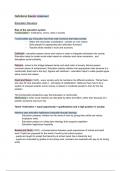
What is the major function of insurance? - ANSWERS To allow the spread of risk. Define "Spread of Risk" - ANSWERS "The losses of the few are shared among the many" What are the 4 other functions of insurance? - ANSWERS 1. Basis of Credit System 2. Eliminates worry - Encourages Entrepreneurship 3. Loss Prevention and Loss Reduction 4. Source of Employment and Investment Capital What are the 3 types of property and casuality (general) insurance? - ANSWERS 1. Automobile 2. Property 3. Liability What are the 2 types of insurer organizations? (including the 2 subtypes) - ANSWERS 1. Private Insurers - Stock Companies - Mutual Companies 2. Government Insurers How do stock companies work? - ANSWERS The money to operate a stock company may come from private funds or via a public sale of stock. Ownership rests in the hand's of the company's shareholders whose main purpose is to derive profit from their investment. How do mutual companies work? - ANSWERS A mutual company is a corporation owned by its policy holders. The creation of profit is not a primary incentive. Instead, the main goal is to provide policyholders with insurance at as low a cost as possible. When the company makes money it's refunded to the policy holders via dividends or rate adjustments. Which insurance are government insurers most involved in? - ANSWERS Federal and provincial governments are involved in medical insurance, employment insurance and workers' compensation. In BC, Saskatchewan, Manitoba and Quebec the government provides compulsory auto insurance. What are 2 ways insurers use to sell their products? - ANSWERS 1. Direct Writing System 2. Independent Brokerage System How does the Direct Writing System work? - ANSWERS - In the direct writing system, the producers are employees of the insurer and are limited to selling only products of the insurer. - Remuneration may be via salary or commission basis or a combination - Insurer owns all business and performs administrative functions - Examples of direct writers include: Belair, RBC Insurance, and Desjardin How does the Independent Brokerage System work? - ANSWERS - Brokerage owners are NOT employees of insurers and in most cases choose to represent more than 1 insurance company as well as the facility association. - The brokerage owns the business it produces and is responsible for providing policyholders with several client services. - The brokerage is paid a commission by the insurer on all the business it writes which is then used to pay salaries, rent, postage and other operating expenses. How does the agency system work? - ANSWERS - Agents are distinct from brokers and direct writers as they are small business owners. - Like direct writers, they represent 1 insurer and the Facility Association. - Agents are paid commission and bonuses for the business they sell and the agents themselves have ownership in their book of business. - Examples of agent companies are Desjardin and Cooperators General Insurance Company. Define Risk. - ANSWERS Risk is "the chance of financial loss to which the object of insurance may be exposed" Define Peril. - ANSWERS Peril is simply defined as "the cause of loss" - Examples can include and are not limited to: fire, wind, hail, etc. Of the 2 distribution methods, which is most common? - ANSWERS The majority of insurance business in Canada is transacted by private insurers. What are 3 major categories of insurance needs? - ANSWERS 1. Personal Risk 2. Property Risk 3. Liability Risk What are the 4 options an insured may use when dealing with risk? - ANSWERS 1. Avoidance of Risk 2. Controlling of Risk 3. Retention of Risk 4. Transfer of Risk Which method of dealing with risk the LEAST practical? - ANSWERS Avoidance of risk What are the 2 types of risk? And which of them is insurable? - ANSWERS 1. Speculative risk 2. Pure risk - Only pure risk is insurable. Describe Pure Risk. - ANSWERS Pure risk involves the chance of financial loss with no chance of financial gain. When there is no opportunity for a person to profit from a loss, the risk is pure. Only pure risk is insurable. Describe Speculative Risk. - ANSWERS Speculative risk involves the possibility of financial loss or gain. What are the 5 elements required to be present in all contracts? - ANSWERS 1. Agreement 2. Consideration 3. Legality of Object 4. Legal Capacity of the Parties to Contract 5. Genuine Intention What are 3 elements of a contract, that are unique to insurance contracts which must be present if an insurance contract is to be enforceable at law. - ANSWERS 1. Insurance Interest 2. Utmost Good Faith 3. Indemnity Define "bind" - ANSWERS In insurance, to "bind" means that the broker has committed the insurer to provide a contract of insurance on the subject matter under discussion. What are 3 types of insurance forms used by insurers to make changes to an existing policy? - ANSWERS 1. Endorsement or Riders 2. Floaters 3. Separate Policies Explain what an endorsement does. - ANSWERS An endorsement or rider acknowledges a change in the terms of the contract. Explain what Floaters are. - ANSWERS A floater is used to provide coverage for property having a high degree of mobility. The terms floater and rider are used interchangeably. Explain why separate policies may be required. - ANSWERS Sometimes a separate policy is required in order to provide addition coverages needed by the insureds. In these cases, there is no actual change to the original contract.

Geschreven voor
- Instelling
- INSURANCE
- Vak
- INSURANCE
Documentinformatie
- Geüpload op
- 23 mei 2024
- Aantal pagina's
- 21
- Geschreven in
- 2023/2024
- Type
- Tentamen (uitwerkingen)
- Bevat
- Vragen en antwoorden
Onderwerpen
-
fundamentals of insurance bc self exami