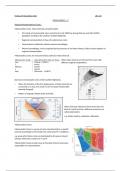
Friday 10th December 2021 LEC 172
Metamorphism – 2
Regional Metamorphism (Cont.):
Metamorphic zones, index minerals and polymorphs:
• First study of metamorphic zones carried out in late 1800s by George Barrow and other British
geologists working in the southern Scottish Highlands
• Regional metamorphism of clay-rich sedimentary rocks
• Zones based on distinctive silicate mineral assemblages
• Mineral assemblages, each recognised by the presence of an index mineral, reflect various degrees of
regional metamorphism
Metamorphic zones are characterised by particular index minerals.
Other index minerals are formed from rocks with
different original compositions.
Barrovian metamorphic zones of the Scottish Highlands…
• When the locations of the first appearances of index minerals are
connected on a map, the result is a line of equal metamorphic
intensity (isograd).
• Pattern of isograds follows faults and folds.
When chemical substances form more than one
kind of crystal structure; different structures are
called polymorphs:
e.g. Al2SiO5 kyanite, andalusite, sillimanite
Metamorphic Facies:
Metamorphic facies is a group of rocks characterised by a specific
mineral assemblage formed under the same broad P-T conditions.
e.g. greenschist facies rocks are dominated by the green mineral
chlorite which forms under low T and P.
Metamorphic facies provide clues to the plate tectonic processes
responsible for metamorphism.
, Contact Metamorphism:
• Occurs when rock is intruded by a body of hot magma
• High T, low P zones of metamorphism develop surrounding the intrusion, i.e. heat from intrusion
metamorphoses the rock immediately surrounding it
• Contact metamorphic rock from originally
clay-rich rock; non-foliated/granoblastic
texture, i.e. any elongate crystals are
oriented randomly = hornfels:
Metamorphism – 2
Regional Metamorphism (Cont.):
Metamorphic zones, index minerals and polymorphs:
• First study of metamorphic zones carried out in late 1800s by George Barrow and other British
geologists working in the southern Scottish Highlands
• Regional metamorphism of clay-rich sedimentary rocks
• Zones based on distinctive silicate mineral assemblages
• Mineral assemblages, each recognised by the presence of an index mineral, reflect various degrees of
regional metamorphism
Metamorphic zones are characterised by particular index minerals.
Other index minerals are formed from rocks with
different original compositions.
Barrovian metamorphic zones of the Scottish Highlands…
• When the locations of the first appearances of index minerals are
connected on a map, the result is a line of equal metamorphic
intensity (isograd).
• Pattern of isograds follows faults and folds.
When chemical substances form more than one
kind of crystal structure; different structures are
called polymorphs:
e.g. Al2SiO5 kyanite, andalusite, sillimanite
Metamorphic Facies:
Metamorphic facies is a group of rocks characterised by a specific
mineral assemblage formed under the same broad P-T conditions.
e.g. greenschist facies rocks are dominated by the green mineral
chlorite which forms under low T and P.
Metamorphic facies provide clues to the plate tectonic processes
responsible for metamorphism.
, Contact Metamorphism:
• Occurs when rock is intruded by a body of hot magma
• High T, low P zones of metamorphism develop surrounding the intrusion, i.e. heat from intrusion
metamorphoses the rock immediately surrounding it
• Contact metamorphic rock from originally
clay-rich rock; non-foliated/granoblastic
texture, i.e. any elongate crystals are
oriented randomly = hornfels: