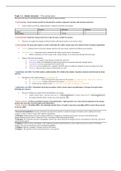
Topic 2.1: Atomic structure – The nuclear atom
The mass of an atom is concentrated in its minute, positively charged nucleus.
• Understanding: Atoms contain a positively charged dense nucleus composed of protons and neutrons (nucleons).
▪ Atoms contain a positively charged nucleus composed of protons and neutrons
Protons Electrons Neutrons
Charge +1 -1 0
Mass (amu) 1 1/1836 1
• Understanding: Negatively charged electrons occupy the space outside the nucleus.
▪ Electrons are negatively charged and found outside orbiting the nucleus in an electron cloud
• Understanding: The mass spectrometer is used to determine the relative atomic mass of an element from its isotopic composition.
▪ Isotopes: different forms of the same element that have the same atomic number but different mass numbers
▪ Mass spectrometer: instrument used to determine the relative atomic mass of an element
• Relative abundance of each isotope (with a single charge) can be determined through detection stage
▪ Stages of the mass spectrometer
• Vaporization: sample is injected and is heated and vaporized
• Ionization: atoms are bombarded by high energy electrons to generate positively charged species
• Acceleration: ions are accelerated in the electric field
• Deflection: ions are deflected by a magnetic field; the degree of deflection depends on mass-to-charge (m/z) ratio
• Detection: detector detects species of particular m/z ratio
• Applications and skills: Use of the nuclear symbol notation 𝑨𝒁𝑿 to deduce the number of protons, neutrons and electrons in atoms
and ions.
▪ Description of 𝐴𝑍𝑋 symbol notation (e.g. deuterium 21𝐻)
• A – mass number: mass of both protons and neutrons in the nucleus (e.g. deuterium has 1 proton and 1 neutron)
• Z – atomic number: number of protons in the nucleus (e.g. deuterium has 1 proton)
• X – symbol for the respective atom (e.g. deuterium is an isotope of hydrogen, so symbol H)
• Applications and skills: Calculations involving non-integer relative atomic masses and abundance of isotopes from given data,
including mass spectra.
▪ Process of finding non-integer RAM and abundance of isotopes
𝑟𝑒𝑙𝑎𝑡𝑖𝑣𝑒 𝑝𝑒𝑟𝑐𝑒𝑛𝑡𝑎𝑔𝑒 𝑜𝑓 𝐴 𝑟𝑒𝑙𝑎𝑡𝑖𝑣𝑒 𝑝𝑒𝑟𝑐𝑒𝑛𝑡𝑎𝑔𝑒 𝑜𝑓 𝐵
• relative atomic mass = (𝑎𝑡𝑜𝑚𝑖𝑐 𝑚𝑎𝑠𝑠 𝑜𝑓 𝐴 × + 𝑎𝑡𝑜𝑚𝑖𝑐 𝑚𝑎𝑠𝑠 𝑜𝑓 𝐵 × )
100 100
• If required, find the relative atomic mass in the periodic table
• Nature of science: Evidence and improvements in instrumentation—alpha particles were used in the development of the nuclear
model of the atom that was first proposed by Rutherford.
• Nature of science: Paradigm shifts—the subatomic particle theory of matter represents a paradigm shift in science that occurred
in the late 1800s.
• International-mindedness: Isotope enrichment uses physical properties to separate isotopes of uranium, and is employed in many
countries as part of nuclear energy and weaponry programmes.
• Utilization: Radioisotopes are used in nuclear medicine for diagnostics, treatment and research, as tracers in biochemical and
pharmaceutical research, and as “chemical clocks” in geological and archaeological dating.
• Utilization: PET (positron emission tomography) scanners give three-dimensional images of tracer concentration in the body, and can be
used to detect cancers.
• Guidance: Relative masses and charges of the subatomic particles should be known, actual values are given in section 4 of the data
booklet. The mass of the electron can be considered negligible.
• Guidance: Specific examples of isotopes need not be learned.
• Guidance: The operation of the mass spectrometer is not required.
The mass of an atom is concentrated in its minute, positively charged nucleus.
• Understanding: Atoms contain a positively charged dense nucleus composed of protons and neutrons (nucleons).
▪ Atoms contain a positively charged nucleus composed of protons and neutrons
Protons Electrons Neutrons
Charge +1 -1 0
Mass (amu) 1 1/1836 1
• Understanding: Negatively charged electrons occupy the space outside the nucleus.
▪ Electrons are negatively charged and found outside orbiting the nucleus in an electron cloud
• Understanding: The mass spectrometer is used to determine the relative atomic mass of an element from its isotopic composition.
▪ Isotopes: different forms of the same element that have the same atomic number but different mass numbers
▪ Mass spectrometer: instrument used to determine the relative atomic mass of an element
• Relative abundance of each isotope (with a single charge) can be determined through detection stage
▪ Stages of the mass spectrometer
• Vaporization: sample is injected and is heated and vaporized
• Ionization: atoms are bombarded by high energy electrons to generate positively charged species
• Acceleration: ions are accelerated in the electric field
• Deflection: ions are deflected by a magnetic field; the degree of deflection depends on mass-to-charge (m/z) ratio
• Detection: detector detects species of particular m/z ratio
• Applications and skills: Use of the nuclear symbol notation 𝑨𝒁𝑿 to deduce the number of protons, neutrons and electrons in atoms
and ions.
▪ Description of 𝐴𝑍𝑋 symbol notation (e.g. deuterium 21𝐻)
• A – mass number: mass of both protons and neutrons in the nucleus (e.g. deuterium has 1 proton and 1 neutron)
• Z – atomic number: number of protons in the nucleus (e.g. deuterium has 1 proton)
• X – symbol for the respective atom (e.g. deuterium is an isotope of hydrogen, so symbol H)
• Applications and skills: Calculations involving non-integer relative atomic masses and abundance of isotopes from given data,
including mass spectra.
▪ Process of finding non-integer RAM and abundance of isotopes
𝑟𝑒𝑙𝑎𝑡𝑖𝑣𝑒 𝑝𝑒𝑟𝑐𝑒𝑛𝑡𝑎𝑔𝑒 𝑜𝑓 𝐴 𝑟𝑒𝑙𝑎𝑡𝑖𝑣𝑒 𝑝𝑒𝑟𝑐𝑒𝑛𝑡𝑎𝑔𝑒 𝑜𝑓 𝐵
• relative atomic mass = (𝑎𝑡𝑜𝑚𝑖𝑐 𝑚𝑎𝑠𝑠 𝑜𝑓 𝐴 × + 𝑎𝑡𝑜𝑚𝑖𝑐 𝑚𝑎𝑠𝑠 𝑜𝑓 𝐵 × )
100 100
• If required, find the relative atomic mass in the periodic table
• Nature of science: Evidence and improvements in instrumentation—alpha particles were used in the development of the nuclear
model of the atom that was first proposed by Rutherford.
• Nature of science: Paradigm shifts—the subatomic particle theory of matter represents a paradigm shift in science that occurred
in the late 1800s.
• International-mindedness: Isotope enrichment uses physical properties to separate isotopes of uranium, and is employed in many
countries as part of nuclear energy and weaponry programmes.
• Utilization: Radioisotopes are used in nuclear medicine for diagnostics, treatment and research, as tracers in biochemical and
pharmaceutical research, and as “chemical clocks” in geological and archaeological dating.
• Utilization: PET (positron emission tomography) scanners give three-dimensional images of tracer concentration in the body, and can be
used to detect cancers.
• Guidance: Relative masses and charges of the subatomic particles should be known, actual values are given in section 4 of the data
booklet. The mass of the electron can be considered negligible.
• Guidance: Specific examples of isotopes need not be learned.
• Guidance: The operation of the mass spectrometer is not required.