D.Tesselhof 26-04-19
Summary EZO
Lecture 2
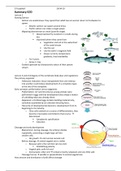
Homing Salmon
- Salmon are anadromous: they spend their adult lives at sea but return to freshwater to
spawn.
o Atlantic salmon can spawn several times
o Pacific salmon can make a single spawn
- Migrating downstream as smolt (juvenile stage)
▪ Newly hatched fry transform in smolts during
this
▪ Imprinted where they came from
• Vegetation and soil in the watershed
of the natal stream
• Use the sun
• Use the earth’s magnetic field
• Ocean currents, temperature
gradients, food availability
o For 4 years
o Grow 2- 5 kg
- Guided upstream by characteristic odour of their parent
stream
Lecture 3 and 4 Ontogeny of the vertebrate body plan and regulations
The primary organizer
- Embryonic induction: tissue transplanted from one embryo
into another could induce development of a complete organ,
at the site of the transplant.
Early concepts: preformation versus epigenesis
- Preformation: (17 and 18 century); young animals were
performed in eggs and that development was simply a matter
of unfolding what was already there.
- Epigenesis: a fertilized egg contains building material only,
somehow assembled by an unknown directing force.
- Hierarchy of developmental decisions: development from its
beginning to its maturity.
o Once cells embark on a course of differentiation, they
become irrevocably committed to that course. →
determined
▪ Cytoplasmic specification
▪ Induction
Cleavage and early development
- Blastomeres: during cleavage, the embryo divides
repeatedly, converting a single large cell into
smaller cells.
o No growth → until normal somatic cell
- Before cleavage → animal-vegetal axis is visible
o Because yolk is the nutrition (at one end)
▪ Establishing polarity
o Vegetal pole: yolk-rich end
o Animal pole: other end → contains mostly cytoplasm and very little yolk
- Cleavage furrow → parallel or perpendicular to animal-vegetal axis
How amount and distribution of yolk affect cleavage
,D.Tesselhof 26-04-19
- Isolecithal: eggs with very little yolk, evenly distributed throughout the egg
- Mesolecithal: eggs that have a moderate amount of yolk concentrated at the vegetal pole
- Teloceithal: eggs contain an abundance of yolk densely concentrated at the vegetal pole of
the egg
- Centrolecithal: eggs have a large, centrally located mass of yolk.
- Yolk: mixture of proteins that provides nutrition for a developing embryo
o When there is much yolk, the dividing will go slowly.
▪ So egg with less yolk, will divide the fastest. (isolecithal)
o Meroblastic cleavage: when much yolk is present, cells sitting atop a mass of
undivided yolk.
▪ Incomplete cleavage
▪ In telolecithal and centrolecithal eggs
o Holoblastic cleavage: when little yolk is present,
normal cleavage.
▪ Holoblastic cleavage in isolecithal or
mesolecithal eggs
▪ In echinoderms, tunicates, cephalochordates,
nemerteans, molluscs, humans
- Cleavages: radial, spiral, discoidal, rotational
o Radial: can be distinguished from spiral, by comparing
the eight-cell stages. The upper layer of cells sits
directly atop the lower layer of cells
o Spiral: the upper layer of cells is packed into the
spaces between the cells of the lower layer.
o Discoidal: when the cleaving cells form a flat disc atop
a mass of yolk
o Rotational: can be distinguished, by comparing the
cleavage furrow in the two-cell stage
- Superficial cleavage: the centrally located mass of yolk
restricts cleavage to the cytoplasmic rim of the egg.
- After 8 rounds of mitosis → the nuclei migrate to the yolk-
free periphery of the egg
o A few nuclei at the end become surrounded by cytoplasm → form pole-cells → rise
germ cells
- When much yolk is present → young exhibit direct development; going from an embryo to a
miniature adult
- When little yolk is present → young develop into various larval stages capable of feeding
themselves.
o Indirect development → larvae differ from adults and must metamorphose to
produce an adult body form
An overview of development following cleavage
Blastulation
- Cleavage subdivides the mass of
the zygote until a cluster of cells:
blastula
o Blastula cells form a layer
around a central fluid-
filled cavity; blastocoel
▪ Great increase in the DNA content
▪ Not increase in size
- Beyond blastula, to form 1 or 2 more germ layers (gastrula stage)
o Produce all structures of the adult body
Gastrulation and Formation of two germ layers
,D.Tesselhof 26-04-19
- Gastrulation: converts the spherical blastula into a two or three layered embryo.
o Layers: germ layers → all body parts develop from this
- Form a second germ layer
o Invagination: one side of the blastula bends inward→ to form a new internal cavity:
archenteron or a gastrocoel
o Blastopore: the opening to the gut, where the inward bending began.
- Gastrula stage has two layers:
1. Ectoderm: an outer layer of cells surrounding the blastocoel
2. Endoderm: inner layer of cells lining the gut
- Incomplete gut: when the gut opens only at the blastopore
o Need completely digested feed
- Complete gut: second opening at the anus.
Formation of the complete gut
- Complete gut→ inward movement of the archenteron continues until the end of the
archenteron meets the ectodermal wall of the gastrula
o Endodermal tube: ectoderm and endoderm joins together
Formation of mesoderm, a third germ layer
- Dipoblastic: animals that develop two germ layers.
- Triploblastic: animals that develop three germ layers.
- Mesoderm: third layer, lays between ectoderm and the endoderm. → initial cells of
mesoderm come from endoderm. Develop in 2 ways
1. Cells arise from a ventral area near the lip of the blastopore and proliferate into the
space between the archenteron and outer body wall.
2. The central region of the archenteron wall pushes outward into the space between the
archenteron and the outer body wall.
- Ectomesoderm: part of a third layer of cells is made from ectoderm.
Formation of the coelom
- Coelom: body cavity completely surrounded by mesoderm; the band of mesoderm with its
internal coelom lies inside the space previously occupied by the blastocoel.
- During gastrulation
o Blastocoel is filled with mesoderm
▪ Coelom cavity appears inside the mesoderm by
• Schizocoely
• Enterocoely
- Coelom formation complete:
o Body has three germ layers
o Two cavities
▪ Gut cavity
▪ Fluid-filled coelomic cavity
Mechanisms of development
Nuclear equivalence
- Roux-Weismann hypothesis: the genome gradually became broken into smaller and smaller
units until finally only the information required to impart the characteristics of a single cell
type remained.
- SCNT (somatic cell nuclear transplant): remove the nucleus of an egg cell and replace it with
the nucleus from a somatic cell from a different individual. → cloning
o Difficult with adult clones → gene expression
▪ Embryonic stem cells: undifferentiated cells capable of differentiating into
many different adult cell types.
- Adult stem cells: the brain, liver and reproductive organs contain these undifferentiated cells.
o Relative rarity + small number of future divisions possible
, D.Tesselhof 26-04-19
- 2 ways by which cells become committed to particular developmental fates:
1. Cytoplasmic partitioning of determinative molecules during cleavage
2. Interaction with neighbouring cells (inductive interactions)
- Fate of cells
o Cell becomes ectoderm, endoderm or mesoderm early in development of an
embryo, and then each of these germ layers makes particular derivatives.
▪ Controlling production
• Certain mRNAs or proteins in cytoplasm
o Transcription factors, promotors and enhancers
• Gene expression
Cytoplasmic specification
- Cytoplasm of fertilized egg is not homogeneous
o Unequally distributed morphogenetic
components
▪ mRNAs and proteins
o cytoplasmic specification or autonomous
specification→ causes mosaic
development of the embryo
▪ differently pigmented cytoplasm
are segregated into different
blastomere, which then proceed
to form distinct tissues or
organs.
Conditional specification
- induction: capacity of some cells to evoke a developmental response, such as a change in cell
shape or cell fate, in other cells.
o While the interaction requires an inducer and a responder, the interactions may be
reciprocal in that the tissues influence each other.
▪ By growth and differentiating factors
o Only grafts from the dorsal lip of the
blastopore were capable of inducing the
formation of a complete secondary embryo.
▪ Presumptive notochord, somites and
prechordal mesoderm.
o Primary organizer: dorsal lip area →the only
tissue capable of inducing the development of
a secondary embryo in the host
▪ Primary induction
o Secondary induction: many other cell types
originate by later inductive interactions
Syncytial specification
- Syncytium: when a single cell membrane surrounds multiple nuclei.
- Syncytial specification is similar to conditional specification, but the molecules that influence
cell fate diffuse within the cytoplasm of a single larger cell and not among cells.
Gene expression during development
- Epigenesis in three stages:
1. Pattern formation
2. Determination of position in the body
3. Induction of limbs and organs appropriate for that position
- Morphogens: diffusible molecules that create a concentration gradient as they move away
from a source.
Pattern formation
Summary EZO
Lecture 2
Homing Salmon
- Salmon are anadromous: they spend their adult lives at sea but return to freshwater to
spawn.
o Atlantic salmon can spawn several times
o Pacific salmon can make a single spawn
- Migrating downstream as smolt (juvenile stage)
▪ Newly hatched fry transform in smolts during
this
▪ Imprinted where they came from
• Vegetation and soil in the watershed
of the natal stream
• Use the sun
• Use the earth’s magnetic field
• Ocean currents, temperature
gradients, food availability
o For 4 years
o Grow 2- 5 kg
- Guided upstream by characteristic odour of their parent
stream
Lecture 3 and 4 Ontogeny of the vertebrate body plan and regulations
The primary organizer
- Embryonic induction: tissue transplanted from one embryo
into another could induce development of a complete organ,
at the site of the transplant.
Early concepts: preformation versus epigenesis
- Preformation: (17 and 18 century); young animals were
performed in eggs and that development was simply a matter
of unfolding what was already there.
- Epigenesis: a fertilized egg contains building material only,
somehow assembled by an unknown directing force.
- Hierarchy of developmental decisions: development from its
beginning to its maturity.
o Once cells embark on a course of differentiation, they
become irrevocably committed to that course. →
determined
▪ Cytoplasmic specification
▪ Induction
Cleavage and early development
- Blastomeres: during cleavage, the embryo divides
repeatedly, converting a single large cell into
smaller cells.
o No growth → until normal somatic cell
- Before cleavage → animal-vegetal axis is visible
o Because yolk is the nutrition (at one end)
▪ Establishing polarity
o Vegetal pole: yolk-rich end
o Animal pole: other end → contains mostly cytoplasm and very little yolk
- Cleavage furrow → parallel or perpendicular to animal-vegetal axis
How amount and distribution of yolk affect cleavage
,D.Tesselhof 26-04-19
- Isolecithal: eggs with very little yolk, evenly distributed throughout the egg
- Mesolecithal: eggs that have a moderate amount of yolk concentrated at the vegetal pole
- Teloceithal: eggs contain an abundance of yolk densely concentrated at the vegetal pole of
the egg
- Centrolecithal: eggs have a large, centrally located mass of yolk.
- Yolk: mixture of proteins that provides nutrition for a developing embryo
o When there is much yolk, the dividing will go slowly.
▪ So egg with less yolk, will divide the fastest. (isolecithal)
o Meroblastic cleavage: when much yolk is present, cells sitting atop a mass of
undivided yolk.
▪ Incomplete cleavage
▪ In telolecithal and centrolecithal eggs
o Holoblastic cleavage: when little yolk is present,
normal cleavage.
▪ Holoblastic cleavage in isolecithal or
mesolecithal eggs
▪ In echinoderms, tunicates, cephalochordates,
nemerteans, molluscs, humans
- Cleavages: radial, spiral, discoidal, rotational
o Radial: can be distinguished from spiral, by comparing
the eight-cell stages. The upper layer of cells sits
directly atop the lower layer of cells
o Spiral: the upper layer of cells is packed into the
spaces between the cells of the lower layer.
o Discoidal: when the cleaving cells form a flat disc atop
a mass of yolk
o Rotational: can be distinguished, by comparing the
cleavage furrow in the two-cell stage
- Superficial cleavage: the centrally located mass of yolk
restricts cleavage to the cytoplasmic rim of the egg.
- After 8 rounds of mitosis → the nuclei migrate to the yolk-
free periphery of the egg
o A few nuclei at the end become surrounded by cytoplasm → form pole-cells → rise
germ cells
- When much yolk is present → young exhibit direct development; going from an embryo to a
miniature adult
- When little yolk is present → young develop into various larval stages capable of feeding
themselves.
o Indirect development → larvae differ from adults and must metamorphose to
produce an adult body form
An overview of development following cleavage
Blastulation
- Cleavage subdivides the mass of
the zygote until a cluster of cells:
blastula
o Blastula cells form a layer
around a central fluid-
filled cavity; blastocoel
▪ Great increase in the DNA content
▪ Not increase in size
- Beyond blastula, to form 1 or 2 more germ layers (gastrula stage)
o Produce all structures of the adult body
Gastrulation and Formation of two germ layers
,D.Tesselhof 26-04-19
- Gastrulation: converts the spherical blastula into a two or three layered embryo.
o Layers: germ layers → all body parts develop from this
- Form a second germ layer
o Invagination: one side of the blastula bends inward→ to form a new internal cavity:
archenteron or a gastrocoel
o Blastopore: the opening to the gut, where the inward bending began.
- Gastrula stage has two layers:
1. Ectoderm: an outer layer of cells surrounding the blastocoel
2. Endoderm: inner layer of cells lining the gut
- Incomplete gut: when the gut opens only at the blastopore
o Need completely digested feed
- Complete gut: second opening at the anus.
Formation of the complete gut
- Complete gut→ inward movement of the archenteron continues until the end of the
archenteron meets the ectodermal wall of the gastrula
o Endodermal tube: ectoderm and endoderm joins together
Formation of mesoderm, a third germ layer
- Dipoblastic: animals that develop two germ layers.
- Triploblastic: animals that develop three germ layers.
- Mesoderm: third layer, lays between ectoderm and the endoderm. → initial cells of
mesoderm come from endoderm. Develop in 2 ways
1. Cells arise from a ventral area near the lip of the blastopore and proliferate into the
space between the archenteron and outer body wall.
2. The central region of the archenteron wall pushes outward into the space between the
archenteron and the outer body wall.
- Ectomesoderm: part of a third layer of cells is made from ectoderm.
Formation of the coelom
- Coelom: body cavity completely surrounded by mesoderm; the band of mesoderm with its
internal coelom lies inside the space previously occupied by the blastocoel.
- During gastrulation
o Blastocoel is filled with mesoderm
▪ Coelom cavity appears inside the mesoderm by
• Schizocoely
• Enterocoely
- Coelom formation complete:
o Body has three germ layers
o Two cavities
▪ Gut cavity
▪ Fluid-filled coelomic cavity
Mechanisms of development
Nuclear equivalence
- Roux-Weismann hypothesis: the genome gradually became broken into smaller and smaller
units until finally only the information required to impart the characteristics of a single cell
type remained.
- SCNT (somatic cell nuclear transplant): remove the nucleus of an egg cell and replace it with
the nucleus from a somatic cell from a different individual. → cloning
o Difficult with adult clones → gene expression
▪ Embryonic stem cells: undifferentiated cells capable of differentiating into
many different adult cell types.
- Adult stem cells: the brain, liver and reproductive organs contain these undifferentiated cells.
o Relative rarity + small number of future divisions possible
, D.Tesselhof 26-04-19
- 2 ways by which cells become committed to particular developmental fates:
1. Cytoplasmic partitioning of determinative molecules during cleavage
2. Interaction with neighbouring cells (inductive interactions)
- Fate of cells
o Cell becomes ectoderm, endoderm or mesoderm early in development of an
embryo, and then each of these germ layers makes particular derivatives.
▪ Controlling production
• Certain mRNAs or proteins in cytoplasm
o Transcription factors, promotors and enhancers
• Gene expression
Cytoplasmic specification
- Cytoplasm of fertilized egg is not homogeneous
o Unequally distributed morphogenetic
components
▪ mRNAs and proteins
o cytoplasmic specification or autonomous
specification→ causes mosaic
development of the embryo
▪ differently pigmented cytoplasm
are segregated into different
blastomere, which then proceed
to form distinct tissues or
organs.
Conditional specification
- induction: capacity of some cells to evoke a developmental response, such as a change in cell
shape or cell fate, in other cells.
o While the interaction requires an inducer and a responder, the interactions may be
reciprocal in that the tissues influence each other.
▪ By growth and differentiating factors
o Only grafts from the dorsal lip of the
blastopore were capable of inducing the
formation of a complete secondary embryo.
▪ Presumptive notochord, somites and
prechordal mesoderm.
o Primary organizer: dorsal lip area →the only
tissue capable of inducing the development of
a secondary embryo in the host
▪ Primary induction
o Secondary induction: many other cell types
originate by later inductive interactions
Syncytial specification
- Syncytium: when a single cell membrane surrounds multiple nuclei.
- Syncytial specification is similar to conditional specification, but the molecules that influence
cell fate diffuse within the cytoplasm of a single larger cell and not among cells.
Gene expression during development
- Epigenesis in three stages:
1. Pattern formation
2. Determination of position in the body
3. Induction of limbs and organs appropriate for that position
- Morphogens: diffusible molecules that create a concentration gradient as they move away
from a source.
Pattern formation