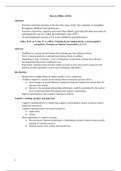
Best & Miller (2010)
Abstract
- Executive function emerges in the first few years of life, but continues to strengthen
throughout childhood and adolescence
- Executive functions: cognitive processes that underlie goal-directed behaviour and are
orchestrated by activity within the prefrontal cortex (PFC)
- No developmental account of EF across childhood and adolescence
Jolles, D. D., & Crone, E. A. (2012). Training the developing brain: A neurocognitive
perspective. Frontiers in Human Neuroscience, 6, 1-13.
Abstract:
- Childhood is a special period during which training may have different effects
- There is much complexity in interpreting training effects in children
- Depending on type of training + level of maturation of individual, training may influence
developmental trajectories in different ways
- Proposition: immature brain structure might set limits on how much can be achieved with
training, but that immaturity can also have advantages (flexibility)
Introduction
- Human brain is highly plastic & adapts quickly to new experiences
- Childhood might be a special period during which training has specific effects
o Great changes in neural efficiency during development, making this period ideal for
training interventions
o However, the maximum achievable performance could be constrained by the current
level of structural brain development and cognitive functioning
- Improved performance after cognitive training in children
Cognitive training: purpose and approach
- Cognitive training=process of improving cognitive functioning by means of practice and/or
intentional instruction
- Cognitive training studies have been focused on:
o Application
o Theory
- Major approaches of cognitive training
o Process-based: repeated performance of demanding executive function tasks (mostly
training of working memory)
o Strategy-based: more explicit task instructions
1
, Flynn et al. (1987)
Learned content
- Learned content has inhibited rather than promoted IQ gains
o The more a test uses learned content as a vehicle, the more it prevents growth
in data
Early maturation
- IQ tests persist to full maturity/may persist
What IQ tests really measure
- Ravens progressive Matrices Test: does not measure intelligence, but a correlate with
a weak causal link to intelligence – this may be the case for all IQ tests
- We can say: IQ tests measure abstract problem-solving ability (APSA)
Causes of IQ gains
- Unidentified environmental variables
o SES
o Better education
Summary implications
- Massive gains on all kinds of IQ tests
- Gains persist to maturity
- IQ tests don’t seem to measure intelligence
IQ gains do not mean intelligence gains
- SAT scores have declined, which may be explained saying IQ tests don’t actually
measure intelligence
Elliot et al. (2010)
Glossary:
- Clinical DA: tester is free to determine the nature and form of feedback that should be
provided to the testee
- Dynamic testing: contingent feedback is provided during the test session, so that learning can
take place and the testee’s capacity for improvement can be gauged
- Learning potential: one’s capacity to learn when conditions are optimal
- Standardized DA: nature of contingent feedback follows a prespecified path not determined by
clinician)
- Static testing: tester assumes a neutral stance and any feedback on perform during testing
session is proscribed
- Zone of proximal development (Vygotsky)
Need for a dynamic approach:
- Most tests used in schools are of static nature
2
Abstract
- Executive function emerges in the first few years of life, but continues to strengthen
throughout childhood and adolescence
- Executive functions: cognitive processes that underlie goal-directed behaviour and are
orchestrated by activity within the prefrontal cortex (PFC)
- No developmental account of EF across childhood and adolescence
Jolles, D. D., & Crone, E. A. (2012). Training the developing brain: A neurocognitive
perspective. Frontiers in Human Neuroscience, 6, 1-13.
Abstract:
- Childhood is a special period during which training may have different effects
- There is much complexity in interpreting training effects in children
- Depending on type of training + level of maturation of individual, training may influence
developmental trajectories in different ways
- Proposition: immature brain structure might set limits on how much can be achieved with
training, but that immaturity can also have advantages (flexibility)
Introduction
- Human brain is highly plastic & adapts quickly to new experiences
- Childhood might be a special period during which training has specific effects
o Great changes in neural efficiency during development, making this period ideal for
training interventions
o However, the maximum achievable performance could be constrained by the current
level of structural brain development and cognitive functioning
- Improved performance after cognitive training in children
Cognitive training: purpose and approach
- Cognitive training=process of improving cognitive functioning by means of practice and/or
intentional instruction
- Cognitive training studies have been focused on:
o Application
o Theory
- Major approaches of cognitive training
o Process-based: repeated performance of demanding executive function tasks (mostly
training of working memory)
o Strategy-based: more explicit task instructions
1
, Flynn et al. (1987)
Learned content
- Learned content has inhibited rather than promoted IQ gains
o The more a test uses learned content as a vehicle, the more it prevents growth
in data
Early maturation
- IQ tests persist to full maturity/may persist
What IQ tests really measure
- Ravens progressive Matrices Test: does not measure intelligence, but a correlate with
a weak causal link to intelligence – this may be the case for all IQ tests
- We can say: IQ tests measure abstract problem-solving ability (APSA)
Causes of IQ gains
- Unidentified environmental variables
o SES
o Better education
Summary implications
- Massive gains on all kinds of IQ tests
- Gains persist to maturity
- IQ tests don’t seem to measure intelligence
IQ gains do not mean intelligence gains
- SAT scores have declined, which may be explained saying IQ tests don’t actually
measure intelligence
Elliot et al. (2010)
Glossary:
- Clinical DA: tester is free to determine the nature and form of feedback that should be
provided to the testee
- Dynamic testing: contingent feedback is provided during the test session, so that learning can
take place and the testee’s capacity for improvement can be gauged
- Learning potential: one’s capacity to learn when conditions are optimal
- Standardized DA: nature of contingent feedback follows a prespecified path not determined by
clinician)
- Static testing: tester assumes a neutral stance and any feedback on perform during testing
session is proscribed
- Zone of proximal development (Vygotsky)
Need for a dynamic approach:
- Most tests used in schools are of static nature
2