Developmental Psychopathology
Hoorcollege 1
DPP is the study of normal development (in children and adolescents) that ‘has gone awry’. It is this abnormal
development that lead to psychopathological problems in children and adolescents. In other words: problem
behaviors for both the youth and his/her environment.
What is abnormal behavior?
Not just atypical but can be also harmful (internalizing <> externalizing)
Developmentally inappropriate
Need to consider a variety of variables:
o Age
o Situation/context
o Gender
o Culture (ethnicity or race)
Parents and professionals may differ on their views of a child and what is considered inappropriate.
Society has changing views of abnormality
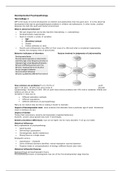
Behavior indicators of disorders Factors involved in judgments of (ab)normality
How common are problems? 5,4 to 35,5% of youth
aged 4-18 years. 15-20% have clinic levels of disorder
symptomology. According to APA: 10% of youth have serious problems and 10% mild or moderate. Infants and
toddlers are also at risk.
Variability in rates due to:
Different estimation methods
Different populations
Different definitions of psychopathology
Many do not receive help and this is making it harder to estimate.
Impact of Developmental level: some evidence that disorders have a particular age of onset. Sometimes
onset is insidious (zie pp).
Impact of Gender
Timing (first occurrence), severity and expression (expected behaviors).
However, concern about gender bias exist stereotypes.
Gender prevalence differences: boys are at higher risk for many disorders zie pp voor table.
Historical influences
Early explanations of psychopathology
Adult-focused
Demonology (possession)
Somatogenesis (bodily imbalances)
Strong focus on a single cause
Nineteenth century
Classification – Kraepelin
Some childhood disorders identified: mental retardation received attention
Progress made on conceptualization of etiology (different factors play roles)
Historical influential theories
Sigmund Freud and psychoanalytic theory
His psychosexual theory of development was one of the first developmental stage theories.
,Behaviorism: Behavior is learned caused by interactions with the environment (Skinner).
Social Learning Theory: learned behavior also comes from observations of one’s environment (Bandura)
(cognitive model).
Perspective and Theory
Perspective: view, approach, cognitive set.
Paradigm: perspective shared by investigators, explicitly stated assumptions and concepts, methods for
evaluation.
Theories of psychopathology: micro and macro
Models
Interactional
Variables interrelate to produce an outcome
E.g. vulnerability stress model (a predisposition)
Transactional/systems
Ongoing, reciprocal transactions of environment and person
E.g. Gottlieb’s biopsychosocial model
Environment variables can be close (proximal) or distant (distal)
So what does developmental psychopathology exactly study?
Origins and developmental course of disordered behavior
Adaption and success
It is the integration of various theories
Causal factors Mediators and moderators
Direct cause: variable X leads
straight to outcome
Indirect: variable X influences other
variables that in turn lead to
outcome
Mediating factors: explain the
relationship between variables
Moderating factors: presence or
absence of a factor influences the
relationship between variables
Types of causal factors
Necessary cause: must be present
for disorder to occur
Sufficient cause: can be responsible
alone
Contributing cause: not always necessary but
sufficient for cause
Pathways to development
Pathway 1 antisocial behavior
Pathway 2 antisocial behavior
Pathway 3 antisocial behavior
Equifinality (different pathways, same
outcomes)
Maltreatment during childhood depression,
anxiety and aggression
, Multifinality (different pathways, different outcomes)
Continuity of DPP symptomology
Homotypic continuity: stable expression of symptoms
Heterotypic continuity: symptom expression change with development
Cumulative continuity: child in an environment that perpetuates maladaptive style
Risk factors
Constitutional (genetic and health)
Family
Emotional and interpersonal
Intellectual and academic
Ecological (criminal living environment)
Non-normative life events (outbreak of war)
The more risks, the poorer the outcome
Timing of risk is important
Risk for onset may differ from risk for persistence
Risk can accumulate over time
Some risk is tied to specific outcomes
Resilience
Positive outcome in the face of risk
Trio of protective factors
1. Individual (self-efficacy and self-control)
2. Family (support and authoritative parenting)
3. Extrafamilial (bonds to positive adult role models)
Can occur with one protective factor or may require more
Can occur in one domain (emotion) and not another (academic)
Can be linked to neurobiology (a child’s temperament)
Temperament: risk or resilience factor?
Temperament is a person’s basic disposition or behavioral tendencies.
Can be observed in newborns and seems to be quite stable over lifespan.
Chess and Thomas suggested three temperament types:
1. Easy (resilience)
2. Slow to warm (risk)
3. Difficult (risk)
Goodness of fit: how the child’s behavioral tendencies fit with their parents’ temperament and their social
environment
Nervous System development
Development begins shortly after conception. Further development is an interaction of biological programming
and (lack of) exposure to stimuli (e.g. babies in war-zone orphanage where the staff can barely feed them, let
alone nurture and attach to them).
Structure
Central nervous system (CNS)
Brain and spinal cord
Peripheral nervous system: nerves outside the CNS. These nerves send messages between CNS and
other areas.
Peripheral Nervous System is made up in two subsystems:
1. Somatic Nervous System: sensory organs and muscles
2. Autonomic Nervous System: arousal and emotions
a. Sympathetic: increase arousal
b. Parasympathetic: decrease arousal
Brain structure (3 major divisions)
1. Hindbrain
a. Pons (relays information)
b. Medulla (regulates heart and lungs)
c. Cerebellum (movement and cognitive processes)
2. Midbrain
, a. Connects hindbrain to higher structures
b. Reticular activating system (waking and sleeping)
3. Forebrain
a. Two hemispheres (left and right) connected by corpus callosum
b. Cerebral cortex (sheet of neural tissue involved in memory, attention, awareness)
c. Each hemisphere has 4 lobes:
1. Frontal-thinking
2. Parietal-integrating senses
3. Occipital-sight
4. Temporal-smell and sound
Subcortical structures: these are located below cerebral hemispheres and deep in the brain
Thalamus: process and relay information between cerebral hemispheres
Hypothalamus: basic urges
Limbic system: emotion and memory center
Brain structure
Neurotransmission
Neurons
Cell body
Dendrites
Axon
Communicate via synapse between neurons
Electrical messages via neurotransmitters
Neurotransmitters
Serve to inhibit or excite neurons
Major neurotransmitters
1. Serotonin
2. Dopamine
3. Norepinephrine
4. Glutamate
5. GABA
Hoorcollege 2
Genetic studies
Important concepts:
Genetic material is in all cells
Genetic material consists of chromosomes that contain DNA
Functional DNA segments are called genes
Behavioral genetics - the study of gene -environment interactions
o Genotype - actual gene makeup
o Phenotype - expression of genetic makeup (e.g., observable behavior)
Behavioral Genetic Research
1. Single gene inheritance dominant (transmission from one parent) and recessive (transmission from
both parents)
2. Multiple gene inheritance this can be studied by: Heritability models, Twin and Adoption studies and
shared and non-shared environmental influence
Hoorcollege 1
DPP is the study of normal development (in children and adolescents) that ‘has gone awry’. It is this abnormal
development that lead to psychopathological problems in children and adolescents. In other words: problem
behaviors for both the youth and his/her environment.
What is abnormal behavior?
Not just atypical but can be also harmful (internalizing <> externalizing)
Developmentally inappropriate
Need to consider a variety of variables:
o Age
o Situation/context
o Gender
o Culture (ethnicity or race)
Parents and professionals may differ on their views of a child and what is considered inappropriate.
Society has changing views of abnormality
Behavior indicators of disorders Factors involved in judgments of (ab)normality
How common are problems? 5,4 to 35,5% of youth
aged 4-18 years. 15-20% have clinic levels of disorder
symptomology. According to APA: 10% of youth have serious problems and 10% mild or moderate. Infants and
toddlers are also at risk.
Variability in rates due to:
Different estimation methods
Different populations
Different definitions of psychopathology
Many do not receive help and this is making it harder to estimate.
Impact of Developmental level: some evidence that disorders have a particular age of onset. Sometimes
onset is insidious (zie pp).
Impact of Gender
Timing (first occurrence), severity and expression (expected behaviors).
However, concern about gender bias exist stereotypes.
Gender prevalence differences: boys are at higher risk for many disorders zie pp voor table.
Historical influences
Early explanations of psychopathology
Adult-focused
Demonology (possession)
Somatogenesis (bodily imbalances)
Strong focus on a single cause
Nineteenth century
Classification – Kraepelin
Some childhood disorders identified: mental retardation received attention
Progress made on conceptualization of etiology (different factors play roles)
Historical influential theories
Sigmund Freud and psychoanalytic theory
His psychosexual theory of development was one of the first developmental stage theories.
,Behaviorism: Behavior is learned caused by interactions with the environment (Skinner).
Social Learning Theory: learned behavior also comes from observations of one’s environment (Bandura)
(cognitive model).
Perspective and Theory
Perspective: view, approach, cognitive set.
Paradigm: perspective shared by investigators, explicitly stated assumptions and concepts, methods for
evaluation.
Theories of psychopathology: micro and macro
Models
Interactional
Variables interrelate to produce an outcome
E.g. vulnerability stress model (a predisposition)
Transactional/systems
Ongoing, reciprocal transactions of environment and person
E.g. Gottlieb’s biopsychosocial model
Environment variables can be close (proximal) or distant (distal)
So what does developmental psychopathology exactly study?
Origins and developmental course of disordered behavior
Adaption and success
It is the integration of various theories
Causal factors Mediators and moderators
Direct cause: variable X leads
straight to outcome
Indirect: variable X influences other
variables that in turn lead to
outcome
Mediating factors: explain the
relationship between variables
Moderating factors: presence or
absence of a factor influences the
relationship between variables
Types of causal factors
Necessary cause: must be present
for disorder to occur
Sufficient cause: can be responsible
alone
Contributing cause: not always necessary but
sufficient for cause
Pathways to development
Pathway 1 antisocial behavior
Pathway 2 antisocial behavior
Pathway 3 antisocial behavior
Equifinality (different pathways, same
outcomes)
Maltreatment during childhood depression,
anxiety and aggression
, Multifinality (different pathways, different outcomes)
Continuity of DPP symptomology
Homotypic continuity: stable expression of symptoms
Heterotypic continuity: symptom expression change with development
Cumulative continuity: child in an environment that perpetuates maladaptive style
Risk factors
Constitutional (genetic and health)
Family
Emotional and interpersonal
Intellectual and academic
Ecological (criminal living environment)
Non-normative life events (outbreak of war)
The more risks, the poorer the outcome
Timing of risk is important
Risk for onset may differ from risk for persistence
Risk can accumulate over time
Some risk is tied to specific outcomes
Resilience
Positive outcome in the face of risk
Trio of protective factors
1. Individual (self-efficacy and self-control)
2. Family (support and authoritative parenting)
3. Extrafamilial (bonds to positive adult role models)
Can occur with one protective factor or may require more
Can occur in one domain (emotion) and not another (academic)
Can be linked to neurobiology (a child’s temperament)
Temperament: risk or resilience factor?
Temperament is a person’s basic disposition or behavioral tendencies.
Can be observed in newborns and seems to be quite stable over lifespan.
Chess and Thomas suggested three temperament types:
1. Easy (resilience)
2. Slow to warm (risk)
3. Difficult (risk)
Goodness of fit: how the child’s behavioral tendencies fit with their parents’ temperament and their social
environment
Nervous System development
Development begins shortly after conception. Further development is an interaction of biological programming
and (lack of) exposure to stimuli (e.g. babies in war-zone orphanage where the staff can barely feed them, let
alone nurture and attach to them).
Structure
Central nervous system (CNS)
Brain and spinal cord
Peripheral nervous system: nerves outside the CNS. These nerves send messages between CNS and
other areas.
Peripheral Nervous System is made up in two subsystems:
1. Somatic Nervous System: sensory organs and muscles
2. Autonomic Nervous System: arousal and emotions
a. Sympathetic: increase arousal
b. Parasympathetic: decrease arousal
Brain structure (3 major divisions)
1. Hindbrain
a. Pons (relays information)
b. Medulla (regulates heart and lungs)
c. Cerebellum (movement and cognitive processes)
2. Midbrain
, a. Connects hindbrain to higher structures
b. Reticular activating system (waking and sleeping)
3. Forebrain
a. Two hemispheres (left and right) connected by corpus callosum
b. Cerebral cortex (sheet of neural tissue involved in memory, attention, awareness)
c. Each hemisphere has 4 lobes:
1. Frontal-thinking
2. Parietal-integrating senses
3. Occipital-sight
4. Temporal-smell and sound
Subcortical structures: these are located below cerebral hemispheres and deep in the brain
Thalamus: process and relay information between cerebral hemispheres
Hypothalamus: basic urges
Limbic system: emotion and memory center
Brain structure
Neurotransmission
Neurons
Cell body
Dendrites
Axon
Communicate via synapse between neurons
Electrical messages via neurotransmitters
Neurotransmitters
Serve to inhibit or excite neurons
Major neurotransmitters
1. Serotonin
2. Dopamine
3. Norepinephrine
4. Glutamate
5. GABA
Hoorcollege 2
Genetic studies
Important concepts:
Genetic material is in all cells
Genetic material consists of chromosomes that contain DNA
Functional DNA segments are called genes
Behavioral genetics - the study of gene -environment interactions
o Genotype - actual gene makeup
o Phenotype - expression of genetic makeup (e.g., observable behavior)
Behavioral Genetic Research
1. Single gene inheritance dominant (transmission from one parent) and recessive (transmission from
both parents)
2. Multiple gene inheritance this can be studied by: Heritability models, Twin and Adoption studies and
shared and non-shared environmental influence