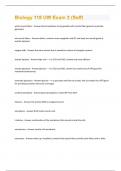
Biology 118 UW Exam 2 (Self) Questions & Answers Already Graded A+
white muscle fibers - Answer-blood capillaries tuning parallel with muscle fiber (good at anaerobic glycolysis) red muscle fibers - Answer-darker; contains more myoglobin and O2 and lipids are stored (good at aerobic lipolysis) oxygen debt - Answer-the extra volume that is needed to restore all energetic systems aerobic lipolysis - Answer-fatty acid —> to CO2 and H2O; slowest and most efficient aerobic glycolysis - Answer-glucose —> to CO2 and H2O; slower but creates lots of ATP (good for marathons/endurance) anaerobic glycolysis - Answer-glucose —> to pyruvate and then to lactate; fast but makes less ATP (good for sprinting and other fast burst of energy) creatine phosphate - Answer-gives phosphate to make ATP from ADP histones - Answer-the protein DNA is wrapped around sarcoplasm - Answer-fluid inside muscle cells t-tubules - Answer-continuation of the membrane that extends inside the cells sarcolemma - Answer-muscle cell membrane sarcomere - Answer-make up a myofibril; contain thick myosin fiber and thin actin fibers with z-disksmyofibril - Answer-made up of many sarcomeres; many of these make up one muscle cell satellite cells - Answer-have many nuclei; help muscle grow faster myoblast - Answer-makes muscle cells; they fuse together to make muscle fibers; leaves satellite cells on the outside voltage gated channel - Answer-open and close in response to changes in membrane potential ligand gated channel - Answer-opens when a neurotransmitter latches onto its receptor (requires ATP) mechanically gated channel - Answer-open in response to physical stretching of membrane Schwann cells - Answer-wraps around neuron until you get many layers if cell membranes (or many combined neurolemma layers called myelin sheath) chemical synapse - Answer-at the axon terminal the axons bond to something on the membrane to create a synapse axon terminals - Answer-junctions with other cells dendrites - Answer-receive messages from other cells peripheral nervous system - Answer-everything in your body except the brain and spinal cord bone loss by gender - Answer-women lose bone mass at a higher rate; lose half at menopause because of estrogen and other hormone changes how do we repair bones? - Answer-bone is eaten away then rebuilt strongerchondrocyte - Answer-cells the build cartilage osteocyte - Answer-mature bone cell osteoclast - Answer-transports H+ out of bone; thus breaking little holes in bone (requires ATP) osteoblast - Answer-secrete bone

Geschreven voor
- Instelling
- Biology 118 UW
- Vak
- Biology 118 UW
Documentinformatie
- Geüpload op
- 16 mei 2024
- Aantal pagina's
- 6
- Geschreven in
- 2023/2024
- Type
- Tentamen (uitwerkingen)
- Bevat
- Vragen en antwoorden
Onderwerpen
-
biology 118 uw self

Ook beschikbaar in voordeelbundel