CCRN review- kupchik Exam Questions and Answers 100% Pass
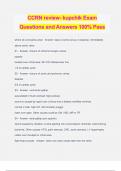
CCRN review- kupchik Exam Questions and Answers 100% Pass where do coronaries arise - Answer- base of aorta (sinus of valsalva); immediately above aortic valve S1 - Answer- closure of mitral & tricuspic valves systole loudest over mitral area, 5th ICS midclavicular line 1/3 of cardiac cycle S2 - Answer- closure of aortic and pulmonic valves diastole 2/3 of cardiac cycle S3 - Answer- ventricular gallop auscultated in fluid overload; high preload. sound is caused by rapid rush of blood into a dilated overfilled ventricle. normal in kids, high CO, 3rd trimester preggo listen over apex. Other causes could be CM, VSD, MR or TR. S4 - Answer- atrial gallop (pre-systolic). sound caused by vibration of atria ejecting into noncompliant ventricles. heard during ischemia. Other causes: HTN, pulm stenosis, CAD, aortic stenosis, LV hypertrophy. Listen over tricuspid or mitral area. Split heart sounds - Answer- when one valve closes later than the other. best heard during INSPIRATION Split S1 - Answer- mitral closes before tricuspid. RBBB, PVCs, or ventricular pacing. Split S2 - Answer- aortic closes before pulmonic. Overfilled RV, atrial septal defect. most sensitive & specific cardiac biomarker - Answer- troponin I (or T) when does troponin elevate - Answer- 3-6 hrs when does troponin peak - Answer- 14-20 hrs when does troponin return to normal - Answer- 1-2 weeks elevated troponin - Answer- >0.4 mcg/L other cardiac biomarkers - Answer- CPK, CK-MB, and myoglobin (not routinely checked) Chest pain assessment - Answer- OLD CART onset, location, duration, characteristics, associated s/sx, relieving factors, treatment NSTEMI - Answer- partial occlusion on coronary artery 8+ leads w/ ST depression or T wave inversion & ST elevation in aVR, high suspicion for proximal LAD occlusion. Tx: PCI STEMI - Answer- complete occlusion of coronary artery Emergent! Activate cath lab! 12 lead, CP/SOB/diaphoresis. Tx: PCI ASAP, if cath lab not readily available, fibrinolytics then cath lab ST depression represents - Answer- ISCHEMIA ST elevation represents - Answer- INJURY timing of EKG changes in STEMI - Answer- Immediate: T wave elevation, STe in leads over infarction area. Within few hours: Large upright T waves. Several hours: After revascularization, ST normalizes, T waves invert. Several hours to days: Q waves may develop, reducaed R waves, low voltage R waves (sometimes for life) ASA in stemi tx - Answer- 81 mg- 325 mg PO load- chewed! rectal if unable to take PO Onset of action: 1-7.5 min Inhibits cyclooxygenase 1 within platelets; prevents formation of thromboxane A. Disables platelets aggregation. Used indefinitely post MI; at least 81 mg daily. Nitroglycerin in stemi tx - Answer- 0.4 mg SL Q5 minutes x3 SL, spray, or infusion (tridil) POTENT VASODILATOR; reduces preload & ventricular wall tension. decreases myocardial O2 consumption. monitor for hypotension & headache when to avoid nitro - Answer- suspected R infarction or use of phosphodiesterase inhibitors (viagra or cialis) O2 in stemi tx - Answer- Hyperoxemia perpetuates oxidative injury after MI!! can worsen & increase infarct size!!!! Not necessary for pt w/o evidence of respiratory distress. Morphine in stemi tx - Answer- small incremental doses IV Q 5-15 min if chest pain is unrelieved by ntg. Potent analgesic and anxiolytic. causes venodilation, reduces preload, mild afterload reduction. Use morphine cautiously in... - Answer- Unstable angina and NSTEMI Avoid in R sided infarction the big 5 - Answer- post MI pts prescribed: 1) ASA indefinately 2) P2Y12 inhibitor-clopidogrel, ticagrelor (usually for

Geschreven voor
- Instelling
- CCRN
- Vak
- CCRN
Documentinformatie
- Geüpload op
- 10 mei 2024
- Aantal pagina's
- 15
- Geschreven in
- 2023/2024
- Type
- Tentamen (uitwerkingen)
- Bevat
- Vragen en antwoorden
Onderwerpen
-
ccrn review kupchik exam questions and answers 10

Ook beschikbaar in voordeelbundel