NAB RC/AL Leadership with 100% correct answers
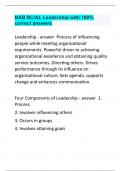
Leadership Process of influencing people while meeting organizational requirements. Powerful driver to achieving organizational excellence and obtaining quality service outcomes. Directing others. Drives performance through its influence on organizational culture. Sets agenda, supports change and enhances communication. Four Components of Leadership 1. Process 2. Involves influencing others 3. Occurs in groups 4. Involves attaining goals Management Activities of planning, decision-making, organizing, staffing, directing, and controlling. Leadership Style Manner and approach of providing direction, implementing plans, and motivating people. Common Leadership Styles 1. Authoritarian 2. Participative 3. Laissez-faire Authoritarian Leader Autocratic. Instructs and directs without input. Participative Democratic. Includes one or more decision-making process. Leader maintains final decision-making authority. Usually used when leader has part of info and employees have other parts. Offers mutual benefit. Enhances decision-making process. Laissez-faire Free reign. Leader allows employees to make decision but leader is responsible for decisions made. Used when employees are able to analyze situation and determine what needs to be done and how to do it. Effective with motivated, and knowledgeable employees, and with professional staff. Manager In charge because of an official designation. Gets things done through and with other people. Ensures that goals of facility are met. Are appointed but never emergent. Leader May be appointed but may also be emergent. Authority Formal or official power of administrator to obtain the compliance of working with him/her by using directives, communications, policies, and objectives. Vested in organizational roles or positions. Responsibility Obligation to of employee to perform the duty assigned. Span of Management Number of people any one person supervises effectively. As one moves down the managerial hierarchy... The span of management generally increases As one moves up the managerial hierarchy... The span of management generally decreases Staff Individual(s) who serve in an advisory capacity to administrator. Line staff Individuals who have direct responsibility to ensure goals are achieved through others. Deriving from direct operational activities such as financing, distribution, leadership, and strategic decision making. Team Building Individuals come together and directs energy toward problem solving, task effectiveness and maximizing resources of each member to accomplish goal or purpose. Consensus Building Strategy to allow all individual a role in decision-making. Steps to Consensus Building 1. Agree on objectives of task, expectation and rules 2. Define problem or decision to be reached 3. Figure out what must be done to reach solution, and brain storm 4. Discuss pros and cons from list of ideas 5. Adjust, compromise, fine tune so all agree 6. Once decision is made, act upon decision 7. If decision can't be made, take a vote and abide by majority Quality Assurance Examines pattern of all actions to ensure that services conform to established technical requirements, regulations or standards. Quality Improvement Achieves quality outcomes through evolving dynamic process. Is sensitive to needs of a changing organization. The Shewart Cycle 1. Plan 2. Do 3. Check 4. Act (or Adjust) Plan Phase (QI) Define Process Brainstorm Flow Chart Brainstorm Determine measures Do Phase (QI) Make Changes Check Phase (QI) Observe effects Control charts Data spreadsheet Performance indicators Act (QI) Identify what was learned TQI or CQI Structured organizational processes for involving personnel in planning and executing a continuous flow of improvements to provide quality healthcare that meets or exceeds expectations. Ethics Represent what should be done but not necessarily what must be done. A system of moral principles, rules, and standards of conduct. Negotiated Risk Process of negotiating way that services are going to be provided in dealing with exceptions outside the regular practices and service plans. Ombudsman Individual trained to provide advocacy and liaison for elderly residents of healthcare facilities regarding the actions of an administrative nature that affect the resident's health, safety, welfare or rights. The Ombudsman Program Nationally funded by AOA. Administered by state agencies.

Geschreven voor
- Instelling
- NAB
- Vak
- NAB
Documentinformatie
- Geüpload op
- 10 mei 2024
- Aantal pagina's
- 15
- Geschreven in
- 2023/2024
- Type
- Tentamen (uitwerkingen)
- Bevat
- Vragen en antwoorden
Onderwerpen
-
nab rcal leadership with 100 correct answers

Ook beschikbaar in voordeelbundel