Summary endterm Organizational Behavior
Week 4
Lecture 4b
Chapter 8
What is motivation?
- What a person does (direction)
- How hard a person works (intensity)
- How long a person works (persistence)
→ The level of motivation varies both between individuals and within individuals at different times
Intrinsic motivation = gain satisfaction from the task itself, more sustainable
Extrinsic motivation = performance, outcome expectancies and satisfaction come from the extrinsic
reward (money).
→ intrinsic contributes to quality, extrinsic to quantity
Need theories
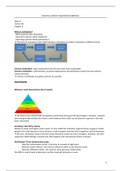
Maslow’s need theory (hierarchy of needs)
→ His theory has received wide recognition, particularly among practicing managers. However, research
does not generally validate the theory. Little evidence that needs are structured or operate in the way
that is described.
Herzberg’s two-factor theory
Relates to lower-and higher-order needs. It’s also called the motivator-hygiene theory. Hygiene is what
people find really important and motivators is what people motivates like recognition and achievement.
→ But also, Herzberg’s theory has been quite influential, known by many managers. However, not well
supported. Methodology is questioned. Both hygiene and motivational factors motivate.
McClelland’s Three fundamental needs
- Need for achievement (nAch) = the drive to succeed at high levels
- Need for power (nPow) = the need to influence others to do what you want
- Need for affiliation (nAff) = the need for close personal relationships
We differ in which need is dominant, and this need will motivate us most.
1
, o High achievers prefer jobs with: personal responsibility, challenging tasks and feedback
o High nAch perform best when probability of success is 0.5
o High nAch linked with career and entrepreneurial success
o High nAch may ham managerial success
o High nPow and low nAff is related to managerial success
→ McClelland’s theory has had the best support of early theories. First managers must determine what
needs worker wants satisfied, second ensure that a person receives outcomes when performing well. But
measuring the three needs is not easy. The process is time consuming and expensive, and few
organizations have been willing to invest in measuring McClelland’s concept.
Goal setting
Goal-setting theory
Goals are a huge source of motivation, they tell an employee what needs to be done and how much effort
is needed. For goals to motivate they need to be SMART
- Specific
Who, what, where, when, why
- Measurable
Set concrete criteria for measuring progress
- Achievable
Goals need to be challenging, but realistic
- Relevant
The goal needs to matter
- Time based
Goals should have a specific time frame
SMART goal setting has been applied using management by objectives (a performance program where
leaders meet with their direct reports and set specific performance objectives.
Regulatory goal focus (RFT)
People may set different types of goals depending on their regulatory focus
- Prevention-focused = individuals are vigilant and careful, emphasize fears, focus on avoiding
threats and set prevention goals
- Promotion-focused = individuals have a need for achievement, focus on advancement, and set
learning goals (they have a learning goal orientation; want to learn new things and see
themselves as adaptable)
→ leaders should keep the focus of their followers in mind
Job characteristics theory
The work itself may have characteristics that have the potential to motivate people to higher levels of
performance.
- Skill variety
The extent to which people use different skills and abilities at work
- Task identity
The task is one that people experience from beginning to end
- Task significance
The degree to which the job is seen as having an impact on others
- Autonomy
The employee has the freedom to plan and perform his or her own work
- Feedback
The job provides information on how effective the employee’s work is
2
, → Motvating jobs must (1) be autonomous, (2) provide feedback and (3) have at least one of the three
meaningfulness factors
Jobs may be redesigned to increase motivation:
- Horizontal (adding different tasks at the same level) or vertical (adding decision-making
responsibility)
- Job rotation = periodic shifting of an employee from one task to another
- Job enrichment = increasing the degree to which the worker controls the planning, execution and
evaluation of their work
Job crafting
The extent to which individuals can demonstrate initiative in designing their own work. ‘To capture the
actions employees, take to shape, mold and redefine their jobs’
- Task crafting = retooling the activities included in your job
- Relational crafting = revamping your interactions with others
- Cognitive crafting = reframing how you view your tasks and relationships
→ the best results when all the three forms are used together
Fairness
Equity theory
People compare themselves to others (referents) by focusing on what they get out of their jobs (money,
praise) and the contributions they make (effort, time, skill). When perceived as unequal = inequity =
distress.
According to the theory, a person (the focal person, FP) compares himself to the coworker (CO). Next, he
compares his inputs to his outcomes. Three situations can occur in this comparison:
1. The inputs and outcomes for the FP equal the inputs and outcomes for the CO. This is referred to
as equity
2. The inputs and outcomes for the FP are lower than the inputs and outcomes for the CO. This is
referred to as underpayment inequity
3. The inputs and outcomes for the FP are higher than the inputs and outcomes for the CO. This is
referred to as overpayment inequity
→ When perceiving inequity, they can be predicted to make one of the 6 choices: change their inputs,
change their outcomes, distort perceptions of self, distort perceptions of others, choose a different
referent or leave the field.
Organizational justice
3
Week 4
Lecture 4b
Chapter 8
What is motivation?
- What a person does (direction)
- How hard a person works (intensity)
- How long a person works (persistence)
→ The level of motivation varies both between individuals and within individuals at different times
Intrinsic motivation = gain satisfaction from the task itself, more sustainable
Extrinsic motivation = performance, outcome expectancies and satisfaction come from the extrinsic
reward (money).
→ intrinsic contributes to quality, extrinsic to quantity
Need theories
Maslow’s need theory (hierarchy of needs)
→ His theory has received wide recognition, particularly among practicing managers. However, research
does not generally validate the theory. Little evidence that needs are structured or operate in the way
that is described.
Herzberg’s two-factor theory
Relates to lower-and higher-order needs. It’s also called the motivator-hygiene theory. Hygiene is what
people find really important and motivators is what people motivates like recognition and achievement.
→ But also, Herzberg’s theory has been quite influential, known by many managers. However, not well
supported. Methodology is questioned. Both hygiene and motivational factors motivate.
McClelland’s Three fundamental needs
- Need for achievement (nAch) = the drive to succeed at high levels
- Need for power (nPow) = the need to influence others to do what you want
- Need for affiliation (nAff) = the need for close personal relationships
We differ in which need is dominant, and this need will motivate us most.
1
, o High achievers prefer jobs with: personal responsibility, challenging tasks and feedback
o High nAch perform best when probability of success is 0.5
o High nAch linked with career and entrepreneurial success
o High nAch may ham managerial success
o High nPow and low nAff is related to managerial success
→ McClelland’s theory has had the best support of early theories. First managers must determine what
needs worker wants satisfied, second ensure that a person receives outcomes when performing well. But
measuring the three needs is not easy. The process is time consuming and expensive, and few
organizations have been willing to invest in measuring McClelland’s concept.
Goal setting
Goal-setting theory
Goals are a huge source of motivation, they tell an employee what needs to be done and how much effort
is needed. For goals to motivate they need to be SMART
- Specific
Who, what, where, when, why
- Measurable
Set concrete criteria for measuring progress
- Achievable
Goals need to be challenging, but realistic
- Relevant
The goal needs to matter
- Time based
Goals should have a specific time frame
SMART goal setting has been applied using management by objectives (a performance program where
leaders meet with their direct reports and set specific performance objectives.
Regulatory goal focus (RFT)
People may set different types of goals depending on their regulatory focus
- Prevention-focused = individuals are vigilant and careful, emphasize fears, focus on avoiding
threats and set prevention goals
- Promotion-focused = individuals have a need for achievement, focus on advancement, and set
learning goals (they have a learning goal orientation; want to learn new things and see
themselves as adaptable)
→ leaders should keep the focus of their followers in mind
Job characteristics theory
The work itself may have characteristics that have the potential to motivate people to higher levels of
performance.
- Skill variety
The extent to which people use different skills and abilities at work
- Task identity
The task is one that people experience from beginning to end
- Task significance
The degree to which the job is seen as having an impact on others
- Autonomy
The employee has the freedom to plan and perform his or her own work
- Feedback
The job provides information on how effective the employee’s work is
2
, → Motvating jobs must (1) be autonomous, (2) provide feedback and (3) have at least one of the three
meaningfulness factors
Jobs may be redesigned to increase motivation:
- Horizontal (adding different tasks at the same level) or vertical (adding decision-making
responsibility)
- Job rotation = periodic shifting of an employee from one task to another
- Job enrichment = increasing the degree to which the worker controls the planning, execution and
evaluation of their work
Job crafting
The extent to which individuals can demonstrate initiative in designing their own work. ‘To capture the
actions employees, take to shape, mold and redefine their jobs’
- Task crafting = retooling the activities included in your job
- Relational crafting = revamping your interactions with others
- Cognitive crafting = reframing how you view your tasks and relationships
→ the best results when all the three forms are used together
Fairness
Equity theory
People compare themselves to others (referents) by focusing on what they get out of their jobs (money,
praise) and the contributions they make (effort, time, skill). When perceived as unequal = inequity =
distress.
According to the theory, a person (the focal person, FP) compares himself to the coworker (CO). Next, he
compares his inputs to his outcomes. Three situations can occur in this comparison:
1. The inputs and outcomes for the FP equal the inputs and outcomes for the CO. This is referred to
as equity
2. The inputs and outcomes for the FP are lower than the inputs and outcomes for the CO. This is
referred to as underpayment inequity
3. The inputs and outcomes for the FP are higher than the inputs and outcomes for the CO. This is
referred to as overpayment inequity
→ When perceiving inequity, they can be predicted to make one of the 6 choices: change their inputs,
change their outcomes, distort perceptions of self, distort perceptions of others, choose a different
referent or leave the field.
Organizational justice
3