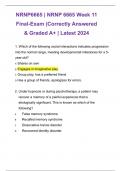
NRNP6665 | NRNP 6665 Week 11
Final-Exam (Correctly Answered
& Graded A+ | Latest 2024 1. Which of the following social interactions indicates progression
into the normal range, meeting developmental milestones for a 5-
year-old?
AShares on own
BEngages in imaginative play
CGroup play; has a preferred friend
DHas a group of friends, apologizes for errors. 2.Under hypnosis or during psychotherapy, a patient may recover a memory of a painful experience that is etiologically significant. This is known as which of the following?
AFalse memory syndrome BRecalled memory syndrome CDissociative trance disorder DRecovered identity disorder 3.Which of the following is true regarding how intermittent explosive disorder is differentiated from antisocial or borderline personality disorder?
AIn personality disorders, the aggressiveness and impulsivity are mild.
BIn personality disorders, the person is much less aware of the symptoms.
CIn personality disorders, functioning is less likely to be affected.
DIn personality disorders, aggressiveness and impulsivity is part of the person’s character and is present between outbursts. Indicators of imitative dissociative identity disorder include which of the following symptoms?
ASymptom exaggeration
BConfusion and shame related to symptoms.
CUse of symptoms to excuse antisocial behaviors. DA and C only
Which of the following would be a developmental trigger for a 3-yearold? Check all that apply .
ACannot balance on one foot for 3 seconds, cannot copy a circle
BLack of imaginative plan; cannot hypothesize an other’s thought
CCannot use a three-word sentence; speech only 50% undesirable. Stuvia.com - The Marketplace to Buy and Sell your Study Material
DSpeech less than 75% understandable; cannot identify self or details in pictures
A child who demonstrates repetitive significant violations of social rules and the rights of others over the course of a year would likely be diagnosed with which of the following diagnoses?
AAttention-deficit/hyperactivity disorder. BAutism spectrum disorder
CConduct disorder
DOppositional defiant disorder
Experiences of depersonalization and derealization are common in which of the following patients?
APatients with seizures
BPatients with migraines . C Patients who use marijuana .
D All of the above
Final-Exam (Correctly Answered
& Graded A+ | Latest 2024 1. Which of the following social interactions indicates progression
into the normal range, meeting developmental milestones for a 5-
year-old?
AShares on own
BEngages in imaginative play
CGroup play; has a preferred friend
DHas a group of friends, apologizes for errors. 2.Under hypnosis or during psychotherapy, a patient may recover a memory of a painful experience that is etiologically significant. This is known as which of the following?
AFalse memory syndrome BRecalled memory syndrome CDissociative trance disorder DRecovered identity disorder 3.Which of the following is true regarding how intermittent explosive disorder is differentiated from antisocial or borderline personality disorder?
AIn personality disorders, the aggressiveness and impulsivity are mild.
BIn personality disorders, the person is much less aware of the symptoms.
CIn personality disorders, functioning is less likely to be affected.
DIn personality disorders, aggressiveness and impulsivity is part of the person’s character and is present between outbursts. Indicators of imitative dissociative identity disorder include which of the following symptoms?
ASymptom exaggeration
BConfusion and shame related to symptoms.
CUse of symptoms to excuse antisocial behaviors. DA and C only
Which of the following would be a developmental trigger for a 3-yearold? Check all that apply .
ACannot balance on one foot for 3 seconds, cannot copy a circle
BLack of imaginative plan; cannot hypothesize an other’s thought
CCannot use a three-word sentence; speech only 50% undesirable. Stuvia.com - The Marketplace to Buy and Sell your Study Material
DSpeech less than 75% understandable; cannot identify self or details in pictures
A child who demonstrates repetitive significant violations of social rules and the rights of others over the course of a year would likely be diagnosed with which of the following diagnoses?
AAttention-deficit/hyperactivity disorder. BAutism spectrum disorder
CConduct disorder
DOppositional defiant disorder
Experiences of depersonalization and derealization are common in which of the following patients?
APatients with seizures
BPatients with migraines . C Patients who use marijuana .
D All of the above