RELATIONSHIPS
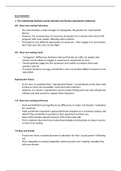
1. The relationship between sexual selection and human reproductive behaviour
A01- Short term mating Preferences
- The more females a male manages to impregnate, the greater his “reproductive
fitness”.
- However, the consequences of casual sex are greater for a woman who may be left
pregnant with ‘poor quality’ offspring and no partner
- This leads to very different approaches to casual sex... Men engage in it, and women
don’t (because the costs are too high)
A01- Short term mating Contd.
- “anisogamy” (differences between male and female sex cells) can explain why
women are less likely to engage in casual sex in comparison to men:
- Female gametes (eggs) are less numerous and costlier to produce than male
gametes (sperm)
- A woman produces one egg a month but a man can produce billions of sperm in one
ejaculation
Reproductive Fitness
- So for men, to maximise their “reproductive fitness” in evolutionary terms they need
to have as much sex as possible- many short-term partners.
- However, for women, reproductive success means finding one man who will give her
children and stick around to support them long term.
+VE -Short-term mating preferences
- Clark and Hatfield found significant sex differences in males’ and females’ motivation
for casual sex.
- Male and female researchers approached total strangers on a university campus and
asked if they would like to go back to their apartment and have sex.
- None of the females agreed, however 75% of the males did.
- This is evidence that men have evolved psychological mechanisms to ensure success
in short-term mating.
+VE Buss and Schmitt
- Found men show a marked decrease in attraction for their ‘casual partner’ following
sex.
- This is allegedly an evolved adaptation which prevents men ‘wasting’ valuable time
with one woman
1. The relationship between sexual selection and human reproductive behaviour
A01- Short term mating Preferences
- The more females a male manages to impregnate, the greater his “reproductive
fitness”.
- However, the consequences of casual sex are greater for a woman who may be left
pregnant with ‘poor quality’ offspring and no partner
- This leads to very different approaches to casual sex... Men engage in it, and women
don’t (because the costs are too high)
A01- Short term mating Contd.
- “anisogamy” (differences between male and female sex cells) can explain why
women are less likely to engage in casual sex in comparison to men:
- Female gametes (eggs) are less numerous and costlier to produce than male
gametes (sperm)
- A woman produces one egg a month but a man can produce billions of sperm in one
ejaculation
Reproductive Fitness
- So for men, to maximise their “reproductive fitness” in evolutionary terms they need
to have as much sex as possible- many short-term partners.
- However, for women, reproductive success means finding one man who will give her
children and stick around to support them long term.
+VE -Short-term mating preferences
- Clark and Hatfield found significant sex differences in males’ and females’ motivation
for casual sex.
- Male and female researchers approached total strangers on a university campus and
asked if they would like to go back to their apartment and have sex.
- None of the females agreed, however 75% of the males did.
- This is evidence that men have evolved psychological mechanisms to ensure success
in short-term mating.
+VE Buss and Schmitt
- Found men show a marked decrease in attraction for their ‘casual partner’ following
sex.
- This is allegedly an evolved adaptation which prevents men ‘wasting’ valuable time
with one woman