10. Hearing in the environment
Envt = environment; h = hear/hearing; = = is/are; w/ = with; btwn = between; mvt =
movement; dvpt = development, cc = cognition/cognitive; ° = tion; s = sound; cs =
complex sound(s); ss = simple sound(s); a = audition/auditory; s = system; as =
auditory system; xpce = experience
Sound localization
A localization = different from determining the location of a visual object. A sound enters your ears in
exactly the same place, whereas an image can fall on different parts of your retina.
Tip: 10.1: Auditory Localization cues https://oup-arc.com/access/content/sensation-and-perception-5e-
student-resources/sensation-and-perception-5e-activity-10-1?previousFilter=all_resources.
Interaural time difference
Interaural time difference (ITD) = the difference in time btwn a sound arriving at one ear versus the
other.
If the source is to the left, the sound will reach the left ear at first. Thus, we can tell whether a sound is
coming from our right or left by determining which ear receives sound first.
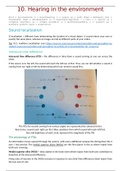
The ITDs for sounds coming from various angles are represented by coloured circles.
Red circles: sound reach right ear first. Blue: positions from which sound will reach left first.
Size and brightness of each circle represent the magnitude of the ITD.
The physiology of ITDs
As information moves upward through the system, with every additional synapse the timing btwn the 2
ears = less precise. The medial superior olives (MSOs) are the first places in the as where inputs from
both ears converge.
Medial superior olive (MSO) = relay station in the brain stem where inputs from both ears contribute to
detection of the interaural difference.
Firing rates of neurons in the MSOs increase in response to very brief time differences btwn inputs from
the two ears of cats.
, Interaural level difference
Second cue to sound localization.
Interaural level difference (ILD) = difference in level (intensity) btwn a sound arriving at one ear versus
the other.
Sounds are more intense at the ear closer to the sound source because the head partially blocks the
sound pressure wave from reaching the opposite ear. The properties of the ILD relevant for a
localization are similar to those of the ITD.
Btwn the 2 extremes (0, right in front, and 180 degrees, directly behind), the ILD correlates with the
angle of the sound source, but because of the irregular shape of the head, the correlation is less precise
than it is with ITDs.
ILDs = greatest for high-frequency tones, and ILD cues work well to determine location as long as the
sounds have higher-frequency energy. ILDs are greatly reduced for low frequencies. This is due to the
fact that the head blocks high-frequency sounds more effectively than it does low-frequency sounds.
The physiology of ILDs
Neurons that are sensitive to intensity differences btwn the two ears are in the lateral superior olives
(LSOs).
Lateral superior olive (LSO) = relay station in the brain stem where inputs from both ears contribute to
detection of the interaural level difference.
These neurons are sensitive to that because excitatory inputs from one ear (ipsilateral) and inhibitory
inputs from the other ear (contralateral) are wired to compete. When the sound is more intense at one
ear, connections from that ear are better both at exciting LSO neurons on that side and at inhibiting LSO
neurons on the other side.
Cones of confusion
Cone of confusion = region of positions in space where all sounds produce the same time and level
differences (ITDs and ILDs).
As soon as you move your head, though, the ITD and ILD of a sound source shift, and only one spatial
location will be consistent with the ITDs and ILDs perceived before and after you move your head.
Pinna and head cues
Other cue for pinpointing the location of sound sources. The shape of the pinna is complex, with a lot of
nooks and crannies. Because of their complex shapes, the pinnae funnel certain sound frequencies more
efficiently than others. The size and shape of the upper torso also affect which frequencies reach the ear
most easily. Because of these effects, the intensity of each frequency varies slightly according to the
direction of the sound. This variation a localization cue.
Directional transfer function (DTF) = measure that describes how the pinna, ear canal, head and torso
change the intensity of sounds with different frequencies that arrive at each ear from different locations
in space.
Simulating DTFs place 2 microphones near the eardrums. Then the sound source is recorded from
these two microphones. When this ‘binaural recording’ is played over headphones, the listener xpces
the sounds as if they were back out in the world where they belong.
Ears grow & develop. Listeners learn about the way DTFs relate to places on the envt through their
extensive xpce listening to sounds, while other sources of information, like vision, provide feedback
about location. Children may update the way they use DTF information during development. Such
learning can continue into adulthood.
Envt = environment; h = hear/hearing; = = is/are; w/ = with; btwn = between; mvt =
movement; dvpt = development, cc = cognition/cognitive; ° = tion; s = sound; cs =
complex sound(s); ss = simple sound(s); a = audition/auditory; s = system; as =
auditory system; xpce = experience
Sound localization
A localization = different from determining the location of a visual object. A sound enters your ears in
exactly the same place, whereas an image can fall on different parts of your retina.
Tip: 10.1: Auditory Localization cues https://oup-arc.com/access/content/sensation-and-perception-5e-
student-resources/sensation-and-perception-5e-activity-10-1?previousFilter=all_resources.
Interaural time difference
Interaural time difference (ITD) = the difference in time btwn a sound arriving at one ear versus the
other.
If the source is to the left, the sound will reach the left ear at first. Thus, we can tell whether a sound is
coming from our right or left by determining which ear receives sound first.
The ITDs for sounds coming from various angles are represented by coloured circles.
Red circles: sound reach right ear first. Blue: positions from which sound will reach left first.
Size and brightness of each circle represent the magnitude of the ITD.
The physiology of ITDs
As information moves upward through the system, with every additional synapse the timing btwn the 2
ears = less precise. The medial superior olives (MSOs) are the first places in the as where inputs from
both ears converge.
Medial superior olive (MSO) = relay station in the brain stem where inputs from both ears contribute to
detection of the interaural difference.
Firing rates of neurons in the MSOs increase in response to very brief time differences btwn inputs from
the two ears of cats.
, Interaural level difference
Second cue to sound localization.
Interaural level difference (ILD) = difference in level (intensity) btwn a sound arriving at one ear versus
the other.
Sounds are more intense at the ear closer to the sound source because the head partially blocks the
sound pressure wave from reaching the opposite ear. The properties of the ILD relevant for a
localization are similar to those of the ITD.
Btwn the 2 extremes (0, right in front, and 180 degrees, directly behind), the ILD correlates with the
angle of the sound source, but because of the irregular shape of the head, the correlation is less precise
than it is with ITDs.
ILDs = greatest for high-frequency tones, and ILD cues work well to determine location as long as the
sounds have higher-frequency energy. ILDs are greatly reduced for low frequencies. This is due to the
fact that the head blocks high-frequency sounds more effectively than it does low-frequency sounds.
The physiology of ILDs
Neurons that are sensitive to intensity differences btwn the two ears are in the lateral superior olives
(LSOs).
Lateral superior olive (LSO) = relay station in the brain stem where inputs from both ears contribute to
detection of the interaural level difference.
These neurons are sensitive to that because excitatory inputs from one ear (ipsilateral) and inhibitory
inputs from the other ear (contralateral) are wired to compete. When the sound is more intense at one
ear, connections from that ear are better both at exciting LSO neurons on that side and at inhibiting LSO
neurons on the other side.
Cones of confusion
Cone of confusion = region of positions in space where all sounds produce the same time and level
differences (ITDs and ILDs).
As soon as you move your head, though, the ITD and ILD of a sound source shift, and only one spatial
location will be consistent with the ITDs and ILDs perceived before and after you move your head.
Pinna and head cues
Other cue for pinpointing the location of sound sources. The shape of the pinna is complex, with a lot of
nooks and crannies. Because of their complex shapes, the pinnae funnel certain sound frequencies more
efficiently than others. The size and shape of the upper torso also affect which frequencies reach the ear
most easily. Because of these effects, the intensity of each frequency varies slightly according to the
direction of the sound. This variation a localization cue.
Directional transfer function (DTF) = measure that describes how the pinna, ear canal, head and torso
change the intensity of sounds with different frequencies that arrive at each ear from different locations
in space.
Simulating DTFs place 2 microphones near the eardrums. Then the sound source is recorded from
these two microphones. When this ‘binaural recording’ is played over headphones, the listener xpces
the sounds as if they were back out in the world where they belong.
Ears grow & develop. Listeners learn about the way DTFs relate to places on the envt through their
extensive xpce listening to sounds, while other sources of information, like vision, provide feedback
about location. Children may update the way they use DTF information during development. Such
learning can continue into adulthood.