TExES Physical Education EC-12 158 Questions & 100% Correct Answers | Latest Update | Graded A+
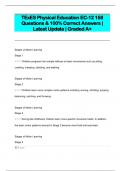
Stages of Motor Learning Stage 1 : Children progress from simple reflexes to basic movements such as sitting, crawling, creeping, standing, and walking. Stages of Motor Learning Stage 2 : Children learn more complex motor patterns including running, climbing, jumping, balancing, catching, and throwing. Stages of Motor Learning Stage 3 : During late childhood, children learn more specific movement skills. In addition, the basic motor patterns learned in Stage 2 become more fluid and automatic. Stages of Motor Learning Stage 4 2 | P a g e : During adolescence, children continue to develop general and specific motor skills and master specialized movements. At this point, factors including practice, motivation, and talent begin to affect the level of further development. Practice : Frequent, structured practice of motor skills enhances skill development in children. Positive Feedback : When a skill is learned it goes into short term memory and receives positive feedback. The skill may eventually go into their long-term memory, creating memory that is more permanent. Encourage the performer and helps in making the performer remember every aspect of the performance. Intrinsic Feedback : Information received by the athlete as a direct result of producing a movement through the kinesthetic senses- e.g. feeling from muscles, joints, and balance. Extrinsic Feedback : Information not inherent in the movement itself but which improves intrinsic feedback (this is also known as augmented feedback)

Geschreven voor
- Instelling
- TExES Physical Education EC-12 158
- Vak
- TExES Physical Education EC-12 158
Documentinformatie
- Geüpload op
- 5 mei 2024
- Aantal pagina's
- 33
- Geschreven in
- 2023/2024
- Type
- Tentamen (uitwerkingen)
- Bevat
- Vragen en antwoorden
Onderwerpen
-
texes physical education ec 12 158 questions 100

Ook beschikbaar in voordeelbundel