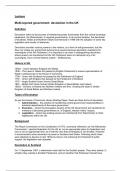
Lecture
Multi-layered government: devolution in the UK
Definition
Devolution refers to the process of transferring power downwards from the central sovereign
parliament, the Westminster, to regional governments. In its current iteration, the devolution
of Scotland, Wales and Northern Ireland commenced in 1998 with the adoption of some key
legislation and results of referenda.
Devolution provides various powers to the nations, as a form of self-government, but this
does not create any entrenched autonomous powers because devolution maintains the
sovereignty of the UK Parliament. It is important to be clear in distinguishing devolution,
where powers are transferred but the UK Parliament does not relinquish any of its
sovereignty, from a formal federal system – McEldowney.
History in UK
1530s – Union between England and Wales.
1536 – The Laws in Wales Act passed by English Parliament to ensure representation of
Welsh constituencies in the House of Commons.
1706 – Union with Scotland Act passed by the Parliament of England.
1707 – Union with England Act passed by the Parliament of Scotland.
1707 – Anglo-Scottish Union formed Great Britain.
1801 – British-Irish Union formed United Kingdom of Great Britain and Ireland.
1920s – Division of Ireland into Northern Ireland and Eire. Creating the state of United
Kingdom of Great Britain and Northern Ireland.
Types of Devolution
As per the House of Commons Library Briefing Paper, there are three forms of devolution.
1. Administrative – the practice of transferring central government responsibilities to
territorial departments of the same government.
2. Executive – where the prerogative powers of the UK Government are transferred to
ministers of devolved governments or, in England, elected ‘metro’ mayors.
3. Legislative – where law-making powers are transferred from Westminster to other
legislatures within the UK.
Background
The Royal Commission on the Constitution of 1973, commonly referred to as ‘the Kilbrandon
Commission’, rejected federalism for the UK as ‘not an appropriate place for federalism and
now is not an appropriate time’ as it held the view that sovereignty is not divisible. However,
it recommended some devolution of power to Scotland and Wales. Following which there
were attempts to devolve in late 1970s but due to not achieving the threshold of public
support, the legislation was repealed.
Devolution in Scotland
On 11 September 1997, a referendum was held for the Scottish people. They were asked (1)
whether they wanted a Scottish Parliament, and (2) whether that Parliament should have
, (limited) tax varying powers. 60% of the voters came out to vote out of which 74% voted in
favour of creation of the Parliament and 63% voted in favour of the tax-raising powers.
These measures were implemented through the Scotland Act 1998. The Parliament officially
convened on 1 July 1999 and powers previously exercised by the Secretary State for
Scotland were transferred to Scottish ministers.
The Parliament has the power to pass primary legislation and s.29 of the act 1998 provides
that the legislative competence extends to all areas of law except reserved matters set out in
Schedule 5.
The Scotland Act 2012 made further changes to the devolution settlement in response to the
recommendations of the Calman Commission, including giving the parliament the power to
set a separate Scottish income tax rate.
The Scotland Act 2016 made additional amendments to the 1998 Act devolving further
power, giving effect to the recommendations of the Smith Commission. The cross-party
Smith Commission was established after the ‘No’ vote in the Scottish independence
referendum of September 2014.
In summary, the Scotland Act 2016:
• declares that the Scottish Parliament and the Scottish Government are considered
permanent parts of the UK’s constitutional arrangements and will not be abolished without a
decision of the people of Scotland. It also recognises that the UK Parliament will not
normally legislate in relation to devolved matters without the consent of the Scottish
Parliament, while retaining the sovereignty to do so.
• gives increased autonomy to the Scottish Parliament and the Scottish Ministers in relation
to the operation of Scottish Parliament and local government elections in Scotland.
• gives increased autonomy to the Scottish Parliament in relation to the power to amend
sections of the Scotland Act 1998 which relate to the operation of the Scottish Parliament
and the Scottish Government within the United Kingdom.
• increases the financial accountability of the Scottish Parliament through devolution of the
rates and bands of income tax, air passenger duty and aggregates levy, and assignment of
VAT revenues.
• increases responsibility for welfare policy and delivery in Scotland through the devolution of
welfare powers to the Scottish Parliament and/or the Scottish Ministers.
• gives significant responsibility to Scotland for areas such as road signs, speed limits,
onshore oil and gas extraction, consumer advocacy and advice, among others, by devolution
of powers in relation to these fields to the Scottish Parliament and the Scottish Ministers and
increases scrutiny for the Scottish Parliament of specific bodies and increases the ability of
the Scottish Government to design schemes relating to energy efficiency and fuel poverty by
the devolution of functions to the Scottish Ministers.
The Sewel convention
This constitutional convention dates from 1998 when Lord Sewell gave a commitment that
when the Westminster or UK Parliament legislated in a devolved area it would ‘not normally’
legislate without the consent of the Scottish Parliament. This consent would be given
through a legislative consent motion.
The Sewel convention has now been given statutory recognition by inserting into s.28 of the
Scotland Act (by s.2 of the 2016 Act), immediately after the subsection preserving the power
of the UK Parliament to make laws for Scotland, the following subsection: ‘(8) But it is
recognised that the Parliament of the United Kingdom will not normally legislate with regard
to devolved matters without the consent of the Scottish Parliament.’
Multi-layered government: devolution in the UK
Definition
Devolution refers to the process of transferring power downwards from the central sovereign
parliament, the Westminster, to regional governments. In its current iteration, the devolution
of Scotland, Wales and Northern Ireland commenced in 1998 with the adoption of some key
legislation and results of referenda.
Devolution provides various powers to the nations, as a form of self-government, but this
does not create any entrenched autonomous powers because devolution maintains the
sovereignty of the UK Parliament. It is important to be clear in distinguishing devolution,
where powers are transferred but the UK Parliament does not relinquish any of its
sovereignty, from a formal federal system – McEldowney.
History in UK
1530s – Union between England and Wales.
1536 – The Laws in Wales Act passed by English Parliament to ensure representation of
Welsh constituencies in the House of Commons.
1706 – Union with Scotland Act passed by the Parliament of England.
1707 – Union with England Act passed by the Parliament of Scotland.
1707 – Anglo-Scottish Union formed Great Britain.
1801 – British-Irish Union formed United Kingdom of Great Britain and Ireland.
1920s – Division of Ireland into Northern Ireland and Eire. Creating the state of United
Kingdom of Great Britain and Northern Ireland.
Types of Devolution
As per the House of Commons Library Briefing Paper, there are three forms of devolution.
1. Administrative – the practice of transferring central government responsibilities to
territorial departments of the same government.
2. Executive – where the prerogative powers of the UK Government are transferred to
ministers of devolved governments or, in England, elected ‘metro’ mayors.
3. Legislative – where law-making powers are transferred from Westminster to other
legislatures within the UK.
Background
The Royal Commission on the Constitution of 1973, commonly referred to as ‘the Kilbrandon
Commission’, rejected federalism for the UK as ‘not an appropriate place for federalism and
now is not an appropriate time’ as it held the view that sovereignty is not divisible. However,
it recommended some devolution of power to Scotland and Wales. Following which there
were attempts to devolve in late 1970s but due to not achieving the threshold of public
support, the legislation was repealed.
Devolution in Scotland
On 11 September 1997, a referendum was held for the Scottish people. They were asked (1)
whether they wanted a Scottish Parliament, and (2) whether that Parliament should have
, (limited) tax varying powers. 60% of the voters came out to vote out of which 74% voted in
favour of creation of the Parliament and 63% voted in favour of the tax-raising powers.
These measures were implemented through the Scotland Act 1998. The Parliament officially
convened on 1 July 1999 and powers previously exercised by the Secretary State for
Scotland were transferred to Scottish ministers.
The Parliament has the power to pass primary legislation and s.29 of the act 1998 provides
that the legislative competence extends to all areas of law except reserved matters set out in
Schedule 5.
The Scotland Act 2012 made further changes to the devolution settlement in response to the
recommendations of the Calman Commission, including giving the parliament the power to
set a separate Scottish income tax rate.
The Scotland Act 2016 made additional amendments to the 1998 Act devolving further
power, giving effect to the recommendations of the Smith Commission. The cross-party
Smith Commission was established after the ‘No’ vote in the Scottish independence
referendum of September 2014.
In summary, the Scotland Act 2016:
• declares that the Scottish Parliament and the Scottish Government are considered
permanent parts of the UK’s constitutional arrangements and will not be abolished without a
decision of the people of Scotland. It also recognises that the UK Parliament will not
normally legislate in relation to devolved matters without the consent of the Scottish
Parliament, while retaining the sovereignty to do so.
• gives increased autonomy to the Scottish Parliament and the Scottish Ministers in relation
to the operation of Scottish Parliament and local government elections in Scotland.
• gives increased autonomy to the Scottish Parliament in relation to the power to amend
sections of the Scotland Act 1998 which relate to the operation of the Scottish Parliament
and the Scottish Government within the United Kingdom.
• increases the financial accountability of the Scottish Parliament through devolution of the
rates and bands of income tax, air passenger duty and aggregates levy, and assignment of
VAT revenues.
• increases responsibility for welfare policy and delivery in Scotland through the devolution of
welfare powers to the Scottish Parliament and/or the Scottish Ministers.
• gives significant responsibility to Scotland for areas such as road signs, speed limits,
onshore oil and gas extraction, consumer advocacy and advice, among others, by devolution
of powers in relation to these fields to the Scottish Parliament and the Scottish Ministers and
increases scrutiny for the Scottish Parliament of specific bodies and increases the ability of
the Scottish Government to design schemes relating to energy efficiency and fuel poverty by
the devolution of functions to the Scottish Ministers.
The Sewel convention
This constitutional convention dates from 1998 when Lord Sewell gave a commitment that
when the Westminster or UK Parliament legislated in a devolved area it would ‘not normally’
legislate without the consent of the Scottish Parliament. This consent would be given
through a legislative consent motion.
The Sewel convention has now been given statutory recognition by inserting into s.28 of the
Scotland Act (by s.2 of the 2016 Act), immediately after the subsection preserving the power
of the UK Parliament to make laws for Scotland, the following subsection: ‘(8) But it is
recognised that the Parliament of the United Kingdom will not normally legislate with regard
to devolved matters without the consent of the Scottish Parliament.’