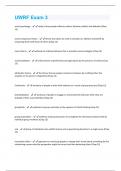
UWRF Exam 3 Questions Perfectly Answered!!
social psychology - study of how people influence others' behavior, beliefs, and attitudes (Chap 13) social comparison theory - theory that states we seek to evaluate our abilities and beliefs by comparing them with those of others (Chap 13) mass histeria - outbreak of irrational behavior that is spread by social contagion (Chap 13) social facilitation - enhancement of performance brought about by the presence of others (Chap 13) attribution theory - the theory that we explain someone's behavior by crediting either the situation or the person's disposition (Chap 13) Conformity - tendency of people to alter their behavior as a result of group pressure (Chap 13) deindividuation - tendency of people to engage in uncharacteristic behavior when they are stripped of their usual identities (Chap 13) groupthink - emphasis on group unanimity at the expense of critical thinking (chap 13) group polarization - tendency of group discussion to strengthen the dominant positions held by individual group members (Chap 13) cult - group of individuals who exhibit intense and unquestioning devotion to a single cause (Chap 13) inoculation effect - approach to convincing people to change their minds about something by first introducing reasons why the perspective might be correct and then debunking them (Chap 13)Stanley Milgram's Obedience Study - Had a "teacher" give shocks to a "learner" if he gave the wrong answer....found that 63 percent would give all shocks even when the learner was screaming in pain (Chap 13) pluralistic ignorance - error of assuming that no one in a group perceives things as we do (Chap 13) diffusion of responsibility - reduction in feelings of personal responsibility in the presence of others (Chap 13) enlightenment effect - learning about psychological research can change real-world behavior for the better (Chap 13) social loafing - phenomenon whereby individuals become less productive in groups (Chap 13) altruism - helping others for unselfish reasons (Chap 13) aggression - behavior intended to harm others, either verbally or physically (Chap 13) relational aggression - form of indirect aggression prevalent in girls, involving spreading rumors, gossiping, and using nonverbal putdowns for the purpose of social manipulation (Chap 13) prejudice - the drawing of negative conclusions about a person, group of people, or situation prior to evaluating the evidence (Chap 13) stereotype - a belief, positive or negative, about the characteristics of members of a group that is applied generally to most members of the group (Chap 13) ultimate attribution error - assumption that behaviors among individual members of a group are due to their internal dispositions (Chap 13)adaptive conservatism - evolutionary principle that creates a predisposition toward distrusting anything or anyone unfamiliar or different (Chap 13) in-group bias - tendency to favor within individuals within our group over those from outside our group (Chap 13) out-group homogeneity - tendency to view all individuals outside our group as highly similar (Chap 13) Discrimination - negative behavior toward members of out-groups. (Chap 13) scapegoat hypothesis - claim that prejudice arises from a need to blame other groups for our misfortunes (Chap 13) just-world hypothesis - claim that our attributions and behaviors are shaped by a deep-seated assumption that the world is fair and all things happen for a reason (Chap 13) explicit prejudice - unfounded negative belief of which we're aware regarding the characteristics of an out-group (Chap 13) implicit prejudice - unfounded negative belief of which we're unaware regarding the characteristics of an out-group (Chap 13) jigsaw classroom - educational approach designed to minimize prejudice by requiring all children to make independent contributions to a shared project (Chap 13) Normal Conformity - desire to fit into a group because of fear of rejection asch experiments shows the strength of social influence on this (Chap 13)Informational Conformity - conformity that occurs when conformity pressures actually persuade group members to adopt new beliefs and/or attitudes (Chap 13) Solomon Asch's Conformity Study - Conformity is yielding to group pressure when no explicit demand has been made. Subjects compared lengths of lines. Asked to chose which line had same length as comparison line. Comparison were easy and obvious. Strong tendency for subjects to conform to incorrect responses of confederates. (Chap 13) cognitive dissonance theory - the theory that we act to reduce the discomfort we feel when two of our thoughts are inconsistent (Chap 13) Reciprocity norm - an expectation that people will help, not hurt, those who have helped them (Chap 13) Foot-in-the door - the tendency for people who have first agreed to a small request to comply later with a larger request (Chap

Geschreven voor
- Instelling
- UWRF
- Vak
- UWRF
Documentinformatie
- Geüpload op
- 2 mei 2024
- Aantal pagina's
- 13
- Geschreven in
- 2023/2024
- Type
- Tentamen (uitwerkingen)
- Bevat
- Vragen en antwoorden
Onderwerpen
-
uwrf

Ook beschikbaar in voordeelbundel