Chapter 1: What is Social Psychology?
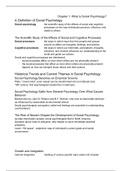
A Definition of Social Psychology
Social psychology the scientific study of the effects of social and cognitive
processes on the way individuals perceive, influence, and
relate to others.
The Scientific Study of the Effects of Social and Cognitive Processes
Social processes the ways in which input from the people and groups
around us affect our thoughts, feelings, and actions.
Cognitive processes the ways in which our memories, perceptions, thoughts,
emotions, and motives influence our understanding of the
world and guide our actions.
Social and cognitive processes are intertwined:
- social processes affect us even when others are not physically present.
- the social processes that affect us even when others are physically present
depend on how we interpret those others and their actions.
Historical Trends and Current Themes in Social Psychology
Social Psychology Becomes an Empirical Science
Plato: “crowd mind”, even wisest can be transformed into an irrational mob.
19th century: first psychological researches in Germany.
Social Psychology Splits from General Psychology Over What Causes
Behavior
Behaviorism by John B. Watson and B.F. Skinner: only look at observable behavior
as influenced by observable environmental stimuli.
Social psychologists: perception, belief and feelings are essential to understanding
overt behavior.
The Rise of Nazism Shapes the Development of Social Psychology
As Nazi domination spread, social psychologists fled to North America.
Question about roots of prejudice, also helped to solve immediate practical
problems.
Lewin: “life space”, subjective map of individual’s current goals and social
environment.
Growth and Integration
Internal integration melding of various specific topic areas into broader
, explanations of behavior.
External integration increasing attention to neighboring scientific fields and to
significant social concerns.
1960: cognitive revolution.
Integration of social psychological theory with:
- cultural psychology
- evolutionary principles
- embodiment
- neuroscience
How The Approach of This Book Reflects an Integrative
Perspective
Two Fundamental Axioms of Social Psychology
1. Construction of Reality
Construction of reality the axiom that each person’s view of reality is a
construction, shaped both by cognitive processes and by
social processes.
2. Pervasiveness of Social Influence
Pervasiveness of social the axiom that other people influence virtually all of our
influence thoughts, feelings, and behavior, whether those others
are physically present or not.
Three Motivational Principles
1. People Strive for Mastery
Striving for mastery the motivational principle that people seek to understand
and predict events in the social world in order to obtain
rewards.
2. People Seek Connectedness
Seeking connectedness the motivational principle that people seek support, liking,
and acceptance from the people and groups they care
about and value.
3. People Value “Me and Mine”
Valuing “me and mine” the motivational principle that people desire to see
themselves, and other people and groups connected to
themselves, in a positive light.
Three Processing Principles
1. Conservatism: Established Views Are Slow to Change
Conservatism principle the processing principle that individuals’ and groups’
views of the world are slow to change and prone to
, perpetuate themselves.
2. Accessibility: Accessible Information Has the Most Impact
Accessibility principle the processing principle that the information that is most
readily available generally has the most impact on
thoughts, feelings, and behavior.
3. Superficiality Versus Depth: People Can Process Superficially or In Depth
Superficiality versus the processing principle that people ordinarily put little
depth effort into dealing with information, but at times are
motivated to consider information in more depth.
Common Processes, Diverse Behaviors
Forementioned 8 principles account for all types of social behavior.
Chapter 3: Perceiving Individuals
Forming First Impressions: Cues, Interpretations, and
Inferences
Mental representations a body of knowledge that an individual has stored in
memory
The Raw Materials of First Impressions
- Physical Appearance
“what is beautiful is good”
Baby-faced adults are considered less dominant and competent.
- Nonverbal Communication
We like people who express nonverbal feelings more.
- Detection of Deception
- Familiarity
Mere exposure exposure to a stimulus without any external reward,
which
creates familiarity with the stimulus and generally makes
people feel more positively about it.
- Environments
- Behavior
- Certain cues
Salience the ability of a cue to attract attention in its context.
, Automatic Interpretations of Cues
Automatic refers to processes that operate spontaneously (without
the perceiver’s deliberate intent) and often efficiently and
without awareness.
Associations a link between two or more mental representations.
Accessibility the ease and speed with which information comes to
mind and is used.
Priming the activation of a mental representation to increase its
accessibility and thus the likelihood that it will be used.
Subliminal presentation of stimuli in such a way (usually with a very
brief duration) that perceivers are not consciously aware
of them.
Characterizing the Behaving Person: Correspondent Inferences
A Definition of Social Psychology
Social psychology the scientific study of the effects of social and cognitive
processes on the way individuals perceive, influence, and
relate to others.
The Scientific Study of the Effects of Social and Cognitive Processes
Social processes the ways in which input from the people and groups
around us affect our thoughts, feelings, and actions.
Cognitive processes the ways in which our memories, perceptions, thoughts,
emotions, and motives influence our understanding of the
world and guide our actions.
Social and cognitive processes are intertwined:
- social processes affect us even when others are not physically present.
- the social processes that affect us even when others are physically present
depend on how we interpret those others and their actions.
Historical Trends and Current Themes in Social Psychology
Social Psychology Becomes an Empirical Science
Plato: “crowd mind”, even wisest can be transformed into an irrational mob.
19th century: first psychological researches in Germany.
Social Psychology Splits from General Psychology Over What Causes
Behavior
Behaviorism by John B. Watson and B.F. Skinner: only look at observable behavior
as influenced by observable environmental stimuli.
Social psychologists: perception, belief and feelings are essential to understanding
overt behavior.
The Rise of Nazism Shapes the Development of Social Psychology
As Nazi domination spread, social psychologists fled to North America.
Question about roots of prejudice, also helped to solve immediate practical
problems.
Lewin: “life space”, subjective map of individual’s current goals and social
environment.
Growth and Integration
Internal integration melding of various specific topic areas into broader
, explanations of behavior.
External integration increasing attention to neighboring scientific fields and to
significant social concerns.
1960: cognitive revolution.
Integration of social psychological theory with:
- cultural psychology
- evolutionary principles
- embodiment
- neuroscience
How The Approach of This Book Reflects an Integrative
Perspective
Two Fundamental Axioms of Social Psychology
1. Construction of Reality
Construction of reality the axiom that each person’s view of reality is a
construction, shaped both by cognitive processes and by
social processes.
2. Pervasiveness of Social Influence
Pervasiveness of social the axiom that other people influence virtually all of our
influence thoughts, feelings, and behavior, whether those others
are physically present or not.
Three Motivational Principles
1. People Strive for Mastery
Striving for mastery the motivational principle that people seek to understand
and predict events in the social world in order to obtain
rewards.
2. People Seek Connectedness
Seeking connectedness the motivational principle that people seek support, liking,
and acceptance from the people and groups they care
about and value.
3. People Value “Me and Mine”
Valuing “me and mine” the motivational principle that people desire to see
themselves, and other people and groups connected to
themselves, in a positive light.
Three Processing Principles
1. Conservatism: Established Views Are Slow to Change
Conservatism principle the processing principle that individuals’ and groups’
views of the world are slow to change and prone to
, perpetuate themselves.
2. Accessibility: Accessible Information Has the Most Impact
Accessibility principle the processing principle that the information that is most
readily available generally has the most impact on
thoughts, feelings, and behavior.
3. Superficiality Versus Depth: People Can Process Superficially or In Depth
Superficiality versus the processing principle that people ordinarily put little
depth effort into dealing with information, but at times are
motivated to consider information in more depth.
Common Processes, Diverse Behaviors
Forementioned 8 principles account for all types of social behavior.
Chapter 3: Perceiving Individuals
Forming First Impressions: Cues, Interpretations, and
Inferences
Mental representations a body of knowledge that an individual has stored in
memory
The Raw Materials of First Impressions
- Physical Appearance
“what is beautiful is good”
Baby-faced adults are considered less dominant and competent.
- Nonverbal Communication
We like people who express nonverbal feelings more.
- Detection of Deception
- Familiarity
Mere exposure exposure to a stimulus without any external reward,
which
creates familiarity with the stimulus and generally makes
people feel more positively about it.
- Environments
- Behavior
- Certain cues
Salience the ability of a cue to attract attention in its context.
, Automatic Interpretations of Cues
Automatic refers to processes that operate spontaneously (without
the perceiver’s deliberate intent) and often efficiently and
without awareness.
Associations a link between two or more mental representations.
Accessibility the ease and speed with which information comes to
mind and is used.
Priming the activation of a mental representation to increase its
accessibility and thus the likelihood that it will be used.
Subliminal presentation of stimuli in such a way (usually with a very
brief duration) that perceivers are not consciously aware
of them.
Characterizing the Behaving Person: Correspondent Inferences