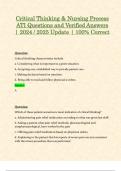
Critical Thinking & Nursing Process ATI Questions and Verified Answers | 2024 / 2025 Update | 100% Correct
Critical Thinking & Nursing Process ATI Questions and Verified Answers | 2024 / 2025 Update | 100% Correct Q: A new nurse is pulled from the surgical unit to work on the oncology unit. The nurse displays the critical thinking attitudes of humility and responsibility by a. Refusing the assignment. b. Asking for an orientation to the unit. c. Assuming that patient care will be the same as on the other units. d. Admitting lack of knowledge and going home. Answer: b. Asking for an orientation to the unit. Q: Professional standards influence a nurse's clinical decisions by a. Bypassing the patient's feelings to promote ethical standards. b. Establishing minimal passing standards for testing. c. Requiring the nurse to use critical thinking for the highest level of quality nursing care. d. Utilizing evidence-based practice based on nurses' needs. Answer: c. Requiring the nurse to use critical thinking for the highest level of quality nursing care. Q: A nurse who is caring for a patient with a pressure ulcer fails to apply the recommended dressing according to hospital policy. If the patient is harmed, the nurse could be subject to legal action for not adhering to a. Fairness. b. Intellectual standards. c. Independent reasoning. d. Institutional practice guidelines. Answer: d. Institutional practice guidelines. Q: Which of these findings, if identified in a plan of care, should the registered nurse revise because it is not characteristic of critical thinking and the nursing process? a. Patient's reactions to diagnostic testing b. Nurse's assumptions about hospital discharge c. Identification of five different nursing diagnoses d. Documentation of patient's ability to cope with loss Answer: b. Nurse's assumptions about hospital discharge Q: 1. The nursing process involves which of the following steps in the clinical decision-making process? (Select all that apply.) a. Identifying patient needs b. Diagnosing the disease process c. Determining priorities of care d. Setting goals e. Performing nursing interventions f. Evaluating effectiveness of medical treatments Answer: a. Identifying patient needs c. Determining priorities of care d. Setting goals e. Performing nursing interventions Q: Which statement accurately describes the process of validating data? Select all that apply. One, some, or all responses may be correct. Validate the findings with information from the patient's family. Validate by getting diagnostic tests done. Validate with findings from a physical examination. Validate by asking the patient directly. Validate by contacting the patient's previous doctor. Answer: Validate the findings with information from the patient's family. Validate with findings from a physical examination. Validate by asking the patient directly. Validate by contacting the patient's previous doctor. Validating data refers to confirming the genuineness of the data collected. It can be done by asking the patient's family, by asking the patient directly, by performing a physical examination, and by contacting the patient's previous doctor. These sources can be used to countercheck that the patient has provided accurate information. Diagnostic tests are prescribed by the health care provider and may not be included in a nursing assessment. Q: While providing care, the nurse finds that a patient is untidy and is uninterested in hygiene. Which action does the nurse take first? Educate the patient about hygiene. Help the patient develop new hygiene practices. Observe the patient performing hygiene care activities. Assess the patient's ability to perform daily hygiene practices. Answer: Assess the patient's ability to perform daily hygiene practices. Assessment of a patient's ability to provide hygiene self-care helps the nurse decide the type and amount of hygiene care to provide. The nurse should ensure that safe and effective hygiene will be provided. Although it is important for the nurse to educate the patient about the importance of hygiene, help the patient in developing new hygiene practices, and to know the patient's personal preferences, the first step of the nursing process is to assess. Q: The nurse is caring for a 50-year-old patient who has had a gall bladder removal and is postoperative day 2. The patient appears to be in pain. Which patient assessment finding collected by the nurse is categorized as objective data? Select all that apply. One, some, or all responses may be correct. Stiffness across the lower back Minimal oozing at the incision site Stinging pain at the incision site Fever of 104° F (40° C) Sharp pain on movement Answer: Minimal oozing at the incision site Fever of 104° F (40° C) Objective data are collected by the nurse on direct observation and examination. Minimal oozing at the incision site is objective data. A fever of 104° F (40° C) is objective data. Subjective data include findings experienced and reported by the patient. A report of lower back stiffness is subjective data. Stinging pain at the incision site and sharp pain on movement are subjective data. Q: The nurse is conducting a physical assessment on a patient admitted to the hospital with hypertension. Which attribute of the nurse will help him or her make a proper assessment about this patient? Select all that apply. One, some, or all responses may be correct. The nurse's relevant knowledge The nurse's critical thinking attitude The nurse's relationship with the patient The nurse's prior clinical experience Advice or assistance from other nurses in the agency Answer: The nurse's relevant knowledge The nurse's critical thinking attitude The nurse's prior clinical experience Critical thinking is a vital part of assessment. It allows the nurse to see the big picture when he or she forms conclusions or makes decisions about a patient's health condition. While gathering data about a patient, the nurse synthesizes the relevant knowledge pertaining to the situation, recalls prior clinical experiences, applies critical thinking standards and attitudes, and uses standards of practice to direct his or her assessment in a meaningful and purposeful way. The nurse's relationship does not directly affect the assessment, and taking advice from other nurses does not help the nurse form proper assessments. Q: The nurse is conducting an interview of a patient after admission. Which datum should the nurse document as subjective datum? Select all that apply. One, some, or all responses may be correct. Nausea Light-headedness Temperature of 100° F (37.8° C)

Geschreven voor
- Instelling
- ATI Critical Thinking
- Vak
- ATI Critical Thinking
Documentinformatie
- Geüpload op
- 29 april 2024
- Aantal pagina's
- 30
- Geschreven in
- 2023/2024
- Type
- Tentamen (uitwerkingen)
- Bevat
- Vragen en antwoorden
Onderwerpen
-
latest version 2024
-
test material
-
exam review
-
exam prep
-
actual exam
-
test manual
-
revision notes
-
test success
-
exam con
-
critical thinking and nursing process ati
-
correct questions and answers
-
study guide

Ook beschikbaar in voordeelbundel