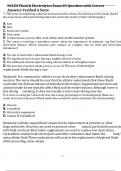
NCLEX Fluid & Electrolytes Exam 83 Question with Correct Answers Verified A Score
NCLEX Fluid & Electrolytes Exam 83 Question with Correct Answers Verified A Score 1. The nurse is completing a physical assessment with a client. On which part of the body should the nurse focus when determining fluid and electrolyte status? (Select all that apply.) A. Ears B. Skin C. Endocrine system D. Oral cavity E. Cardiovascular system: skin, oral cavity and cardiovascular system 2. The nurse is teaching a marathon runner about the importance of maintain- ing fluid and electrolyte balance. Which situation puts runners at a higher risk for fluid and electrolyte imbalances? A. The use of electrolyte replacement fluids during a race B. The significant loss of water during a lengthy exercise session C. The additional calcium taken by using calcium tablets to strengthen bones D. The increase of protein intake prior to a race: A. The use of electrolyte replacement fluids during a race Rationale: It is common for athletes to use electrolyte replacement fluids during exercise. The nurse should be sure that the athlete understands that these fluids could alter the delicate balance of individual electrolytes. Supplemental protein and calcium intake do not typically affect fluid and electrolyte balance. Although water is lost during sweating, it does not usually create issues during exercise. 3. A nurse is caring for a client who has lost a large percentage of circulating body fluids as a result of excessive diuresis. Which medication would the nurse anticipate this client needing? A. Diuretic B. Crystalloid C. Electrolyte supplement D. Colloid: B. Crystalloid Rationale: Colloids expand fluid volume by the replacement of proteins or other large molecules. Diuretics are used to promote urine output, particularly associated with fluid overload. Electrolyte supplements are used to replace lost electrolytes. Crystalloids contain both electrolytes and other substances that mimic the body's extracellular fluid. These medications will assist in the replacement of depleted fluids while promoting urine output. 4. The nurse is administering a blood transfusion to a client who is hemor- rhaging. In which fluid compartment should the nurse identify that the client is experiencing a deficit? A. Intravascular fluid B. Transcellular fluid C. Intracellular fluid D. Interstitial fluid: A. Intravascular fluid Rationale: Blood loss causes a deficit in the intravascular fluid compartment, which is a subcompartment of extracellular fluid (ECF). Transcellular and interstitial flui along with lymph, make up the other compartments of ECF. Intracellular fluid is the other major fluid compartment in the body. 5. The nurse reviews the care needs for a group of clients. Which condition should the nurse realize occurs from a fluid volume deficit? A. Diarrhea B. Water intoxication C. Kidney failure D. Hypertension: A. Diarrhea Rationale: Fluid volume deficit, or dehydration, can occur when excessive amou of fluids are lost through diarrhea or vomiting. Kidney failure causes water retention, leading to fluid volume excess, not deficit. Water intoxication results from excessive fluid intake and leads to fluid volume excess. Fluid volume excess, not deficit, ca result in hypertension. 6. The nurse is reviewing the fluid needs for a group of clients. Which charac- teristic of the intracellular fluid compartment of the body should the nurse identify? A. Makes about one third of total body fluid in adults B. Includes cerebrospinal and peritoneal fluids C. Serves as a medium for metabolic processes D. Divides into intravascular, interstitial, and transcellular fluid: sC. Serves as a medium for metabolic processes Rationale: The intracellular fluid compartment makes up about two thirds of total body fluid in adults and is found within cells. It is a medium for metabolic processes. Extracellular fluid makes up the other one third of total body fluid and is divided into intravascular, interstitial, and transcellular fluids. Cerebrospinal and peritoneal fluids are examples of transcellular fluids. 7. The nurse is preparing material on fluid compartments in the body. Which fluids should the nurse identify as the components of extracellular fluid? A. Intracellular, interstitial, and intravascular fluids B. Intravascular, interstitial, and intracellular fluids C. Intravascular, interstitial, and transcellular fluids D. Transcellular, intracellular, and extracellular fluid: sC. Intravascular, intersti- tial, and transcellular fluids Rationale: Body fluids found outside of the cell include intravascular, interstitial, and transcellular fluids. Conversely, intracellular fluids are found inside the cell. 8. The nurse prepares intravenous fluid for a client. Which mechanism should the nurse recall that represents the movement of fluid across cell membranes from an area of less concentration to an area of higher concentration? A. Diffusion B. Active transport C. Filtration D. Osmosis: D. Osmosis Rationale: Osmosis is the movement of water across cell membranes, from the less-concentrated solution to the more-concentrated solution. Filtration is the process by which fluid and solutes move together across a membrane from one compartment to another. Active transport is a process by which substances move across the cell membrane and must combine with a carrier for transportation, requiring metabolic energy. With diffusion, the molecules move from a solution of higher concentration to a solution of lower concentration. 9. The nurse is caring for a hospitalized client who is experiencing anxiety-re- lated hyperventilation. When calculating the client's intake and output, whe would the nurse anticipate the need for an adjustment in fluid loss? A. Insensible loss B. Feces C. Urine D. Sweat: A. Insensible loss Rationale: With increased respirations, the client will experience a greater-than-n mal insensible loss of fluid through the lungs. Hyperventilation will not affect the amount of fluid lost through the urine, sweat, or feces. 10. The nurse is determining a client's fluid balance. Which method should the nurse use to identify this client's fluid volume excess or deficit? A. Blood pressure B. Intake and output C. Skin turgor D. Daily weight: D. Daily weight Rationale: Daily weight is the best indicator of fluid volume excess or deficit. Skin turgor, blood pressure, and intake and output are assessments that would be included in the care of a client with fluid imbalances, but daily weight is the best indicator of changes in fluid status. 11. The nurse is performing an assessment on a client with fluid volume excess. Which finding should the nurse identify that supports fluid volume excess? (Select all that apply.) A .Tenting of skin B. Pitting edema C. Weight gain D. Thirst E. Crackles on auscultation: pitting edema, weight gain, crackles on auscultation Rationale: Pitting edema, weight gain, and crackles in the lungs upon auscultatio are indicative of fluid volume excess. Tenting of skin and thirst are found in fluid volume deficit. 12. The nurse is assessing a client with fluid volume deficit. Which finding should the nurse identify that supports fluid volume deficit? A. Increased hematocrit B. Wheezes upon auscultation C. Edema D. Weight gain: A. Increased hematocrit Rationale: Increased hematocrit is a finding consistent with fluid volume deficit. Edema and weight gain are consistent with fluid volume overload. Wheezes upon auscultation of the lungs is not related to fluid imbalances. 13. The nurse is teaching a client ways to prevent fluid imbalances. Which fluids should the nurse encourage the client to

Geschreven voor
- Instelling
- NCLEX Fluid & Electrolytes
- Vak
- NCLEX Fluid & Electrolytes
Documentinformatie
- Geüpload op
- 27 april 2024
- Aantal pagina's
- 25
- Geschreven in
- 2023/2024
- Type
- Tentamen (uitwerkingen)
- Bevat
- Vragen en antwoorden
Onderwerpen
-
nclex fluid electrolytes exam 83 question with c
-
1the nurse is completing a physical assessment w
-
2the nurse is teaching a marathon runner about t
-
3a nurse is caring for a client who has lost a l

Ook beschikbaar in voordeelbundel