
CASE 1
1. What is the structure of neurons and what types are there? (brief)
Roughly, there are three types of neurons:
• Sensory neurons
• Motor neurons
• Intermediate neurons
The sensory neurons and motor neurons also
consist of many different sorts, which can be
classified based on a lot of different
characteristics. For example based on their
number of neurites:
You can have uni-, bi- or multipolar neurons.
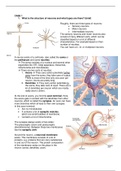
A neuron exists of a cell body, also called the soma or
the perikaryon and some neurites.
→ The soma consists of a nucleus and several other
organelles like: ER, Golgi apparatus, ribosomes,
mitochondria and microtubules.
→ There are two sorts of neurites:
1. Axons → They carry action potentials further
away from the soma, they take care of output.
There is most of the time only one axon per
neuron. Axons are pretty long.
2. Dendrites → They carry action potentials to
the soma, they take care of input. There are a
lot of dendrites per neuron which are mostly
really short (<2mm).
At the end of axons, you find the axon terminal. Here,
the axons gets in contact with the dendrites from other
neurons, which is called the synapse. An axon can have
more branches which all lead to their own synapse.
In this axon terminal:
• Are no microtubules
• It contains a lot of synaptic vesicles,
which are small bubbles of membrane.
• Contains a lot of mitochondria.
The synapse always exists of two sides:
The presynaptic (axon) and postsynaptic
(dendrite/soma). Between these two membranes
lies the synaptic cleft.
Around the neuron, a neuronal membrane
exists. This membrane consists of a lot of
proteins, e.g. proteins that can carry substances
in and out of the neuron. The protein composition
of the membrane varies on the place in the
neuron (soma, dendrites, axon).
, A neuron has a pretty characteristic shape, which is formed by the
cytoskeleton. This cytoskeleton exists of three sorts of ‘bones’ which
are:
• Microtubules → they run longitudinally down neurites. A
microtubule is formed out of lots of the same protein called tubulin.
• Microfilaments → Are found everywhere in the neuron. Made
out of polymers of actin.
• Neurofilaments → These are also intermediate filaments but in
neurons they are called this.
Another important thing about neurons is that
they are most of the time accompanied by glial
cells. In the case of action potential conduction,
Schwann cells and oligodendroglia play an
important role. These form myelin sheets over
the neurites of neurons, to fasten the conduction.
2. How is an action potential (AP) formed?
An action potential lasts about 2 (msec.) and consists of different phases:
1. Rising phase → A rapid depolarization of the membrane → When the inside of the
membrane has a negative electrical potential, there is a large driving force on N+ ions.
Therefore, Na+ ions rush into the cell through the open sodium channels, causing the
membrane to rapidly depolarize.
2. Overshoot → Part where the inside of neuron is positively charged with respect to
outside → Because the relative permeability of the membrane greatly favors sodium,
the membrane potential goes to a value close to ENa, which is greater than 0 mV.
3. Falling phase → Rapid repolarization until the membrane is more negative than
resting potential → Two channels are involved in this phase:
a. First, the voltage-gated sodium channels inactivate.
b. Second, the voltage-gated potassium channels finally open (triggered to do so
1 msec earlier by the depolarization of the membrane). There is a great
driving force on K+ ions when the membrane is strongly depolarized.
Therefore, K+ ions rush out of the cell through the open channels, causing the
membrane potential to become negative again.
4. Undershoot / After-hyperpolarization → The last part of the falling phase → The
open voltage-gated potassium channels add to the resting potassium membrane
permeability. Because there is very little sodium permeability, the membrane potential
, goes toward EK, causing a hyperpolarization relative to the resting membrane
potential until the voltage gated potassium channels close again.
5. Absolute refractory period → Gradual restoration of the resting potential → Sodium
channels inactivate when the membrane becomes strongly depolarized. They cannot
be activated again, and another action potential cannot be generated, until the
membrane potential goes sufficiently negative to deinactivate the channels.
6. Relative refractory period → Hyperpolarization → The membrane potential stays
hyperpolarized until the voltage-gated potassium channels close. Therefore, more
depolarizing current is required to bring the membrane potential to threshold.
Here, the threshold is the critical level of depolarization of a membrane that must be
crossed in order to trigger an action potential.
→ This depolarization can be caused by different things.
• Mostly by Na+ influx in channels sensitive to neurotransmitters.
• By injecting electrical current through a microelectrode.
, In a neuron, there are sodium and potassium channels and a sodium-potassium-pump,
which are responsible for generating an action potential. Via influx and efflux of Na+ and K+
the Vm will change:
The channels seen in the pictures above are also called voltage-gated sodium channels
and voltage-gated potassium channels. These are both pretty complex mechanisms:
Voltage-gated sodium channels
→ These are channels that are highly selective to Na+ ions. They can be opened or
closed by changing the electrical potential of the membrane (Vm)
Structure
The channel is made out of a single (long) polypeptide, which has four domains (I-IV).
The domains are together in a way, that they form a closed pore. Each domain
consists of 6 alpha helices (S1-6). S4 contains a voltage sensor and the pore loop
which, together with the 3 other pore loops is called the selectivity filter.
1. What is the structure of neurons and what types are there? (brief)
Roughly, there are three types of neurons:
• Sensory neurons
• Motor neurons
• Intermediate neurons
The sensory neurons and motor neurons also
consist of many different sorts, which can be
classified based on a lot of different
characteristics. For example based on their
number of neurites:
You can have uni-, bi- or multipolar neurons.
A neuron exists of a cell body, also called the soma or
the perikaryon and some neurites.
→ The soma consists of a nucleus and several other
organelles like: ER, Golgi apparatus, ribosomes,
mitochondria and microtubules.
→ There are two sorts of neurites:
1. Axons → They carry action potentials further
away from the soma, they take care of output.
There is most of the time only one axon per
neuron. Axons are pretty long.
2. Dendrites → They carry action potentials to
the soma, they take care of input. There are a
lot of dendrites per neuron which are mostly
really short (<2mm).
At the end of axons, you find the axon terminal. Here,
the axons gets in contact with the dendrites from other
neurons, which is called the synapse. An axon can have
more branches which all lead to their own synapse.
In this axon terminal:
• Are no microtubules
• It contains a lot of synaptic vesicles,
which are small bubbles of membrane.
• Contains a lot of mitochondria.
The synapse always exists of two sides:
The presynaptic (axon) and postsynaptic
(dendrite/soma). Between these two membranes
lies the synaptic cleft.
Around the neuron, a neuronal membrane
exists. This membrane consists of a lot of
proteins, e.g. proteins that can carry substances
in and out of the neuron. The protein composition
of the membrane varies on the place in the
neuron (soma, dendrites, axon).
, A neuron has a pretty characteristic shape, which is formed by the
cytoskeleton. This cytoskeleton exists of three sorts of ‘bones’ which
are:
• Microtubules → they run longitudinally down neurites. A
microtubule is formed out of lots of the same protein called tubulin.
• Microfilaments → Are found everywhere in the neuron. Made
out of polymers of actin.
• Neurofilaments → These are also intermediate filaments but in
neurons they are called this.
Another important thing about neurons is that
they are most of the time accompanied by glial
cells. In the case of action potential conduction,
Schwann cells and oligodendroglia play an
important role. These form myelin sheets over
the neurites of neurons, to fasten the conduction.
2. How is an action potential (AP) formed?
An action potential lasts about 2 (msec.) and consists of different phases:
1. Rising phase → A rapid depolarization of the membrane → When the inside of the
membrane has a negative electrical potential, there is a large driving force on N+ ions.
Therefore, Na+ ions rush into the cell through the open sodium channels, causing the
membrane to rapidly depolarize.
2. Overshoot → Part where the inside of neuron is positively charged with respect to
outside → Because the relative permeability of the membrane greatly favors sodium,
the membrane potential goes to a value close to ENa, which is greater than 0 mV.
3. Falling phase → Rapid repolarization until the membrane is more negative than
resting potential → Two channels are involved in this phase:
a. First, the voltage-gated sodium channels inactivate.
b. Second, the voltage-gated potassium channels finally open (triggered to do so
1 msec earlier by the depolarization of the membrane). There is a great
driving force on K+ ions when the membrane is strongly depolarized.
Therefore, K+ ions rush out of the cell through the open channels, causing the
membrane potential to become negative again.
4. Undershoot / After-hyperpolarization → The last part of the falling phase → The
open voltage-gated potassium channels add to the resting potassium membrane
permeability. Because there is very little sodium permeability, the membrane potential
, goes toward EK, causing a hyperpolarization relative to the resting membrane
potential until the voltage gated potassium channels close again.
5. Absolute refractory period → Gradual restoration of the resting potential → Sodium
channels inactivate when the membrane becomes strongly depolarized. They cannot
be activated again, and another action potential cannot be generated, until the
membrane potential goes sufficiently negative to deinactivate the channels.
6. Relative refractory period → Hyperpolarization → The membrane potential stays
hyperpolarized until the voltage-gated potassium channels close. Therefore, more
depolarizing current is required to bring the membrane potential to threshold.
Here, the threshold is the critical level of depolarization of a membrane that must be
crossed in order to trigger an action potential.
→ This depolarization can be caused by different things.
• Mostly by Na+ influx in channels sensitive to neurotransmitters.
• By injecting electrical current through a microelectrode.
, In a neuron, there are sodium and potassium channels and a sodium-potassium-pump,
which are responsible for generating an action potential. Via influx and efflux of Na+ and K+
the Vm will change:
The channels seen in the pictures above are also called voltage-gated sodium channels
and voltage-gated potassium channels. These are both pretty complex mechanisms:
Voltage-gated sodium channels
→ These are channels that are highly selective to Na+ ions. They can be opened or
closed by changing the electrical potential of the membrane (Vm)
Structure
The channel is made out of a single (long) polypeptide, which has four domains (I-IV).
The domains are together in a way, that they form a closed pore. Each domain
consists of 6 alpha helices (S1-6). S4 contains a voltage sensor and the pore loop
which, together with the 3 other pore loops is called the selectivity filter.





