

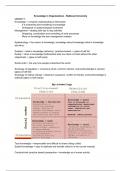
Knowledge in Organisations - Radboud University
Lecture 1:
Knowledge = a shared understanding of information
- It is everything and everything is knowledge
- Ontological or epistemological incoherent
Management = dealing with day to day activities
- Designing, coordination and controlling of work processes
- More on knowledge the less management matters
Epistemology = the nature of knowledge, knowledge about knowledge (what is knowledge
and why)
Dualism = what is knowledge (either/or) (practice-based) -> glass is half full
Duality = when is knowledge (both/and/as well) one does not exist without the other
(objectivist) -> glass is half empty
Social order = the way how people understand the world
Sociology of regulation = consensus (trust, common interest, science/knowledge is neutral)
(glass is half full)
Sociology of radical change = dissensus (suspicion, conflict of interest, science/knowledge is
political) (glass is half empty)
Tacit knowledge = inexpressible and difficult to share (riding a bike)
Explicit knowledge = easy to replicate and transfer (what is in the course manual)
Constructivist (practice based) perspective = knowledge as a human activity
,Critical discourse = dualism, knowledge is an object, connects political issue
Dialogical discourse = knowledge is discipline (step app,10.000 steps), power/knowledge
Leveraging = achieving efficiency
Expanding = incremental innovation by bringing existing expertise in
Appropriating = building up a new knowledge domain
Probing = radical innovation
Alvesson and Karreman:
The mode of managerial intervention = strength of managerial control
The medium of interaction = the division in management systems focussed on controlling
behavior and workers attitudes
Typology of knowledge management
Extended library = creating a central database and archive
Community = encourage the direct sharing of knowledge
Normative control = values and rewards employee participation
Enacted blueprint = dissemination of best practice ways at work
Knowledge intensive firms = when most work is of intellectual nature with well qualified
employees
, Lecture 2:
Define what a discourse is about -> explain definition based on the epistemology and
social order dimensions
The neo-functionalist discourse
- Epistemological dimension -> knowledge can be measured (what is knowledge)
- You have knowledge or you do not (either/ or)
- Dualism -> the world can be completely be knowable
- Based on categories from a dualism point of view
- The basis for commensuration (transformation of qualities into quantities)
- Commensuration example = your paycheck should commensurate with the amount
of time worked
- Social order dimension ->
- Consensus -> there is trust, people have a common interest, Science and knowledge
is neutral
Objectivist perspective on KM
- Explicit knowledge over tacit knowledge -> easier to manage
- Based on positivist philosophy
- Structuring knowledge
- AI /ICT plays a key role
Neo-functionalist perspective on KM
- Knowledge is neutral
- Knowledge is an asset for organizations
- Aim to achieve an optimal allocation of resources
- Focus on optimizing knowledge processes
- Codification of knowledge (categories)
- Data produces knowledge (omniscience)
- Data lowers insecurity
- Knowledge from data solves problems (omnipotence)
- Striving for more efficiency is a good thing
Knowledge based theory of the firm
- Knowledge as a strategic resource to achieve a competitive advantage
- VRIO
- Interests of workers, managers and owners are alike to achieve a goal
Knowledge- intensive firms
- Intellectual nature and well-qualified employees
3 dimensions:
- Knowledge intensity ->needed for creation of outputs
- Low capital intensity-> not dependent upon non-human assets (factories)
- Workforce is professionalized
Lecture 1:
Knowledge = a shared understanding of information
- It is everything and everything is knowledge
- Ontological or epistemological incoherent
Management = dealing with day to day activities
- Designing, coordination and controlling of work processes
- More on knowledge the less management matters
Epistemology = the nature of knowledge, knowledge about knowledge (what is knowledge
and why)
Dualism = what is knowledge (either/or) (practice-based) -> glass is half full
Duality = when is knowledge (both/and/as well) one does not exist without the other
(objectivist) -> glass is half empty
Social order = the way how people understand the world
Sociology of regulation = consensus (trust, common interest, science/knowledge is neutral)
(glass is half full)
Sociology of radical change = dissensus (suspicion, conflict of interest, science/knowledge is
political) (glass is half empty)
Tacit knowledge = inexpressible and difficult to share (riding a bike)
Explicit knowledge = easy to replicate and transfer (what is in the course manual)
Constructivist (practice based) perspective = knowledge as a human activity
,Critical discourse = dualism, knowledge is an object, connects political issue
Dialogical discourse = knowledge is discipline (step app,10.000 steps), power/knowledge
Leveraging = achieving efficiency
Expanding = incremental innovation by bringing existing expertise in
Appropriating = building up a new knowledge domain
Probing = radical innovation
Alvesson and Karreman:
The mode of managerial intervention = strength of managerial control
The medium of interaction = the division in management systems focussed on controlling
behavior and workers attitudes
Typology of knowledge management
Extended library = creating a central database and archive
Community = encourage the direct sharing of knowledge
Normative control = values and rewards employee participation
Enacted blueprint = dissemination of best practice ways at work
Knowledge intensive firms = when most work is of intellectual nature with well qualified
employees
, Lecture 2:
Define what a discourse is about -> explain definition based on the epistemology and
social order dimensions
The neo-functionalist discourse
- Epistemological dimension -> knowledge can be measured (what is knowledge)
- You have knowledge or you do not (either/ or)
- Dualism -> the world can be completely be knowable
- Based on categories from a dualism point of view
- The basis for commensuration (transformation of qualities into quantities)
- Commensuration example = your paycheck should commensurate with the amount
of time worked
- Social order dimension ->
- Consensus -> there is trust, people have a common interest, Science and knowledge
is neutral
Objectivist perspective on KM
- Explicit knowledge over tacit knowledge -> easier to manage
- Based on positivist philosophy
- Structuring knowledge
- AI /ICT plays a key role
Neo-functionalist perspective on KM
- Knowledge is neutral
- Knowledge is an asset for organizations
- Aim to achieve an optimal allocation of resources
- Focus on optimizing knowledge processes
- Codification of knowledge (categories)
- Data produces knowledge (omniscience)
- Data lowers insecurity
- Knowledge from data solves problems (omnipotence)
- Striving for more efficiency is a good thing
Knowledge based theory of the firm
- Knowledge as a strategic resource to achieve a competitive advantage
- VRIO
- Interests of workers, managers and owners are alike to achieve a goal
Knowledge- intensive firms
- Intellectual nature and well-qualified employees
3 dimensions:
- Knowledge intensity ->needed for creation of outputs
- Low capital intensity-> not dependent upon non-human assets (factories)
- Workforce is professionalized



