EXAMFX PROPERTY AND CASUALTY EXAM PREP QUESTIONS AND ANSWERS 2024.
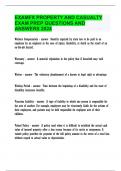
Workers Compensation Benefits required by state law to be paid to an employee by an employer in the case of injury, disability, or death as the result of an on-the-job hazard. Warranty A material stipulation in the policy that if breached may void coverage. Waiver The voluntary abandonment of a known or legal right or advantage. Waiting Period Time between the beginning of a disability and the start of disability insurance benefits. Vicarious Liability A type of liability in which one person is responsible for the acts of another. For example, employers may be vicariously liable for the actions of their employees, and parents may be held responsible for negligent acts of their children. Valued Policy A policy used when it is difficult to establish the actual cash value of insured property after a loss occurs because of its rarity or uniqueness. A valued policy provides for payment of the full policy amount in the event of a total loss without regard to actual value or depreciation. Vacant A property that has no contents, furnishings, or occupants. Upmost Good Faith The fair and equal bargaining by both parties in forming the contract, where the applicant must make full disclosure of risk to the company, and the insurance company must be fair in underwriting the risk. Unoccupied A property that has contents or furnishings in it, but is not being used or lived in. Unintentional Tort The result of acting without proper care, generally referred to as negligence. Uninsured Motorist Coverage Coverage that allows the named insured, resident relative(s) and passengers in a covered auto to collect sums another driver would be legally liable to pay for bodily injury resulting from an auto accident, providing the accident was caused by an uninsured motorist, a hit-and-run driver or a driver whose insurance company is insolvent. Underinsured Motorist Coverage Coverage in an automobile insurance policy under which the insurer will pay costs up to specified limits for bodily injury, if the liable driver's policy limits are exhausted and he/she cannot pay the full amount for which he or she is liable. Unilateral Contract A contract that legally binds only one party to contractual obligations after the premium is paid. Underwriting The process of reviewing, accepting or rejecting applications for insurance. Underwriter A person who evaluates and classifies risks to accept or reject them on behalf of the insurer. Unauthorized Insurer An insurance company that has not applied, or has applied and been denied a Certificate of Authority. Umbrella Liability Coverage Coverage that provides extra protection against liability, and excess amount of insurance above the primary policy. Twisting A form of misrepresentation in which an agent persuades an insured/owner to cancel, lapse, or switch policies, even when it's to the insured's disadvantage. Transfer A basic principle of insurance under which the risk of financial loss is assigned to another party. Tort A wrongful act or the violation of someone's rights that leads to legal liability. Torts are classified as intentional or unilateral (referred to as negligence). Third-Party Provisions Insurance provisions that address the rights of someone other than the policyowner to have a secured financial interest in the insured property. Theft Any act of stealing or removing property from its rightful owner. Theft encompasses both burglary and robbery. Surplus Lines Insurance for which there is no readily available, admitted market. Surety Bond A guarantee that debts and obligations will be carried out, and the benefits will be paid for losses caused by nonperformance. Superintendent (Commissioner, Director) The head of the state department of insurance. Subrogation The acquisition by an insurer of an insured's rights against any third party for indemnification of loss or other payment, to the extent that the insurer pays the loss. Strict Liability A liability that refers to damages caused by defective products even though the manufacturer's fault or negligence cannot be proven. Stock Companies Companies owned by the stockholders whose investments provide the capital necessary to establish and operate the insurance company. Statute Law The written law as enacted by a legislative body (i.e. the laws of the state), which generally takes precedence in cases where both common law and statute law apply. Stated Amount An amount of insurance scheduled in a property policy which is not subject to any coinsurance requirements in the event of a covered loss. Split Separately stated limits of liability for different coverage, which may be stated on a per person, per occurrence, per policy period basis, or can be divided between bodily injury and property damage. Speculative Risk The uncertainty or chance of a loss occurring in a situation that involves the opportunity for either loss or gain. Specific Insurance A property insurance policy that covers a specific kind or unit of property for a specific amount of insurance. Sharing A method of dealing with risk for a group of individual persons or businesses with the same or similar exposure to loss who share the losses that occur within that group. Severability of Interests A provision that insurance applies separately to each insured in a policy, treating each individual as the only insured. Settlement The process by which an agreement is reached and a claim is reached and a claim is resolved in liability insurance. Salvage The amount of money realized from the sale of damaged merchandise or property. A salvage clause is found in ocean marine insurance and usually states that the rescuers of a ship are entitled to the salvage of the ship and cargo. Robbery The taking of property from a person's possession by using force or the threat of violence. Pure Risk The uncertainty or chance of a loss occurring in a situation that can only result in a loss or no change. Risk Uncertainty as to the outcome of an event when two or more possibilities exist. Right of Salvage A provision in property insurance policy requiring that after payment of a total loss to insured property, the insured must transfer the title (or ownership) to the property to the insurer. Retrospective Rating A self-rating plan under which the actual losses during the policy period determine the final premium (subject to a minimum and maximum premium). Retention A method of dealing with risk by intentionally or unintentionally keeping a portion of it for the insured's account; the amount of responsibility assumed but not reinsured by the insurance company. Representations Statements made by the applicant on the insurance application that are believed to be true, but are not guaranteed to be true. Replacement Cost The cost to replace damaged property with like kind and quality at current price, without any deduction for depreciation. Reinsurance A form of insurance whereby one insurance company (the reinsurer) in consideration of a premium paid to it, agrees to indemnify another insurance company (the ceding company) for part or all of its liabilities from insurance policies it has issued. Reduction Lessening the possibility or severity of a loss. Reciprocal Insurance resulting from an interchange of reciprocal agreements of indemnity among persons known as subscribers. Rebating Any inducement offered in the sale of insurance products that is not specified in the policy. Proximate Cause Any act or event that is the immediate or actual cause of a loss. Property Damage Liability Legal liability arising from physical damage to tangible property of others caused by the negligence of an insured. Proof of Loss A sworn statement that must usually be furnished by the insured to an insurer before any loss under a policy c

Geschreven voor
- Instelling
- Property & Casualty
- Vak
- Property & Casualty
Documentinformatie
- Geüpload op
- 16 april 2024
- Aantal pagina's
- 51
- Geschreven in
- 2023/2024
- Type
- Tentamen (uitwerkingen)
- Bevat
- Vragen en antwoorden
Onderwerpen
-
examfx property and casualty exam prep questions

Ook beschikbaar in voordeelbundel