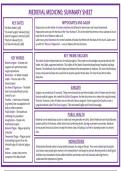
MEDIEVAL MEDICINE: SUMMARY SHEET
KEY DATES HIPPOCRATES AND GALEN
The Black Death (1348) Hippocrates was the father of modern medicine; he believed in observation and natural treatments.
‘The Great Surgery’ released (1363) Hippocrates came up with the idea of the ‘Four Humours’. This is the belief that there are four substances in our
Guild of Surgeons is formed (1368) body that if out of balance, make us ill.
‘Practica’ released (1376) Galen was a great showman who wrote hundreds of books that fitted with the ideas of the church. Galen came
£20 fines introduced (1388) up with the ‘Theory of Opposites’ – a way to balance the four humours.
KEY WORDS KEY THEME: RELIGION
The Islamic Empire helped make lots of medical progress. They made sure knowledge was preserved and their
Barber-surgeon – A barber and
leader, the Caliph, supported medicine. The Caliphs of the Islamic Empire developed major hospitals and large
surgeon who performed minor
libraries. The Medieval Church both helped and hindered the development of medicine. The church built leprosy
surgical procedures
houses and preserved ideas but would not let anyone question these ideas. The church also did not allow
Bimaristan – An Islamic hospital
dissection.
Caliph – The one ruler of the
Islamic Empire
Doctrine of Signatures – The belief SURGERY
that God created illness but also Surgery was created out of necessity. Things were invented as and when needed. John of Ardene was the most
created a cure famous medical surgeon. He created the Guild of Surgeons. He then also went on to release his surgical manual,
Poultice – A soft mass of material ‘Practica’. However, John of Ardene was not the only famous surgeon. French surgeon De Chauliac wrote a
(e.g herbs) that was applied to the surgical textbook called ‘The Great Surgery’. This dominated English and French knowledge.
body to relieve soreness
Public Health – The health and
wellbeing of a population PUBLIC HEALTH
Gongfarmers – People who Medieval towns needed easy access to water and were generally very dirty. Some Medieval towns had elaborate
maintained cesspits systems built by the Romans, whilst others had overflowing drains, leaving excrement everywhere. Medieval
Bubonic Plague – Plague spread by towns passed various local laws to keep the streets clean, including a £20 fine for dumping waste in a stream /
a flea bite river.
Pneumonic Plague – Plague spread
by breathing in germs from the MONASTERIES
infected lungs of a bubonic plague
Monasteries allowed monks to keep healthy because of a range of factors. They were isolated and located in
victim
rural areas; many people gave money to the monasteries in exchange for prayers allowing monks to build good
Buboes – Lumps, these were a
facilities; most monasteries had excellent facilities; and monks were well educated, allowing them to
symptom of the Black Death
understand the importance of germs.
KEY DATES HIPPOCRATES AND GALEN
The Black Death (1348) Hippocrates was the father of modern medicine; he believed in observation and natural treatments.
‘The Great Surgery’ released (1363) Hippocrates came up with the idea of the ‘Four Humours’. This is the belief that there are four substances in our
Guild of Surgeons is formed (1368) body that if out of balance, make us ill.
‘Practica’ released (1376) Galen was a great showman who wrote hundreds of books that fitted with the ideas of the church. Galen came
£20 fines introduced (1388) up with the ‘Theory of Opposites’ – a way to balance the four humours.
KEY WORDS KEY THEME: RELIGION
The Islamic Empire helped make lots of medical progress. They made sure knowledge was preserved and their
Barber-surgeon – A barber and
leader, the Caliph, supported medicine. The Caliphs of the Islamic Empire developed major hospitals and large
surgeon who performed minor
libraries. The Medieval Church both helped and hindered the development of medicine. The church built leprosy
surgical procedures
houses and preserved ideas but would not let anyone question these ideas. The church also did not allow
Bimaristan – An Islamic hospital
dissection.
Caliph – The one ruler of the
Islamic Empire
Doctrine of Signatures – The belief SURGERY
that God created illness but also Surgery was created out of necessity. Things were invented as and when needed. John of Ardene was the most
created a cure famous medical surgeon. He created the Guild of Surgeons. He then also went on to release his surgical manual,
Poultice – A soft mass of material ‘Practica’. However, John of Ardene was not the only famous surgeon. French surgeon De Chauliac wrote a
(e.g herbs) that was applied to the surgical textbook called ‘The Great Surgery’. This dominated English and French knowledge.
body to relieve soreness
Public Health – The health and
wellbeing of a population PUBLIC HEALTH
Gongfarmers – People who Medieval towns needed easy access to water and were generally very dirty. Some Medieval towns had elaborate
maintained cesspits systems built by the Romans, whilst others had overflowing drains, leaving excrement everywhere. Medieval
Bubonic Plague – Plague spread by towns passed various local laws to keep the streets clean, including a £20 fine for dumping waste in a stream /
a flea bite river.
Pneumonic Plague – Plague spread
by breathing in germs from the MONASTERIES
infected lungs of a bubonic plague
Monasteries allowed monks to keep healthy because of a range of factors. They were isolated and located in
victim
rural areas; many people gave money to the monasteries in exchange for prayers allowing monks to build good
Buboes – Lumps, these were a
facilities; most monasteries had excellent facilities; and monks were well educated, allowing them to
symptom of the Black Death
understand the importance of germs.