Organization Development Lecture Summary
Lecture 1 Introduction to Organization
Development
Organization Development is the long-
range effort to improve
1) An organization’s and system’s
problem-solving capabilities
2) Its abilities to cope with
changes in the external
environment
With the help of external or internal
behavioural-scientist consultants or
change agents
Characteristics of OD
Planned
Effectiveness
Scientific approach
Systematic approach
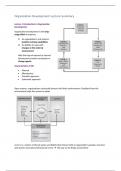
Open systems: organizations continually interact with their environments. Feedback from the
environment helps the system to adapt.
Culture is a system of shared values and beliefs that interact with an organization’s people, structure
and systems to produce behavioural norms ‘the way we do things around here’
,It includes:
Artifacts: clothes,
language, behaviours
Norms and values:
unwritten rules
Deep assumptions
Lecture 2: Understanding OD process, resistance to change and interventions
The intervention strategy
Concrete agreements about which functions are eligible for diversity candidates.
A temporary project organisation that actively intervenes in recruitment and selection procedures,
advising and monitoring.
The project organisation is given the power to intervene
Diagnosis = a systematic approach to understanding and describing the present state of the
organisation. The purpose of the diagnostic phase is
To gather information to specify the exact nature of the problem requiring solution
To identify the underlying causal forces
To provide a basis for selecting effective change strategies and techniques
Diagnosis is a cyclical process that involves data gathering, interpretations, and identification of
problem areas and possible action programs.
Data collection
Step 1: define objectives of the
change program (session of interview
with key members of the
organization)
Step 2: selection of key factors
(central variables involved)
, Step 3: selection of data gathering method ( e.g. secondary data, survey, sociometric
approach, direct observation, interviewing)
Diagnostic models
1. Analytical model (difference-integration model): relations among departments
2. The sociotechnical systems model (Eric Trist Tavistock Institute)
= a social system consisting of the network of interpersonal relationships and a technological
system consisting of the task, activities and tools used to accomplish the organization’s purpose
The social system and the technological system are interrelated and interdependent. The
diagnosis determines how they interrelate, with emphasis on the feedback or lack of
feedback between various subsystems.
3. The Force-Field Analysis Model (Kurt Lewin, Tavistock):
Organizational behaviour is a dynamic balance of forces working in opposite directions.
Restraining forces = forces acting to keep the organization stable. They put pressure on the
organization not to change.
Driving forces = put pressure on the organization to change
If the forces for and against change are equal, the result is equilibrium and the organizations
remains stable
Resistance to change
On a personal level, change represent the alternation of set patterns of behaviour, defines
relationships with others, work procedures and job skills
Lecture 1 Introduction to Organization
Development
Organization Development is the long-
range effort to improve
1) An organization’s and system’s
problem-solving capabilities
2) Its abilities to cope with
changes in the external
environment
With the help of external or internal
behavioural-scientist consultants or
change agents
Characteristics of OD
Planned
Effectiveness
Scientific approach
Systematic approach
Open systems: organizations continually interact with their environments. Feedback from the
environment helps the system to adapt.
Culture is a system of shared values and beliefs that interact with an organization’s people, structure
and systems to produce behavioural norms ‘the way we do things around here’
,It includes:
Artifacts: clothes,
language, behaviours
Norms and values:
unwritten rules
Deep assumptions
Lecture 2: Understanding OD process, resistance to change and interventions
The intervention strategy
Concrete agreements about which functions are eligible for diversity candidates.
A temporary project organisation that actively intervenes in recruitment and selection procedures,
advising and monitoring.
The project organisation is given the power to intervene
Diagnosis = a systematic approach to understanding and describing the present state of the
organisation. The purpose of the diagnostic phase is
To gather information to specify the exact nature of the problem requiring solution
To identify the underlying causal forces
To provide a basis for selecting effective change strategies and techniques
Diagnosis is a cyclical process that involves data gathering, interpretations, and identification of
problem areas and possible action programs.
Data collection
Step 1: define objectives of the
change program (session of interview
with key members of the
organization)
Step 2: selection of key factors
(central variables involved)
, Step 3: selection of data gathering method ( e.g. secondary data, survey, sociometric
approach, direct observation, interviewing)
Diagnostic models
1. Analytical model (difference-integration model): relations among departments
2. The sociotechnical systems model (Eric Trist Tavistock Institute)
= a social system consisting of the network of interpersonal relationships and a technological
system consisting of the task, activities and tools used to accomplish the organization’s purpose
The social system and the technological system are interrelated and interdependent. The
diagnosis determines how they interrelate, with emphasis on the feedback or lack of
feedback between various subsystems.
3. The Force-Field Analysis Model (Kurt Lewin, Tavistock):
Organizational behaviour is a dynamic balance of forces working in opposite directions.
Restraining forces = forces acting to keep the organization stable. They put pressure on the
organization not to change.
Driving forces = put pressure on the organization to change
If the forces for and against change are equal, the result is equilibrium and the organizations
remains stable
Resistance to change
On a personal level, change represent the alternation of set patterns of behaviour, defines
relationships with others, work procedures and job skills