Financial Accounting summary
Chapter 1: financial statements and business decisions
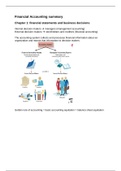
Internal decision makers managers (management accounting)
External decision makers stockholders and creditors (financial accounting)
The accounting system collects and processes financial information about an
organization and reports that information to decision makers.
Golden rule of accounting = basic accounting equitation = balance sheet equitation
, The 4 basic financial statements
1. Balance sheet: report the economic resources a company owns, and the
sources of financing for those sources.
2. Income statement: company’s ability to sell goods for more than their cost to
produce and sell.
3. Statement of stockholders’ equity: company’s additional contributions or
payments to investors, and the amount of income the company reinvested for
future growth.
4. Statement of cash flows: company reports its ability to generate cash and how
it was used.
Before you start, ALWAYS make up the heading with those 4 items:
1. Name of entity (Coca-Cola)
2. Title of statement (Balance sheet)
3. Specific date of statement (At December 31, 2012)
4. Unit of measure (in millions of dollars)
Balance sheet
Balance sheet = reports the amount of assets, liabilities and stockholders’ equity of
an accounting entity at a point in time.
Accounting entity = the organization for which financial data is collected.
Assets Liabilities
Short-term Short-term
Cash Accounts payable
Short-term investment Accrued expenses
Accounts receivable Notes payable
Notes receivable Taxes payable
Inventory (to be sold) Unearned revenue
Prepaid expenses Long-term
Supplies Long-term loans (5-20 years)
Long-term Mortgage (bank financed your
Chapter 1: financial statements and business decisions
Internal decision makers managers (management accounting)
External decision makers stockholders and creditors (financial accounting)
The accounting system collects and processes financial information about an
organization and reports that information to decision makers.
Golden rule of accounting = basic accounting equitation = balance sheet equitation
, The 4 basic financial statements
1. Balance sheet: report the economic resources a company owns, and the
sources of financing for those sources.
2. Income statement: company’s ability to sell goods for more than their cost to
produce and sell.
3. Statement of stockholders’ equity: company’s additional contributions or
payments to investors, and the amount of income the company reinvested for
future growth.
4. Statement of cash flows: company reports its ability to generate cash and how
it was used.
Before you start, ALWAYS make up the heading with those 4 items:
1. Name of entity (Coca-Cola)
2. Title of statement (Balance sheet)
3. Specific date of statement (At December 31, 2012)
4. Unit of measure (in millions of dollars)
Balance sheet
Balance sheet = reports the amount of assets, liabilities and stockholders’ equity of
an accounting entity at a point in time.
Accounting entity = the organization for which financial data is collected.
Assets Liabilities
Short-term Short-term
Cash Accounts payable
Short-term investment Accrued expenses
Accounts receivable Notes payable
Notes receivable Taxes payable
Inventory (to be sold) Unearned revenue
Prepaid expenses Long-term
Supplies Long-term loans (5-20 years)
Long-term Mortgage (bank financed your