ORGB 364 – Glossary Study Guide
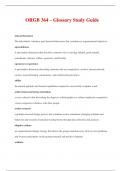
ORGB 364 – Glossary Study Guide task performance The individual's voluntary goal-directed behaviours that contribute to organizational objectives. agreeableness A personality dimension that describes someone who is trusting, helpful, good natured, considerant, tolerant, selfless, generous, and flexible. openness to experience A personality dimension describing someone who are imaginative, creative, unconventional, curious, nonconforming, autonomous, and aesthetically perceptive. ability the natural aptitudes and learned capabilities required to successfully complete a task achievement-nurturing orientation a cross-cultural value describing the degree to which people in a culture emphasize competitive versus cooperative relations with other people action research a problem-focused change process that combines action orientation (changing attitudes and behavior) and research orientation (testing theory through data collection and analysis) adaptive culture an organizational change strategy that directs the groups attention away from its own problems and focuses participants on the groups potential and positive elements artifacts the observable symbols and signs of an organization's culture attitudes the cluster of beliefs, assessed feelings, and behavioral intentions toward a person, object, or event (called an attitude object) Attraction-Selection-Attrition (ASA) Framework a theory which states that organizations have a natural tendency to attract, select, and retain people with values and personality characteristics that are consistent with the organization's character resulting in a more homogeneous organization and a stronger culture attribution process the perceptual process of deciding whether an observed behavior or event is caused largely by internal or external factors Authentic Leadership the view that effective leaders need to be aware of, feel comfortable with, and act consistently with their values, personality, and self-concept availability heuristic a natural tendency to assign higher probabilities to objects or events that are easier to recall from memory, even though ease of recall is also affected by non-probability factors (eg emotional response, recent events). best alternative to a negotiated agreement (BATNA) the best outcome you might achieve through some other course of action if you abandon the current negotiation bicultural audit a process of diagnosing cultural relations between companies and determining the extent to which cultural clashes will likely occur bounded rationality the view that people are bounded in their decision-making capabilities, including access to limited information, limited information processing, and tendency toward satisficing rather than maximizing when making choices Brainstorming a freewheeling, face-to-face meeting where team members aren't allowed to criticize but are encouraged to speak freely, generate as many ideas as possible, and build on the ideas of others brainwriting a variation of brainstorming whereby participants write (rather than speak about) and share their ideas brooks's law the principle that adding more people to a late software project only makes it later categorical thinking organizing people and objects into preconceived categories that are stored in our long-term memory Centrality a contingency of power pertaining to the degree and nature of interdependence between the power holders and others Centralization the degree to which decision-making authority is held by a small group of people, typically those at the top of the organizational hierarchy

Geschreven voor
- Instelling
- ORGB 364
- Vak
- ORGB 364
Documentinformatie
- Geüpload op
- 6 april 2024
- Aantal pagina's
- 31
- Geschreven in
- 2023/2024
- Type
- Tentamen (uitwerkingen)
- Bevat
- Vragen en antwoorden
Onderwerpen
-
orgb 364 glossary study guide

Ook beschikbaar in voordeelbundel