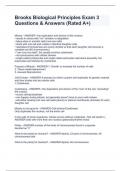
Brooks Biological Principles Exam 3 Questions & Answers (Rated A+)
Brooks Biological Principles Exam 3 Questions & AnsweMitosis - ANSWER-• the duplication and division of the nucleus • results in clones with *no* variation or adaptation • takes place in somatic cells (non-sex cells) • starts with one cell and creates 2 identical daughter cells • replicated chromosomes are evenly divided so that each daughter cell receives a complete set (46 chromosomes) • *can occur by itself*, but usually involves cytokinesis • not synonymous with cellular division • single-celled prokaryotes and single celled eukaryotes reproduce asexually, but eukaryotes are followed by cytokinesis Purpose of Mitosis - ANSWER-1. Growth: to increase the number of cells 2. Tissue repair/replacement 3. Asexual Reproduction Cell Division - ANSWER-A process by which a parent cell duplicates its genetic material and then divides into two similar cells = Cytokinesis Cytokinesis - ANSWER-• the duplication and divison of the *rest* of the cell, *excluding* the nucleus • occurs during telophase • can happen during mitosis, but generally doesn't have to occur with mitosis • will either develop into new cell walls (plants) or plasma membranes (animals) for each daughter cell Mitosis is not equal to - ANSWER-Cell division/Cytokinesis Only duplicates the nucleus, not the entire cell In the cells of some organisms, mitosis occurs without cytokinesis. This will result in - ANSWER-cells with more than one nucleus (plasmodium/slime mold) Ploidy - ANSWER-number of the kinds of chromosomes found in a species denoted as "n" What is the ploidy for humans? - ANSWER-diploid, 23 pairs of chromosomes, 46 chromosomes total What is the ploidy for bacteria? - ANSWER-diploid, 46 chromosomes Haploid (n) - ANSWER-1 set of each kind of chromosome no homologous chromosomes *only in gametes* Diploid (2n) - ANSWER-2 sets of each kind of chromosome, one set inherited from each parent contains a pair of homologous chromosomes *in all other body cells* You should do a ploidy count when - ANSWER-the mitotic or meiotic stages have been completed, and new nuclear membranes separated into the sets of DNA Most cells in the body are - ANSWER-diploid Mitosis - ANSWER-takes any ploidy condition and makes exact copies of that condition Meiosis - ANSWER-is not versatile (must have a diploid cell) to yield a haploid cell Germinal Cells - ANSWER-Cells involved directly in the process of reproduction, like testes and ovaries Somatic Cells - ANSWER-•body cells that are not specialized for reproduction Ex: muscle and skin •can't undergo *meiosis* •human cells have *46 chromosomes* in their somatic cells (contain two sets of chromosomes known as *homologous pairs* they are not identical, but they have similar, specialized characteristics) Homologous Chromosome Pairs - ANSWER-Refers to *pairs* of the *same* kind of chromosome rs (Rated A+)

Geschreven voor
- Instelling
- Brooks Biological Principles
- Vak
- Brooks Biological Principles
Documentinformatie
- Geüpload op
- 4 april 2024
- Aantal pagina's
- 21
- Geschreven in
- 2023/2024
- Type
- Tentamen (uitwerkingen)
- Bevat
- Vragen en antwoorden
Onderwerpen
-
brooks biological principles exam 3 questions an
-
brooks biological principles
-
mitosis answer the duplication and division of
-
cell division answer a process by which a parent

Ook beschikbaar in voordeelbundel