

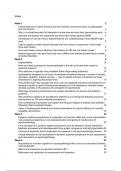
Index
Week 1 3
Critical features of “good” theories and why theories can be best seen as disposables
(are not forever) 3
Why it is critical/important for therapists to know how and why their interventions work 4
Describe and explain the arguments that have been raised against EMDR 4
Contribution of van den Hout’s experiments for our understanding of how EMDR might
work 5
Clark’s cognitive model of panic disorder and how various components of the model
have been tested 6
How (and where) various effective interventions for PD tap into Clark’s model 8
Network approach (van den Hout) and how it differs from traditional latent factor models
of mental disorders 9
Week 2 9
Explain/define 10
How can these concepts be measured/tested in the lab (and have been tested in
empirical research 13
Why addiction is typically very persistent (idem binge eating problems) 14
Interventions designed on the basis of presented models/ecvidence in context of anxiety
disorders, addiction, bulimia nervosa → how to explain relevant components of these
interentions in learning theoretical terms 15
How phobic fears may develop and how it can be explained that some individuals do not
develop a phobia in spite of having been exposed to a US experience, whereas others
develop a phobia in the absence of contingent US experiences 16
What type of learning mechanisms can explain persistence of anxiety and addiction
problems 17
Why predictive relations do but affective relations do not extinguish following exposure
interventions (or CS-only extinction procedures) 18
How conditioning mechanism can explain the frequent relapse of phobias and addiction
following initial successful therapy 18
Types of starting point derived from these explanations to improve efficacy of currently
available interventions 19
Week 3 20
Dynamic systems perspectives & explanation on how they differ from more individualistic
/ bio-medical perspectives in conceptualizing the emergence & maintenance of
psychopathology 20
Core concepts of a dynamic system perspective such as attractors, phase transitions,
feedback processed and interdependent time scales, emergence and self-organization22
Concept of ergodicity and its implication for research in the psychopathology domain 25
Critical reflection on the implications of dynamic systems perspective for the assessment
and intervention on psychopathology 26
Week 4 27
Importance to consider cognition in psychopathology with a focus on executive functions
and functionality 27
Nature and measures on executive functions (EF) 28
Relevance and implication for assessment and treatment 30
,Week 5 31
The development and subsquent course of psychopathology using the interpersonal
situation 31
How interpersonal style of patients and their therapists may play a role in the treatment
of psychopathology 33
Week 6 35
The role of genetics and epigenetics in the development of psychopathology 35
What non-human animal experiments can contribute to biological theories of
psychopathoogy 36
Changes in the brain that help explain the effectiveness of medication for treating
psychopathology 36
Week 7 37
Explain 37
Explain why substance use disorders, eating disorders, depressive disorders and anxiety
disorders are so persistent and often return following initial successful treatment 39
Design a clinical intervention within the context of addiciton, eating disorders,
depression, and anxiety disorders on the basis of dual process model 39
How attentional biass could play a role in the persistence of psychopathology such as
phobias, eating disorders, and addiction, and how attentional bias may vary across the
various syndromes 40
How cognitive biases (attention bais) can be used as a starting point for fresh
theory-derived interventions 41
,Week 1
Critical features of “good” theories and why theories can be best seen as
disposables (are not forever)
● Making sense of loose facts and observations
○ Understanding the origin of psychopathology
■ Predict who and under what type of conditions
● Prevention
○ Understanding factors involved in the persistence of psychopathology
■ Predict for whom and under what conditions will not persist
● Interventions
● Guides further inquiries
● Criteria of a “good” theory (necessary features)
○ External criteria
■ Is consistent with known facts
■ Testable / fasifiable
○ Internal criteria
■ Internally consistent
● No conflicting predictions
■ As simple as possible
● Parsimony
■ The fewer the number of assumptions, the better
● Occam’s razor
● Many different theories
○ Complementary (additional)
■ Social anxiety disorder - Genetic theory (behavioural inhibition)
■ Developmental psychological theory
■ Associative learning theory
○ Convertible
■ Gene x development x learning experiences
○ Incompatinle
■ Only one can be the best!
● Case of Panic Disorder → explained ahead
○ Two theories
■ Psychiatric theory
● Increase CO2 in a rat brain
● → hyperarousal Locus Coeruleus (LC)
● → panic stymptoms?
● Panic Disorder is caused by a neurophysiological defect that
renders people hypersensitive for increase in CO2 levels
● How can this be tested?
○ If A leads to B
■ Induce/heighten A and examine if B
occurs/increases
○ ** Experimental lactate studio
■ Results suggest that PD is a biological disease
● Lactate goes up, CO2 levels go up
, ● Effective itervention via cloniddinge (LC
inhibition)
■ Hyperventilation theory of PD
● Hyperventilation symptoms are kinda the same
● Lowering CO2
● → Panic Attack
○ Thus PA elicited by hyperventilation?
○ = A lead to B, therefore A?
○ Therefore PA due to hyperventilation?
● Next step
○ In naturalist contexts PA accompanied by reduction in
CO2 level?
■ Effective “bag” intervention
● Theories are disposables
○ No theory has eternal value
■ They can be incompatible (PD example) and change over time
○ As soon as there is a better theory available
■ → Exchange
Why it is critical/important for therapists to know how and why their interventions
work
● No theory?
○ → Rash empiricism (electro convulsion therapy (ECT))
● Theory yes, but defective
○ Jim van Os
■ Explains that madness has been misrepresented as a ‘devastating
genetic brain disease’
● Referred to as schizophrenia
■ Is said to leave the person completely disabled
● Modern science has discovered that sublte states of madness
(psychosis) are quite common in the general population
■ Madness, therefore, is about human variation
● We can all connect to it
○ Using nobel mobile apps that trak thoughts and
experience in daily life
● Optimal interventions are techniques from optimal theories
○ Without (optimal) theories
■ Therapy is Hocus Pokus
○ Therefore beware of
■ Pragmatists who don’t want to know why their interventions work
■ People who hold on to theories that cannot stand the test of empirical
scrutiny
Describe and explain the arguments that have been raised against EMDR
● EMDR = eye movement desensitization and reprocessing
Week 1 3
Critical features of “good” theories and why theories can be best seen as disposables
(are not forever) 3
Why it is critical/important for therapists to know how and why their interventions work 4
Describe and explain the arguments that have been raised against EMDR 4
Contribution of van den Hout’s experiments for our understanding of how EMDR might
work 5
Clark’s cognitive model of panic disorder and how various components of the model
have been tested 6
How (and where) various effective interventions for PD tap into Clark’s model 8
Network approach (van den Hout) and how it differs from traditional latent factor models
of mental disorders 9
Week 2 9
Explain/define 10
How can these concepts be measured/tested in the lab (and have been tested in
empirical research 13
Why addiction is typically very persistent (idem binge eating problems) 14
Interventions designed on the basis of presented models/ecvidence in context of anxiety
disorders, addiction, bulimia nervosa → how to explain relevant components of these
interentions in learning theoretical terms 15
How phobic fears may develop and how it can be explained that some individuals do not
develop a phobia in spite of having been exposed to a US experience, whereas others
develop a phobia in the absence of contingent US experiences 16
What type of learning mechanisms can explain persistence of anxiety and addiction
problems 17
Why predictive relations do but affective relations do not extinguish following exposure
interventions (or CS-only extinction procedures) 18
How conditioning mechanism can explain the frequent relapse of phobias and addiction
following initial successful therapy 18
Types of starting point derived from these explanations to improve efficacy of currently
available interventions 19
Week 3 20
Dynamic systems perspectives & explanation on how they differ from more individualistic
/ bio-medical perspectives in conceptualizing the emergence & maintenance of
psychopathology 20
Core concepts of a dynamic system perspective such as attractors, phase transitions,
feedback processed and interdependent time scales, emergence and self-organization22
Concept of ergodicity and its implication for research in the psychopathology domain 25
Critical reflection on the implications of dynamic systems perspective for the assessment
and intervention on psychopathology 26
Week 4 27
Importance to consider cognition in psychopathology with a focus on executive functions
and functionality 27
Nature and measures on executive functions (EF) 28
Relevance and implication for assessment and treatment 30
,Week 5 31
The development and subsquent course of psychopathology using the interpersonal
situation 31
How interpersonal style of patients and their therapists may play a role in the treatment
of psychopathology 33
Week 6 35
The role of genetics and epigenetics in the development of psychopathology 35
What non-human animal experiments can contribute to biological theories of
psychopathoogy 36
Changes in the brain that help explain the effectiveness of medication for treating
psychopathology 36
Week 7 37
Explain 37
Explain why substance use disorders, eating disorders, depressive disorders and anxiety
disorders are so persistent and often return following initial successful treatment 39
Design a clinical intervention within the context of addiciton, eating disorders,
depression, and anxiety disorders on the basis of dual process model 39
How attentional biass could play a role in the persistence of psychopathology such as
phobias, eating disorders, and addiction, and how attentional bias may vary across the
various syndromes 40
How cognitive biases (attention bais) can be used as a starting point for fresh
theory-derived interventions 41
,Week 1
Critical features of “good” theories and why theories can be best seen as
disposables (are not forever)
● Making sense of loose facts and observations
○ Understanding the origin of psychopathology
■ Predict who and under what type of conditions
● Prevention
○ Understanding factors involved in the persistence of psychopathology
■ Predict for whom and under what conditions will not persist
● Interventions
● Guides further inquiries
● Criteria of a “good” theory (necessary features)
○ External criteria
■ Is consistent with known facts
■ Testable / fasifiable
○ Internal criteria
■ Internally consistent
● No conflicting predictions
■ As simple as possible
● Parsimony
■ The fewer the number of assumptions, the better
● Occam’s razor
● Many different theories
○ Complementary (additional)
■ Social anxiety disorder - Genetic theory (behavioural inhibition)
■ Developmental psychological theory
■ Associative learning theory
○ Convertible
■ Gene x development x learning experiences
○ Incompatinle
■ Only one can be the best!
● Case of Panic Disorder → explained ahead
○ Two theories
■ Psychiatric theory
● Increase CO2 in a rat brain
● → hyperarousal Locus Coeruleus (LC)
● → panic stymptoms?
● Panic Disorder is caused by a neurophysiological defect that
renders people hypersensitive for increase in CO2 levels
● How can this be tested?
○ If A leads to B
■ Induce/heighten A and examine if B
occurs/increases
○ ** Experimental lactate studio
■ Results suggest that PD is a biological disease
● Lactate goes up, CO2 levels go up
, ● Effective itervention via cloniddinge (LC
inhibition)
■ Hyperventilation theory of PD
● Hyperventilation symptoms are kinda the same
● Lowering CO2
● → Panic Attack
○ Thus PA elicited by hyperventilation?
○ = A lead to B, therefore A?
○ Therefore PA due to hyperventilation?
● Next step
○ In naturalist contexts PA accompanied by reduction in
CO2 level?
■ Effective “bag” intervention
● Theories are disposables
○ No theory has eternal value
■ They can be incompatible (PD example) and change over time
○ As soon as there is a better theory available
■ → Exchange
Why it is critical/important for therapists to know how and why their interventions
work
● No theory?
○ → Rash empiricism (electro convulsion therapy (ECT))
● Theory yes, but defective
○ Jim van Os
■ Explains that madness has been misrepresented as a ‘devastating
genetic brain disease’
● Referred to as schizophrenia
■ Is said to leave the person completely disabled
● Modern science has discovered that sublte states of madness
(psychosis) are quite common in the general population
■ Madness, therefore, is about human variation
● We can all connect to it
○ Using nobel mobile apps that trak thoughts and
experience in daily life
● Optimal interventions are techniques from optimal theories
○ Without (optimal) theories
■ Therapy is Hocus Pokus
○ Therefore beware of
■ Pragmatists who don’t want to know why their interventions work
■ People who hold on to theories that cannot stand the test of empirical
scrutiny
Describe and explain the arguments that have been raised against EMDR
● EMDR = eye movement desensitization and reprocessing



