NYPD Corruption Study Test Question Exam#1 Correctly Answered.
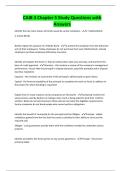
LEXOW COMMITTEE (1894) - correct answer The Lexow Committee, which took its name from its chairperson. - Its star witness, Max Schmittberger, testified that he had paid $300 to become an officer and $12,000 to become a captain - merit system created CURRAN COMMITTEE/BECKER-ROSENTHAL AFFAIR INVESTIGATION (1912) - correct answer Herman Rosenthal, a gambler, was shot and killed in front of the Hotel Metropole on 43rd Street in Times Square. Several on-duty police officers witnessed the killing but allegedly took no action. - The Committee concluded that there was an extensive system of payoffs to police by gamblers and operators of brothels. Officers took bribes to throw cases and the Department made little or no effort to discipline its ranks. - Becker and four others were executed for the Rosenthal murder and eight inspectors were indicted. THE SEABURY INVESTIGATION (1932) - correct answer In the same month that Seabury was appointed to chair the Committee, a Supreme Court justice stepped into a taxi in front of a restaurant on West 45th Street and was never seen again. - Several attorneys were disbarred for participating in corruption. Two magistrates were removed from office for both accepting loans from gamblers and falsifying transcripts. THE GROSS/HELFAND INVESTIGATION (1949) - correct answer Gross paid 1 mill for police protection 21 officers were charged with conspiracy for accepting money for not enforcing the law. Nearly 60 other officers were named as unindicted co-conspirators. The accused officers ranged from patrolman to assistant chief inspector, which was the second highest uniformed rank in the NYPD then. All of the accused officers were released for lack of evidence and the double jeopardy clause precluded their re-prosecution. THE KNAPP COMMISSION (1970) - correct answer The Commission was given the task of determining the extent and nature of police corruption in New York City. The Commission found corruption to be widespread at various levels. Some plainclothesmen received as much as $3,500 from the gambling establishments in their area. - Corrupt officers were labeled as "grass-eaters" and "meat-eaters." - The formation of an internal investigative body (i.e., "Internal Affairs Division" [IAD]) - By doing this, he addressed the theory of "rotten apples" (i.e., there are only a few corrupt officers in a department or precinct) and "rotten pockets" (i.e., there are a few corrupt officers cooperating with one another in a department or precinct). THE MOLLEN COMMISSION (1992) - correct answer The concepts of grass-/meat-eaters and rotten apples/pockets became more apparent in the late 1980s and early 1990s when a series of corruption scandals were exposed: the 77 pct. "buddy boys" (Henry Winter), the Long Island cocaine ring (Michael Dowd), and the "dirty 30" (Kevin Nannery). - Formation of IAB

Geschreven voor
- Instelling
- NYPD.
- Vak
- NYPD.
Documentinformatie
- Geüpload op
- 31 maart 2024
- Aantal pagina's
- 2
- Geschreven in
- 2023/2024
- Type
- Tentamen (uitwerkingen)
- Bevat
- Vragen en antwoorden
Onderwerpen
-
nypd corruption

Ook beschikbaar in voordeelbundel