OCR A-Level English Language: Child Language Acquisition key theories &
information
Theories:
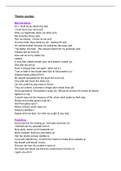
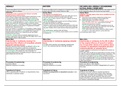
Halliday – the 7 functions of language:
1. Instrumental – to get things done
2. Regulatory – to control others
3. Personal – to express thoughts and opinions
4. Interactional – to form and maintain social relationships
5. Heuristic – to seek knowledge
6. Informative – to convey information
7. Imaginative – to express creative thoughts
Piaget – Cognitive Theory*:
1. Sensorimotor (0-2 years)
Using senses and actions to discover the world
2. Pre-operational (2-7 years)
Egocentrism (the child believes that everybody feels and thinks the same way
they do)
Animism (the child believes that inanimate objects have human feelings and
intentions)
Inability to distinguish fantasy from reality
Inability to understand conservation (the idea that a quantity will remain the
same despite adjustment of the container, shape or apparent size)
3. Concrete operational (7-11 years)
More logical thinking and problem solving with concrete (visual) events
The idea of conservation is developed
4. Formal operational (11+ years)
Thinking internally about abstract/theoretical issues
*This theory is not very reliable as Piaget observed only his own children and
undertook interviews with adolescents. No one confirmed his findings or worked with
him
Roger Brown – order of inflections:
Usually acquired in this order from 20-36 months
1. Ing
2. s (plural)
3. ‘s (possessive)
4. A/the
5. ed
6. s (3rd person singular verb ending)
, 7. Be (primary auxiliary verb)
Ursula Bellugi – stages of using negatives:
1. ‘No’ put at the beginning or end of a sentence
2. ‘No’ put in the middle of a sentence. Modal verbs ‘can’t’ and ‘don’t’ sometimes
used
3. More variety in the tense of modal verbs e.g. ‘didn’t’
4. Uses ‘do not’ correctly
Katherine Nelson – categories for early acquisition:
1. Naming things/people – ball, mummy, dog
2. Actions/events – down, more, up
3. Describing/modifying – dirty, nice, pretty
4. Social words – hi, bye-bye
Katherine Nelson – acquisition of nouns:
60% of a child’s first words are concrete nouns
Abstract nouns are not generally used until the ages of 5-7
Leslie Rescorla – categories of overextension:
1. Categorical – confusing a hypernym e.g. ‘fruit’ with a hyponym e.g. ‘banana’
2. Predicate – meaning that relates to absence e.g. saying ‘cat’ when pointing at
the cat’s empty basket
3. Analogical – unrelated objects that share a common feature e.g. being the
same colour
Lenneberg – the Critical Period:
The idea that there is a ‘critical period’ (ages 0-5) during which children can
learn language
After this period, language acquisition becomes less successful
Jean Aitchison – stages of acquisition of vocab:
1. Labelling – linking the sounds of words and the objects (lexis)
2. Packaging – understanding a word’s range of meaning (semantics)
3. Network building – grasping the connections between the words (grammar)
Ursula Bellugi – stages of questions:
1. Using intonation
2. Words such as ‘what’, ‘where’ and ‘when’ are used
3. Using ‘can’ and ‘do’ correctly
information
Theories:
Halliday – the 7 functions of language:
1. Instrumental – to get things done
2. Regulatory – to control others
3. Personal – to express thoughts and opinions
4. Interactional – to form and maintain social relationships
5. Heuristic – to seek knowledge
6. Informative – to convey information
7. Imaginative – to express creative thoughts
Piaget – Cognitive Theory*:
1. Sensorimotor (0-2 years)
Using senses and actions to discover the world
2. Pre-operational (2-7 years)
Egocentrism (the child believes that everybody feels and thinks the same way
they do)
Animism (the child believes that inanimate objects have human feelings and
intentions)
Inability to distinguish fantasy from reality
Inability to understand conservation (the idea that a quantity will remain the
same despite adjustment of the container, shape or apparent size)
3. Concrete operational (7-11 years)
More logical thinking and problem solving with concrete (visual) events
The idea of conservation is developed
4. Formal operational (11+ years)
Thinking internally about abstract/theoretical issues
*This theory is not very reliable as Piaget observed only his own children and
undertook interviews with adolescents. No one confirmed his findings or worked with
him
Roger Brown – order of inflections:
Usually acquired in this order from 20-36 months
1. Ing
2. s (plural)
3. ‘s (possessive)
4. A/the
5. ed
6. s (3rd person singular verb ending)
, 7. Be (primary auxiliary verb)
Ursula Bellugi – stages of using negatives:
1. ‘No’ put at the beginning or end of a sentence
2. ‘No’ put in the middle of a sentence. Modal verbs ‘can’t’ and ‘don’t’ sometimes
used
3. More variety in the tense of modal verbs e.g. ‘didn’t’
4. Uses ‘do not’ correctly
Katherine Nelson – categories for early acquisition:
1. Naming things/people – ball, mummy, dog
2. Actions/events – down, more, up
3. Describing/modifying – dirty, nice, pretty
4. Social words – hi, bye-bye
Katherine Nelson – acquisition of nouns:
60% of a child’s first words are concrete nouns
Abstract nouns are not generally used until the ages of 5-7
Leslie Rescorla – categories of overextension:
1. Categorical – confusing a hypernym e.g. ‘fruit’ with a hyponym e.g. ‘banana’
2. Predicate – meaning that relates to absence e.g. saying ‘cat’ when pointing at
the cat’s empty basket
3. Analogical – unrelated objects that share a common feature e.g. being the
same colour
Lenneberg – the Critical Period:
The idea that there is a ‘critical period’ (ages 0-5) during which children can
learn language
After this period, language acquisition becomes less successful
Jean Aitchison – stages of acquisition of vocab:
1. Labelling – linking the sounds of words and the objects (lexis)
2. Packaging – understanding a word’s range of meaning (semantics)
3. Network building – grasping the connections between the words (grammar)
Ursula Bellugi – stages of questions:
1. Using intonation
2. Words such as ‘what’, ‘where’ and ‘when’ are used
3. Using ‘can’ and ‘do’ correctly