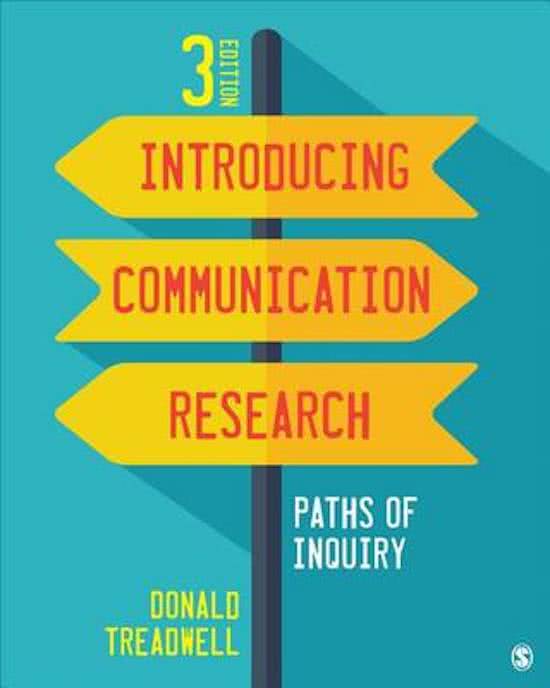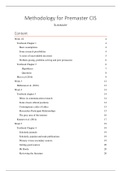
Methodology for Premaster CIS
SUMMARY
Content
Week 1/2 4
Textbook Chapter 1 4
Basic assumptions 4
Some research possibilities 4
A series of unavoidable decisions 5
Problem-posing, problem-solving and peer persuasion 6
Textbook Chapter 2 6
Hypotheses 7
Questions 8
Mui et al (2016) 9
Week 3 12
Holleman et al. (2016) 12
Week 4 14
Textbook chapter 3 14
Ethics in communication research 14
Some classic ethical positions 14
Contemporary codes of ethics 15
Researcher-Participant Relationships 15
The grey area of the internet 16
Kramer et al. (2014) 17
Week 5 19
Textbook Chapter 4 19
Scholarly journals 19
Scholarly, popular and trade publications 19
Primary versus secondary sources 19
Getting good sources 20
Mr Boole 20
Reviewing the literature 20
, 2
Bartels & Reinders (2010) 21
Week 6 23
Textbook chapter 10 23
Field experiments and ex-post facto designs 23
Experimental designs 23
Between-subjects and a within-subjects design 25
Validity 25
Van Amelsvoort & Schilperoord 26
Week 7 29
Textbook Chapter 5 29
Types of measurements 29
Reliability and validity 30
Reliability 30
Validity 31
Two common measurement scales 31
Vanden Abeele et al. (2018) 32
Week 9 35
Textbook Chapter 8 35
Sampling methods 35
Advantages and disadvantages of sampling methods 36
Sample size 37
Issues with sampling frames 37
Behrend et al. (2011) 38
Week 10 40
Textbook Chapter 9 40
Advantages and disadvantages of surveys 40
Types of Surveys 40
Types of survey questions 41
Survey wording 42
Advantages and disadvantages of online surveys 43
Improving survey response rates 43
Pollmann & Finkenauer (2009) 45
Week 11 47
Marit Kamp Stuvia ©
, 3
Textbook Chapter 11 (part 1) 47
Qualitative and quantitative research: similarities and differences 47
Decisions to make in qualitative research 47
Interviews 48
Broeder & Kistemaker (2015) 49
Week 12 52
Textbook Chapter 11 (part 2) 52
Focus groups 52
Ethnographic methods 53
Observational studies 54
Unobtrusive measures 55
Conversation analysis 55
Making sense of qualitative data 55
Zwaanswijk et al. (2007) 56
Week 13 58
Textbook Chapter 12 58
Content analysis 58
Content analysis software 59
Mahrt & Scharkow (2013) 60
Week 14 61
Farrel & Lewandowsky (2015) 61
Week 15 65
Munafò et al. (2017) 65
Marit Kamp Stuvia ©
, 4
Week 1/2
Textbook Chapter 1
GETTING STARTED: POSSIBILITIES AND DECISIONS
Basic assumptions
There are several basic assumptions that underpin all communication research methods.
- Observations capture/do not capture an underlying reality.
Attitudes can’t be seen, but the underlying behaviour tells us something about
someone’s attitude. The concept of attitude provides, therefore, a useful tool for
thinking about communication processes.
- Theories about human behaviour can/cannot be generalized.
Researchers using survey or experimental methods want to assume that the results of
their research will apply to people who are similar to the study participants. Not all
people can be generalized, but it can help with an experiment to do so sometimes.
- Researchers should/should not distance themselves from their research
participants.
When distancing themselves, researchers become more objective but will miss some
important insights. On the other hand, getting closer to the participants will maybe
influence them or the researcher him/herself.
- Research should/should not be done for a specific purpose.
If the purpose of your research is to simply answer a question or solving a problem of
society it is fine. However, some researchers do research that is funded by a
corporation or foundation. The researcher is instructed to get specific answers to the
questions given as quickly as possible. This will possibly influence the research
process.
- There is/is not one best position from which to observe human behaviour.
Researchers will typically find one of the several components present in their research
more interesting than others and will give that component priority in their
investigations. So yes, it is possible, but it never happens.
Some research possibilities
Two characteristics of scientific research methods are:
1. Observation or empiricism.
2. The attempt to rule out alternative explanations.
There are different ways in which research can be done:
- Observation
- Setting up surveys or focus groups
- Critical content analysis
- Interviewing
Marit Kamp Stuvia ©
, 5
The different research methods look at different aspects of human communication, which
consists of five major components:
1. Source
The provider or initiator of content.
➔ With interviews.
2. Message(s)
The content of the communication.
➔ With content analysis.
3. Channel or medium
The vehicle for communication content (example: social media)
4. Receiver(s)
The recipients or consumers of information.
➔ With observation, surveys or a focus group.
5. Noise
Extraneous information or distractions that can disrupt an interaction.
A series of unavoidable decisions
Human communication is very complex. For this reason, researchers focus only on parts of
this totality. They make decisions in what they do and do not want to investigate.
- Wide or narrow.
Communication scholars typically divide communication studies into a number of
specific interest areas in order to get a clear view of the research area as well as giving
a possibility to narrow down your research topic.
- Dispassionate or involved.
One sees research as a personal quest for knowledge, the other as an engaged
contribution to society (called action research).
- Objective or subjective.
Social scientists try to be as objective as possible while by contrast phenomenologists
and ethnographers try to understand people’s subjective worlds.
- Your questions or their answers.
You can decide to get answers to specific questions you have or elicit people’s views
in their own language, not quite knowing what you get.
- Quantitative or qualitative
Some research questions can be answered with numbers and ask for a quantitative
research method, while other questions (about the human motivation for example) ask
for a qualitative research method. A combination of both methods is called a
triangulation. Q-methodology is a form of triangulation. Quantitative data check the
qualitative data.
Marit Kamp Stuvia ©
, 6
Problem-posing, problem-solving and peer persuasion
Communication research can be regarded as having three main components:
1. Problem-posing
To do research you have to decide what the question.
Corresponding questions: What question and why this question? (chapter 2)
2. Problem-solving
Now you need to answer this question.
Corresponding questions: How do I answer this question? (chapter 2)
3. Peer persuasion
After that, you need to let the world know about your research by publishing it.
In summary
Lecture
[text]● Communication research is a systematic process of posing questions about human
communication, designing and implementing research that will answer those
questions, and then persuading other researchers that your results are valid.
● Communication researchers typically specialize in one aspect of communication.
● Researchers may use qualitative methods, quantitative methods, or both.
● Researchers have empirical, interpretive, or critical perspectives on
communication.
Textbook Chapter 2
FIRST DECISIONS: WHAT, WHY, HOW?
Chapter two will continue where chapter one finished. It will answer the questions: what
research question do I need? Why do I need this research question? And how am I going to
answer this question?
The “what” question
Scientists move between theory and observation when they are formulating a research
question. Three thought processes that link theory and observation are induction, deduction,
and abduction.
- Induction
Reasoning from observations to a theory that might explain your observations. After
generating several theories, you chose one theory that offers the best explanation of
the observations done.
- Deduction
Reasoning from a theory to define observations you will make to test the theory.
Deduction is in a sense more efficient than induction because it leads to a specific
observation that will test your hypothesis.
- Abduction
Reasoning from an effect to possible causes.
Marit Kamp Stuvia ©
SUMMARY
Content
Week 1/2 4
Textbook Chapter 1 4
Basic assumptions 4
Some research possibilities 4
A series of unavoidable decisions 5
Problem-posing, problem-solving and peer persuasion 6
Textbook Chapter 2 6
Hypotheses 7
Questions 8
Mui et al (2016) 9
Week 3 12
Holleman et al. (2016) 12
Week 4 14
Textbook chapter 3 14
Ethics in communication research 14
Some classic ethical positions 14
Contemporary codes of ethics 15
Researcher-Participant Relationships 15
The grey area of the internet 16
Kramer et al. (2014) 17
Week 5 19
Textbook Chapter 4 19
Scholarly journals 19
Scholarly, popular and trade publications 19
Primary versus secondary sources 19
Getting good sources 20
Mr Boole 20
Reviewing the literature 20
, 2
Bartels & Reinders (2010) 21
Week 6 23
Textbook chapter 10 23
Field experiments and ex-post facto designs 23
Experimental designs 23
Between-subjects and a within-subjects design 25
Validity 25
Van Amelsvoort & Schilperoord 26
Week 7 29
Textbook Chapter 5 29
Types of measurements 29
Reliability and validity 30
Reliability 30
Validity 31
Two common measurement scales 31
Vanden Abeele et al. (2018) 32
Week 9 35
Textbook Chapter 8 35
Sampling methods 35
Advantages and disadvantages of sampling methods 36
Sample size 37
Issues with sampling frames 37
Behrend et al. (2011) 38
Week 10 40
Textbook Chapter 9 40
Advantages and disadvantages of surveys 40
Types of Surveys 40
Types of survey questions 41
Survey wording 42
Advantages and disadvantages of online surveys 43
Improving survey response rates 43
Pollmann & Finkenauer (2009) 45
Week 11 47
Marit Kamp Stuvia ©
, 3
Textbook Chapter 11 (part 1) 47
Qualitative and quantitative research: similarities and differences 47
Decisions to make in qualitative research 47
Interviews 48
Broeder & Kistemaker (2015) 49
Week 12 52
Textbook Chapter 11 (part 2) 52
Focus groups 52
Ethnographic methods 53
Observational studies 54
Unobtrusive measures 55
Conversation analysis 55
Making sense of qualitative data 55
Zwaanswijk et al. (2007) 56
Week 13 58
Textbook Chapter 12 58
Content analysis 58
Content analysis software 59
Mahrt & Scharkow (2013) 60
Week 14 61
Farrel & Lewandowsky (2015) 61
Week 15 65
Munafò et al. (2017) 65
Marit Kamp Stuvia ©
, 4
Week 1/2
Textbook Chapter 1
GETTING STARTED: POSSIBILITIES AND DECISIONS
Basic assumptions
There are several basic assumptions that underpin all communication research methods.
- Observations capture/do not capture an underlying reality.
Attitudes can’t be seen, but the underlying behaviour tells us something about
someone’s attitude. The concept of attitude provides, therefore, a useful tool for
thinking about communication processes.
- Theories about human behaviour can/cannot be generalized.
Researchers using survey or experimental methods want to assume that the results of
their research will apply to people who are similar to the study participants. Not all
people can be generalized, but it can help with an experiment to do so sometimes.
- Researchers should/should not distance themselves from their research
participants.
When distancing themselves, researchers become more objective but will miss some
important insights. On the other hand, getting closer to the participants will maybe
influence them or the researcher him/herself.
- Research should/should not be done for a specific purpose.
If the purpose of your research is to simply answer a question or solving a problem of
society it is fine. However, some researchers do research that is funded by a
corporation or foundation. The researcher is instructed to get specific answers to the
questions given as quickly as possible. This will possibly influence the research
process.
- There is/is not one best position from which to observe human behaviour.
Researchers will typically find one of the several components present in their research
more interesting than others and will give that component priority in their
investigations. So yes, it is possible, but it never happens.
Some research possibilities
Two characteristics of scientific research methods are:
1. Observation or empiricism.
2. The attempt to rule out alternative explanations.
There are different ways in which research can be done:
- Observation
- Setting up surveys or focus groups
- Critical content analysis
- Interviewing
Marit Kamp Stuvia ©
, 5
The different research methods look at different aspects of human communication, which
consists of five major components:
1. Source
The provider or initiator of content.
➔ With interviews.
2. Message(s)
The content of the communication.
➔ With content analysis.
3. Channel or medium
The vehicle for communication content (example: social media)
4. Receiver(s)
The recipients or consumers of information.
➔ With observation, surveys or a focus group.
5. Noise
Extraneous information or distractions that can disrupt an interaction.
A series of unavoidable decisions
Human communication is very complex. For this reason, researchers focus only on parts of
this totality. They make decisions in what they do and do not want to investigate.
- Wide or narrow.
Communication scholars typically divide communication studies into a number of
specific interest areas in order to get a clear view of the research area as well as giving
a possibility to narrow down your research topic.
- Dispassionate or involved.
One sees research as a personal quest for knowledge, the other as an engaged
contribution to society (called action research).
- Objective or subjective.
Social scientists try to be as objective as possible while by contrast phenomenologists
and ethnographers try to understand people’s subjective worlds.
- Your questions or their answers.
You can decide to get answers to specific questions you have or elicit people’s views
in their own language, not quite knowing what you get.
- Quantitative or qualitative
Some research questions can be answered with numbers and ask for a quantitative
research method, while other questions (about the human motivation for example) ask
for a qualitative research method. A combination of both methods is called a
triangulation. Q-methodology is a form of triangulation. Quantitative data check the
qualitative data.
Marit Kamp Stuvia ©
, 6
Problem-posing, problem-solving and peer persuasion
Communication research can be regarded as having three main components:
1. Problem-posing
To do research you have to decide what the question.
Corresponding questions: What question and why this question? (chapter 2)
2. Problem-solving
Now you need to answer this question.
Corresponding questions: How do I answer this question? (chapter 2)
3. Peer persuasion
After that, you need to let the world know about your research by publishing it.
In summary
Lecture
[text]● Communication research is a systematic process of posing questions about human
communication, designing and implementing research that will answer those
questions, and then persuading other researchers that your results are valid.
● Communication researchers typically specialize in one aspect of communication.
● Researchers may use qualitative methods, quantitative methods, or both.
● Researchers have empirical, interpretive, or critical perspectives on
communication.
Textbook Chapter 2
FIRST DECISIONS: WHAT, WHY, HOW?
Chapter two will continue where chapter one finished. It will answer the questions: what
research question do I need? Why do I need this research question? And how am I going to
answer this question?
The “what” question
Scientists move between theory and observation when they are formulating a research
question. Three thought processes that link theory and observation are induction, deduction,
and abduction.
- Induction
Reasoning from observations to a theory that might explain your observations. After
generating several theories, you chose one theory that offers the best explanation of
the observations done.
- Deduction
Reasoning from a theory to define observations you will make to test the theory.
Deduction is in a sense more efficient than induction because it leads to a specific
observation that will test your hypothesis.
- Abduction
Reasoning from an effect to possible causes.
Marit Kamp Stuvia ©