1.4 – Managing People
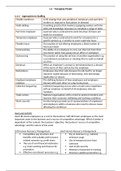
1.4.1 – Approaches to Stafng
Flexible workforce A HR strategy that uses peripheral, temporary and part-tme
workers to respond to fuctuatons in demand
Mult-skilling A working practce that involves equipping workers with the
skills and knowledge necessary to complete a range of tasks
Part-tme employee A person who is contracted to work less than 30 hours per
week for a business
Temporary employee A person who is contracted to work for a business for a
specifc period e.g. 6 months to cover maternity leave
Flexible hours The practse of not ofering employees a fxed number of
hours per week
Homeworking The ability of an employee to carry out their job from their
own home rather than going into an ofce or workplace
Outsourcing The practce of using the services of another organisaton e.g.
a recruitment consultancy or cleaning frm to work on behalf
of a frm
Dismissal When an employee’s contract is terminated due to a breach
of the terms of that contract by the employee
Redundancy Employees lose their jobs because the job itself is no longer
required, maybe because of downsizing, new technology,
duplicaton or closure
Employer/employee The defning features of how employees and employers
relatons interact with each other on a day to day basis
Collectve bargaining Collectve bargaining occurs when a trade union negotates
with an employer on behalf of all employees who are
members
Trade unions Natonal organisatons with a remit to protect members and
improve their economic wellbeing and working conditons
Work councils An internal group made up of representatves of employees
and employers within a business who meet to discuss issues
afectng the workforce
Hard and Sof HR
Hard HR treats employees as a cost to the business. Sof HR treats employees as the most
important asset to the business and a source of compettve advantage. Which is beter is
dependant of the context: the business’ objectvee the business’ source of compettve
advantagee and the nature of the work.
Sof Human Resource Management Hard Human Resource Management
Compettve pay structure and Pay at minimum e.g. natonal
benefts with suitable performance- minimum wage
related rewards e.g. proft share Use of temporary/zero hour
The use of non-fnancial motvators contracts
e.g. team working and chances for Lack of job security
promoton Minimum investment in training
Efectve recruitment processes e.g. Minimum additonal benefts e.g.
1.4.1 – Approaches to Stafng
Flexible workforce A HR strategy that uses peripheral, temporary and part-tme
workers to respond to fuctuatons in demand
Mult-skilling A working practce that involves equipping workers with the
skills and knowledge necessary to complete a range of tasks
Part-tme employee A person who is contracted to work less than 30 hours per
week for a business
Temporary employee A person who is contracted to work for a business for a
specifc period e.g. 6 months to cover maternity leave
Flexible hours The practse of not ofering employees a fxed number of
hours per week
Homeworking The ability of an employee to carry out their job from their
own home rather than going into an ofce or workplace
Outsourcing The practce of using the services of another organisaton e.g.
a recruitment consultancy or cleaning frm to work on behalf
of a frm
Dismissal When an employee’s contract is terminated due to a breach
of the terms of that contract by the employee
Redundancy Employees lose their jobs because the job itself is no longer
required, maybe because of downsizing, new technology,
duplicaton or closure
Employer/employee The defning features of how employees and employers
relatons interact with each other on a day to day basis
Collectve bargaining Collectve bargaining occurs when a trade union negotates
with an employer on behalf of all employees who are
members
Trade unions Natonal organisatons with a remit to protect members and
improve their economic wellbeing and working conditons
Work councils An internal group made up of representatves of employees
and employers within a business who meet to discuss issues
afectng the workforce
Hard and Sof HR
Hard HR treats employees as a cost to the business. Sof HR treats employees as the most
important asset to the business and a source of compettve advantage. Which is beter is
dependant of the context: the business’ objectvee the business’ source of compettve
advantagee and the nature of the work.
Sof Human Resource Management Hard Human Resource Management
Compettve pay structure and Pay at minimum e.g. natonal
benefts with suitable performance- minimum wage
related rewards e.g. proft share Use of temporary/zero hour
The use of non-fnancial motvators contracts
e.g. team working and chances for Lack of job security
promoton Minimum investment in training
Efectve recruitment processes e.g. Minimum additonal benefts e.g.