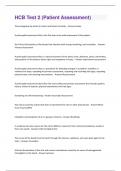
HCB Test 2 (Patient Assessment) Questions And Answers With Complete Solutions
The passageway by which air enters and leaves the body. - Answer-airway A prehospital assessment that is the first step in the total assessment of the patient. You'll focus Exclusively on life threats that interfere with airway, breathing, and circulation. - AnswerPrimary Assessment A prehospital assessment that is a rapid assessment of the head, chest, abdomen, pelvis, extremities, and posterior of the body to detect signs and symptoms of injury. - Answer-rapid trauma assessment A prehospital assessment that is a procedure for detecting changes in a patient's condition. It involves four steps: repeating the primary assessment, repeating and recording vital signs, repeating physical exam, and checking interventions. - Answer-Reassessment A prehospital assessment done after the scene safety and primary assessment that includes patient history, review of systems, physical examination and vital signs. Everything non-life threatening - Answer-Secondary Assessment Any injury caused by a blow that does not penetrate the skin or other body tissues - Answer-Blunt Force Trauma (BFT) Inhalation and exhalation of air or gaseous mixtures - Answer-Breathing in medicine the main reason for the call (in EMS) or reason for their visit (in/out patient), usually in their own words - Answer-Chief Complaint (CC) The course of the blood from the heart through the arteries, capillaries, and veins back again to the heart - Answer-Circulation A bluish discoloration of the skin and mucous membranes caused by an excess of deoxygenated hemoglobin in the blood - Answer-Cyanosisa concept involving an integrated system of care that guides and tracks patient over time through a comprehensive array of health services spanning all levels of intensity of care - Answer-continuum of care the area around the wreckage of a vehicle collision or other incident within which special safety precautions should be taken - Answer-danger zone an assessment of the head, neck, chest, abdomen, pelvis, extremities, and posterior of the body to detect signs and symptoms of injury. It differs from the rapid trauma assessment only in that it also includes examination of the face, ears, eyes, nose, and mouth during the examination of the head. - Answer-detailed physical exam a description or label for a patient's condition that assists a clinician in further evaluation and treatment - Answer-diagnosis a condition of being stretched, inflated, or larger than normal - Answer-distention difficult or labored breathing - Answer-dyspnea impression of the patient's condition formed on first approaching the patient, based on the patient's environment,chief complaint,and appearance - Answer-general impression awareness that there may be injuries - Answer-index of suspicion actions taken to correct or manage a patient's problems - Answer-interventions

Geschreven voor
- Instelling
- HCB
- Vak
- HCB
Documentinformatie
- Geüpload op
- 15 maart 2024
- Aantal pagina's
- 6
- Geschreven in
- 2023/2024
- Type
- Tentamen (uitwerkingen)
- Bevat
- Vragen en antwoorden
Onderwerpen
-
hcb tpatient assessment

Ook beschikbaar in voordeelbundel