100% tevredenheidsgarantie Direct beschikbaar na je betaling Lees online óf als PDF Geen vaste maandelijkse kosten 4.2 TrustPilot
logo-home
Tentamen (uitwerkingen)

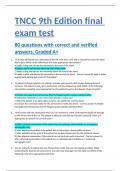
Updated!! TNCC 9th Edition final exam test - 80 questions with correct and verified answers. Graded A+

Beoordeling
5,0
(2)
Verkocht
-
Pagina's
15
Cijfer
A+
Geüpload op
02-03-2024
Geschreven in
2023/2024

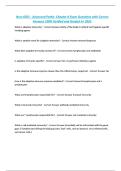
TNCC 9th Edition final exam test 80 questions with correct and verified answers. Graded A+ 1. "A 36-year old female has a deformity of the left wrist after a fall. She is reluctant to move her hand due to pain. Which of the following is the most appropriate intervention? A) apply a sling and elevate the extremity to the level of the heart. B) apply a splint and elevate above the level of the heart C) Apply a sling and elevate the extremity above the level of the heart D) apply a splint and elevate the extremity to the level of the heart. - Correct answer B) apply a splint and ELEVATE ABOVE THE LEVEL OF THE HEART" 2. "A patient is thrown against a car during a tornado and presents with obvious bilateral femoral fractures. The patient is pale, alert, disoriented, and has delayed cap refill. Which of the following interventions would be most appropriate for this patient based on the disaster triage principle? A) initiate two large bore intravenous lines for Ringers lactate solution administration B) Administer Dilaudid for pain control and provide comfort care C) Place the patient in an observation area for care within the next few hours D) Contact the command center for the personnel to notify next of kin. - Correct answer A) initiate two large bore intravenous lines for Ringers lactate solution administration" 3. "EMS arrives with the intoxicated driver of a car involved in a MVC. EMS reports significant damage to the drivers side of the car. The patient is asking to have the cervical color removed. when is it appropriate to remove the cervical collar? A) after a physical examination if the patient has no radiologic abnormalities on a computed tomography scan B) after physician evaluation if the patient has not neurologic abnormalities on exam C) after palpation of the spine if the patient has no point tenderness the the vertebral column D) after physical examination if the patient has not neck pain with movement - Correct answer A) after a physical examination if the patient has no radiologic abnormalities on a computed tomography scan" 4. You are caring for a patient who was thrown from a bike and was not wearing a helmet. While performing the head-to-toe assessment, you note clear drainage from the right ear. Which of the following is the most appropriate next step? A. Clean the ear with a cotton-tipped applicator. B. Pack the ear with gauze. C. Notify the physician D. Document and continue the exam. - Correct answer C. Notify the physician" 5. "A patient is brought to the emergency department of a rural hospital following a high-speed motor vehicle collision. When significant abdominal and pelvic injuries are noted in the primary survey, what is the priority intervention? A. Initiate transfer to a trauma center B. Attempt family notification C. Obtain additional imaging studies D. Place an indwelling urinary catheter - Correct answer A. Initiate transfer to a trauma center" 6. "An unresponsive trauma patient has an oropharyngeal airway in place, shallow and labored respiratory, and dusky skin. the trauma team has administered medications for drug assisted intubation and attempted intubation but was unsuccessful. What is the most appropriate immediate next step? A) Ventilate with a BVM B) Prepare for cricothyroidotomy C) administer reversal medications D) contact anesthesia for assistance - Correct answer A) Ventilate with a BVM" 7. "An adult who fell from a second story roof is brought to the emergency department by private vehicle. The patient is confused with unlabored respirations and has strong, palpable radial pulses. There is an open wound in proximity to an obvious deformity of the left lower extremity. What is the priority intervention? A. Initiate cervical spine stabilization B. Apply a splint to the lower extremity C. Put the patient on portable oxygen. D. Log roll the patient onto a spine board - Correct answer A. Initiate cervical spine stabilization" 8. "An adult patient who sustained a severe head trauma has been intubated and is being manually ventilated via a bag-mask device at a rate of 18 breaths/minute. The patient has received one intravenous fluid bolus of 500 mL of warmed isotonic crystalloid solution. The PaCO2 is 30 mm Hg (4.0 kPa), and the pulse oximetry is 92%. BP is 142/70 mm Hg. What is the most important intervention to manage the cerebral blood flow? A. Decrease the rate of manual ventilation. B. Initiate another fluid bolus. C. Recheck endotracheal tube placement. D. Increase the amount of oxygen delivered. - Correct answer A. Decrease the rate of manual ventilation." 9. "An adult patient is brought to the emergency department following a vehicle "roll-over" with prolonged extrication. Assessment reveals swelling and bruising to the right proximal thigh and a weak pedal pulse. Skin is pale, cool, and moist. What is the most appropriate initial intervention? A. Application of a tourniquet to the affected extremity B. Application of a pelvic binder C. Fluid resuscitation to maintain a urine output of 0.5 mL/kg/hour D. Oxygen to maintain the ETCO2 between 30-35 mm Hg (3.9-4.6 kPa) - Correct answer B. Application of a pelvic binder" 10. You are treating a 27-year old male in respiratory distress who was involved in a house fire. Calculating TBSA burned is deferred d/t the need for emergent intubation. At what rate should you begin fluid resuscitation? A) 1000 mL/hr B) 500 mL/hr C) 250 mL/hr D) 125 mL/hr - Correct answer B) 500 mL/hr" 11. "A patient has been in the ED for several hours waiting to be admitted. He sustained multiple rib fractures and a femur fracture after a fall. He has been awake, alert, and c/o leg pain. His wife reported suddenly becoming anxious and confused. Upon reassessment, the patient is restless, with respiratory distress and petechiae to his neck. the patient is exhibiting signs of symptoms commonly associated with which of the following conditions? A) acute lung injury B) fat embolism C) PTX D) pulmonary contusion - Correct answer B) fat embolism" 12. "Which pulse pressure description is an indication of early hypovolemic shock? A) widened B) narrowed C) bounding D) weak - Correct answer B) narrowed" 13. "Which of the following considerations is most important when caring for a geriatric trauma patient? A) head to to exam B) medical history C) incontinence D) falls - Correct answer B) medical history" 14. "Which of the following assessment findings differentiates a tension pneumothorax from a simple pneumothorax? A) increased work of breathing B) unilaterally diminished breath sounds C) pleuritic chest pain D) hypotension that worsens with inspiration - Correct answer D) hypotension that worsens with inspiration. 15. "The nurse is caring for a 120 kg male is brought in after a warehouse fire and is calculating the patient's fluid resuscitation needs. He has painful red blistering to the entire surface of both upper extremities and superficial burns to the anterior chest. Using the modified Lund and Browder chart to calculate the total BSA burned, how much IV fluids would be administered in the first 8 hours? A) 2280 mL B) 3840 mL C) 4560 mL D) 7680 mL - Correct answer A) 2280 mL 16. "Which of the following is a component of the trauma triad of death? A) Acidosis B) hyperthermia C) hemorrhage D) sepsis - Correct answer A) Acidosis 17. which of the following is the priority intervention for this patient? A) Expedite transport to the CT scanner B) prepare the patient for spinal radiographs C) expedite transfer to the closest trauma center D) notify the patients family - Correct answer C) expedite transfer to the closest trauma center" 18. "An elderly patient with a history of anticoagulant use presents after a fall at home that day. she denies any loss of consciousness. She has a hematoma to her forehead and complains of headache, dizziness, and nausea. Which is a most likely cause of her symptoms? A) epidural hematoma B) diffuse axonal injury C) post-concussive syndrome D) subdural hematoma - Correct answer D) subdural hematoma" 19. "A trauma patient is restless and repeatedly asking "where am I?" vital signs upon arrival were BP 100/60 mm Hg, HR 96 beats/min, and RR 24 breaths/min. Her skin is cool and dry. Current vital signs are BP 104/84mm Hg, HR 108, RR 28 breaths/min. The patient is demonstrating signs and symptoms of which stage of shock? A) compensated B) Progressive C) irreversible D) decompensated - Correct answer A) compensated" 20. "Why is a measure of serum lactate obtained in the initial assessment of the trauma patient? a) to measure oxygenation and ventilation b) to quantify the base deficit for the adequacy of cellular perfusion c) to gauge end-organ perfusion and tissue hypoxia d) to determine the underlying cause of shock - Correct answer c) to gauge end-organ perfusion and tissue hypoxia" 21. "EMS brings a patient who fell riding his bicycle. Using the American College of Surgeons screening guidelines, which assessment finding would prompt the nurse to prepare the patient for radiologic spine clearance? A) Alert with no neurologic deficits B) Multiple abrasions to the extremities C) Multiple requests of water D) Smell of alcohol on breath - Correct answer D) Smell of alcohol on breath" 22. "Which of the following occurs during the third impact of a motor vehicle crash? A) The driver of the vehicle collides with the steering wheel B) the vehicle collides with a tree C) the aorta is torn at its attachment with the ligamentum arteriosum D) the airbag deploys and strikes the front seat passenger - Correct answer C) the aorta is torn at its attachment with the ligamentum arteriosum" 23. "A passenger is brought to the emergency department of a rural hospital following a high-speed MVC. When significant abdominal and pelvic injuries are noted in the primary survey, which of the following is the priority interventions? A) initiate transfer to a trauma center B) provide report to the operating room nurse C) Obtained imaging studies D) Place a gastric tube - Correct answer A) initiate transfer to a trauma center" 24. "Which of the following injuries is LEAST likely to be promptly identified? A) spleen B) lung C) bowel D) brain - Correct answer C) bowel" 25. "Patients with a crush injury should be monitored for which of the following conditions? A) Hypernatremia B) Hypercalcemia C) Dysrhythmias D) polyuria - Correct answer C) Dysrhythmias" 26. "What finding raises suspicion of complete spinal cord injury? A) Weakness in the lower extremities B) Priapism C) voluntary anal sphincter tone D) intact reflexes distal to the injury - Correct answer B) Priapism" 27. "A patient with a complete spinal cord injury in neurogenic shock will demonstrate hypotension and which other clinical signs? A) Bradycardia and ipsilateral absences of motor function B) Tachycardia and respiratory depression C) Tachycardia and absent motor function below the level of injury D) Bradycardia and absent motor function below the level of the injury - Correct answer D) Bradycardia and absent motor function below the level of the injury" 28. "A 5-year old child presents to the ED with bruises to the upper arms and buttocks in various stages of healing and multiple small, clean, round burns to the back. There are no abnormalities found based on the pediatric assessment triangle or primary survey. Which of the following is the priority nursing intervention? A) report your suspicion of the maltreatment in accordance with local regulations B) apply ice to the bruises and consult wound care C) engage in therapeutic communication to determine the MOI D) provide the family with injury prevention recourses - Correct answer A) report your suspicion of the maltreatment in accordance with local regulations" 29. "A patient with lower extremity fracture complains of severe pain and tightness in his calf, minimally relieved by pain medications. Which of the following is the priority nursing intervention? A) elevating the extremity above the level of the heart B) repositioning and apply ice C) Elevating the extremity to the level of the heart D) Preparing the patient for ultrasound - Correct answer C) Elevating the extremity to the level of the heart" 30. "Which of the following is a late sign of increased intracranial pressure? A) Restlessness or drowsiness B) Nausea and vomiting C) Decreased respiratory effort D) Amnesia and anxiety - Correct answer C) Decreased respiratory effort" 31. "Which of the following mnemonics can help the nurse prioritize care for a trauma patient with massive uncontrolled hemorrhage? A) ABC B) MARCH C) AVPU D) VIPP - Correct answer B) MARCH" 32. "A patient arrives with a large open chest wound after being assaulted with a machete, Prehospital providers placed a nonporous dressing over the chest wound and tapes it on 3 sides. He is now showing signs of anxiety, restlessness, severe respiratory distress, cyanosis, and decreasing blood pressure. Which of the following is the MOST appropriate interventions? A) needle decompression B) tube thoracostomy C) dressing removal D) surgical repair - Correct answer C) dressing removal" 33. "A patient is found lying on the floor after falling 13 hours ago. Which of the following lab values is expected with a musculoskeletal complication associated with this presentation? A) elevated creatine kinase B) decreased potassium level C) decreased WBC D) elevated GFR - Correct answer A) elevated creatine kinase" 34. "Caregivers carry a 2-year old into the ED who fell out of 2nd story window. The patient is awake and crying with increased work of breathing and pale skin. which of the following interventions has the highest priority? A) padding the upper back while stabilizing the cervical spine B) applying a tight-fitting NRB mask with an attached resevior C) establishing intravenous access and administering a 20mL/kg bolus D) preparing for drug assisted intubation - Correct answer A) padding the upper back while stabilizing the cervical spine" 35. "A 35-year old male presents with facial trauma after bring struck in the face with a baseball. a tear-drop shaped left pupil is noted on exam. What type of injury is suspected? A) oculomotor nerve palsy B) globe rupture C) Uncal herniation D) retinal detachment - Correct answer B) globe rupture" 36. "Which of the following is true about the log roll maneuver? A) it causes less spinal motion than the lift and slide maneuver B) it is recommended for patients with unstable pelvic fractures C) it can worsen cord damage from an unstable spinal injury D) it does not increases the risk of life threatening hemorrhage from unstable injuries - Correct answer C) it can worsen cord damage from an unstable spinal injury" 37. "If a patient has received multiple transfusions of banked blood preserved with citrate, which electrolyte is most likely to drop and require supplementation? A) potassium B) magnesium C) sodium D) calcium - Correct answer D) calcium" 38. "Tearing of the bridging veins is most frequently associated with which brain injury? A) epidural hematoma B) subdural hematoma C) diffuse axonal injury D) intracerebral hematoma - Correct answer B) subdural hematoma" 39. "A trauma patient is en route to a rural ED. Radiology notifies the charge nurse that the CT scanner will be out of service for several of hours. The team gathers to plan accordingly. Which of the following terms best describes this trauma teams communication? A) Brief B) loop C) debrief D) huddle - Correct answer D) huddle" 40. "An intubated trauma patient is being transferred to a tertiary care center. After moving the patient to the stretcher for transport, a drop in pulse oximetry to 85% is noted. Which of the following is the priority interventions? A) call for a portable CXR stat B) chest to make sure the ventilator is plugged in C) suction the ET tube D) confirm ET tube placement - Correct answer D) confirm ET tube placement" 41. "What factor contributes most the kinetic energy of a body in motion? A) acceleration B) mass C) velocity D) inertia - Correct answer C) velocity" 42. "During the primary survey of an unconscious patient with multi-system trauma, the nurse notes snoring respirations. Which priority nursing interventions should be performed next? A) open the airway with the head-tilt/chin lift maneuver B) auscultate bilateral breath sounds to assess ventilatory status C) assist respirations using a BVM D) insert an oropharyngeal airway if there is no gag reflex - Correct answer D) insert an oropharyngeal airway if there is no gag reflex" 43. "Following a review of recent drills and a real disaster event, a hospital has identified deficiencies and is taking steps to minimize the impact of future disaster. Which phase of the disaster life cycle does this describe? A) mitigation B) preparedness C) response D) recovery - Correct answer A) mitigation" 44. "A 49-year old restrained driver involved in a MVC presents to the trauma center c/o abd, pelvic, and bil lower extremity pain Vitals signs are stable. The nurse can anticipate all of these negative fast exam except which of the following? A. Diagnostic peritoneal lavage B. Serial FAST exams C. Abdominal and pelvic CT scans D. Serial abdominal assessments - Correct answer A) diagnostic peritoneal lavage 45. "The most reassuring finding for a male patient with hop pain after a fall is which of the following? A) a normal prostate exam B) absence of abdominal distension C) a normal fast exam D) pelvic stability - Correct answer D) pelvic stability" 46. "Which of the following is an expected finding in a patient with a thoracostomy connected to a chest drainage system? A) output of 200 mL/hr B) tubing clamp closed for transport C) dependent loops in the tubing to promote drainage D) fluctuations in the water serial chamber - Correct answer D) fluctuations in the water serial chamber" 47. "Which of the following patients warrants referral to a burn center? A) a 21- year old female with a partial thickness burn to the right forearm B) a 40-year old hypertensive male with a superficial burn to the back C) a 52-year old diabetic male with partial thickness burn to the left lower leg D) a 35-year old hyperlipidemic female with superficial burns to the anterior thorax. - Correct answer C) a 52-year old diabetic male with partial thickness burn to the left lower leg" 48. "Which is the effect of hypothermia on the oxyhemoglobin dissociation curve? A) Hemoglobin does not readily release oxygen for use by the tissues B) The amount of oxygen available to the tissues increases C) Tissue oxygenation (PaO2) increases D) Hemoglobin molecule saturation (SaO2) decreases - Correct answer A) Hemoglobin does not readily release oxygen for use by the tissues" 49. "A 20-year old male presents to the ED c/o severe lower abd pain after landing hard on the bicycle cross bars which performing an aerial BMX maneuver. Secondary assessment reveals lower abd tenderness and scrotal ecchymosis. Which of the following orders would the nurse questions? A) Fast exam B) CT scan C) straight cath for urine sample D) ice and elevation of the scrotum - Correct answer C) straight cath for urine sample" 50. "Which of the following is possible complication of positive-pressure ventilation? A) worsening pneumothorax B) worsening flail chest C) reabsorption of pleural air D) negative intrapleural pressure - Correct answer A) worsening pneumothorax" 51. "Which of the following is NOT considered goal-directed therapy of cardiogenic shock? A) controlled fluid boluses B) antidysrhythmic administration C) pericardiocentesis D) cardiac cath - Correct answer C) pericardiocentesis" 52. "What bedside monitoring parameters are used to assess for adequacy of oxygenation and effectiveness of ventilation? A) pulse oximetry and capnogaphy B) respiratory rate and capnography C) pulse oximetry and respiratory rate D) capnography and capnometry - Correct answer A) pulse oximetry and capnogaphy" 53. "Which of the following values indicates the need for alcohol withdrawal interventions? A) CIWA-Ar of 36 B) GCS 13 C) ETCo2 of 48 mm Hg D) heart rate of 45 beats/min - Correct answer A) CIWA-Ar of 36" 54. "The trauma nurse knows that placing a bariatric patients in a "ramped position" provides better visualization during the insertion of which device? A) Intraosseous line B) orogastric tube C) ET tube D) urinary catheter - Correct answer C) ET tube" 55. "You are caring for a patient who was involved in a MVA and is 32 weeks pregnant. Findings of your secondary survey include abd pain on palpation, fundal high at the costal margin, and some dark bloody show. Varying, accelerations and decelerations are noted on the cardiotocography. These findings are most consistent with which of the following? A) placental abruption B) preterm labor C) uterine rupture D) fetal demise - Correct answer A) placental abruption" 56. A patient fell two weeks ago, striking their head. Today, the patient presented with a persistent headache and nausea and was diagnosed with a small subdural hematoma. The patient has been in the ED for 24 hours awaiting an inpatient bed. The night shift nurse reports the patient has been anxious, restless, shaky, and vomited twice during the night. The patient states they couldn't sleep because a young child kept coming into the room. What is the most likely cause for these signs and symptoms? a. increase intracranial pressure b. alcohol withdrawal c. rhabdomyolysis d. pulmonary embolus - Correct answer b. alcohol withdrawal" 57. "Treatment for frostbite can include which of the following interventions? a. warm the affected part over 30-60 minutes b. use gentle friction to improve circulation c. administer tissue plasminogen activator d. leave all of the blisters intact - Correct answer c. administer tissue plasminogen activator" 58. "A patient with a spinal cord injury at C5 is being cared for in the emergency department while awaiting transport to a trauma center. Which of the following represents the highest priority for ongoing assessment and management for this patient? a. maintain adequate respiratory status. b. administer balanced resuscitation fluid c. perform serial assessments of neurologic function d. maintain core temperature - Correct answer a. maintain adequate respiratory status" 59. "Following a bomb explosion, fragmentation injuries from the bomb or objects in the environment are examples of which phase of injury? a. primary b. secondary c. tertiary d. quaternary - Correct answer b. secondary" 60. "A trauma nurse cared for a child with devastating burns two weeks ago. The nurse called in sick for a couple of days and is now back working on the team. Which of the following behaviors would indicate this nurse is coping well? a. They are talking about taking the emergency nursing certification examination. b. They keep requesting to be assigned to the walk-in/ambulatory area c. They are impatient and snap at their coworkers. d. They are thinking about transferring out of the emergency department. - Correct answer a. They are talking about taking the emergency nursing certification examination." 61. "Which of the following accurately describes ventilation principles associated with use of a bag-mask device for an adult? a. Compress the bag-mask device at a rate of one breath every 6 seconds. b. Delivers 100% oxygen. c. Squeeze the bag-mask device completely for each breath. d. Maintain the oxygen saturation levels between 92% and 94%. - Correct answer a. Compress the bag-mask device at a rate of one breath every 6 seconds." 62. "The general impression step in the initial assessment provides the opportunity to do which of the following? a. Assess for uncontrolled internal hemorrhage b. Accurately triage the patient c. Reprioritize circulation before airway or breathing. d. Activate the trauma team - Correct answer c. Reprioritize circulation before airway or breathing." 63. "The vital signs of a pregnant trauma patient at 30 weeks include a blood pressure of 94/62 mm Hg and a heart rate of 108 beats/minute. Fetal heart tones are 124 beats/minute. The emergency nurse interprets the patient's hemodynamic findings as an indication of which of the following? a. Decompensated shock b. Normal vital signs in pregnancy c. Compensated shock d. Supine hypotension syndrome - Correct answer b. Normal vital signs in pregnancy" 64. "While performing an assessment on a 13-month-old involved in a motor vehicle collision, the nurse identifies which of the following findings from the patient as a sign of possible altered mental status? a. Sunken fontanel b. Crying, but consolable c. Spontaneous movement of arms and legs d. Cooperation with the assessment - Correct answer d. Cooperation with the assessment" 65. "A patient involved in a MVC has sustained a fracture to the second rib of the anterior left chest. Which concurrent injury is most commonly associated with this fracture? a. Blunt cardiac injury b. Brachial plexus injury c. Pneumothorax d. Hemothorax - Correct answer b. Brachial plexus injury" 66. "A patient arrives at the emergency department by private vehicle after sustaining an injury to the right lower extremity while using a saw. There is a large gaping wound to the right thigh area with significant bleeding. What is the priority intervention? a. Elevate the extremity to the level of the heart b. Initiate direct pressure c. Apply a tourniquet d. Cover the open wound with sterile saline dressings - Correct answer b. Initiate direct pressure" 67. "What is the best position for maintaining an open airway in the obese patient? a. Prone b. Supine c. Reverse Trendelenburg d. Right lateral recumbent - Correct answer c. Reverse Trendelenburg" 68. "Understanding the kinematic concepts associated with the mechanism of injury and energy transfer can initially assist the trauma care provider in which of the following? a. Anticipating the types of injuries that may be present b. Deciding whether law enforcement should be notified c. Determining needed laboratory tests d. Predicting the need for a surgical procedure - Correct answer a. Anticipating the types of injuries that may be present" 69. "What is the leading cause of preventable death for the trauma patient in the prehospital environment? a. Airway compromise b. Ineffective ventilation c. Secondary head injury d. Uncontrolled external hemorrhage - Correct answer d. Uncontrolled external hemorrhage" 70. "A adult patient with a knife injury to the neck has an intact airway and is hemodynamically stable. They complain of difficulty swallowing and speaking. In the primary survey, further assessment is indicated next for which of the following conditions? a. Damage to the cervical spine b. An expanding pneumothorax c. Laceration of the carotid artery d. Injury to the thyroid gland - Correct answer a. Damage to the cervical spine" 71. "What is the best measure of the adequacy of cellular perfusion and can help to predict the outcome of resuscitation? a. End-tidal carbon dioxide b. Hematocrit level c. Base deficit d. Oxygen saturation - Correct answer c. Base deficit" 72. "Which of the following is considered a cornerstone of a high-performance trauma team? a. Individual goals b. Use of TeamSTEPPS c. Identification of a single decision maker d. Effective communication - Correct answer d. Effective communication" 73. "The nurse is obtaining a history for a patient who presents following sexual assault. This history is completed using which of the following techniques? a. Bring the family in to the interview room. b. Use direct quotes to record information. c. Obtain information specific only to the assault. d. Provide food and drink to help create rapport. - Correct answer b. Use direct quotes to record information." 74. "In a patient with severe traumatic brain injury, hypocapnia causes which condition? a. Respiratory acidosis b. Metabolic acidosis c. Neurogenic shock d. Cerebral vasoconstriction - Correct answer d. Cerebral vasoconstriction" 75. "What is the appropriate technique for palpating the pelvis for stability? a. Apply gentle pressure over the iliac crests, downward and laterally. b. Apply gentle pressure over the iliac crests, downward and medially. c. Apply firm pressure over the iliac crests, downward and laterally. d. Apply firm pressure over the iliac crests, downward and medially. - Correct answer b. Apply gentle pressure over the iliac crests, downward and medially." 76. An adult patient who sustained a severe head trauma has been intubated and has been manually ventilated via a bag mask device at a rate of 18 breaths per minute. The patient has received one intravenous fluid bolus of 500 ML of warmed isotonic crystalloid solution. The PaCO2 is 30 and a pulse ox symmetry is 92%. BP is 142/70. What is the most important intervention to manage the cerebral blood flow? - Correct answer decrease the rate of manual ventilation" 77. "An adult who fell from a second story roof is brought to the emergency department by private vehicle. The patient is confused with an labored, respirations. It has strong, palpable, radial pulses. There is an open wound in proximity to Novios, deformity of the left lower extremity. What is the priority intervention? - Correct answer Stabilize the C-spine" 78. "An adult patient with a restraint passenger involved in a high-speed motor vehicle collision. The patient complained of generalized abdominal and left leg pain. A fast examines negative for fluid in the abdominal cavity. While awaiting impatient bed placement, the patient develops increase abdominal pain with rebound tenderness, fever, in an elevated white blood cell count. These findings are most consistent with an injury to which organ? - Correct answer Small bowel" 79. "A trauma patient is being held in the emergency department, because there are no available inpatient beds. The patient has seen a femur fracture and required multiple blood products. The patient now has blood oozing from abrasions, IV sides, the nose, and gums. What condition is most consistent with these findings? - Correct answer DIC" 80. "Three adults present at different times during a one-hour period with a high fever, fatigue, and headache. All three patients have a rash which started on their mouth, face, and arms with progression to the chest and abdomen. They all visited the same grocery store within the last week. What is the most appropriate intervention from triage for these patients? - Correct answer immediately initiate isolation precautions" "A patient with a traumatic brain injury has a mean arterial pressure (MAP) of 65 mm Hg (8.66 kPa) and an intracranial pressure (ICP) of 22 mm Hg (2.93 kPa). Which finding is most likely an indication of the body's response to these findings? - Correct answer reflex tachycardia" "An adult patient involved in an assault presents with shortness of breath, BP 88/50 mmHg, heart rate of 130 beats/minute, and RR 32 breaths/minute. The patient has muffled heart sounds and is cyanotic. What is the priority intervention? - Correct answer pericardiocentesis"

Meer zien Lees minder
Instelling
TNCC
Vak
TNCC


Oeps! We kunnen je document nu niet laden. Probeer het nog eens of neem contact op met support.

Geschreven voor

Instelling
TNCC
Vak
TNCC

Documentinformatie

Geüpload op
2 maart 2024
Aantal pagina's
15
Geschreven in
2023/2024
Type
Tentamen (uitwerkingen)
Bevat
Vragen en antwoorden

Onderwerpen

Voorbeeld van de inhoud

TNCC 9th Edition final
exam test
80 questions with correct and verified
answers. Graded A+
1. "A 36-year old female has a deformity of the left wrist after a fall. She is reluctant to move her hand
due to pain. Which of the following is the most appropriate intervention?
A) apply a sling and elevate the extremity to the level of the heart.
B) apply a splint and elevate above the level of the heart
C) Apply a sling and elevate the extremity above the level of the heart
D) apply a splint and elevate the extremity to the level of the heart. - Correct answer B) apply a splint
and ELEVATE ABOVE THE LEVEL OF THE HEART"

2. "A patient is thrown against a car during a tornado and presents with obvious bilateral femoral
fractures. The patient is pale, alert, disoriented, and has delayed cap refill. Which of the following
interventions would be most appropriate for this patient based on the disaster triage principle?

A) initiate two large bore intravenous lines for Ringers lactate solution administration
B) Administer Dilaudid for pain control and provide comfort care
C) Place the patient in an observation area for care within the next few hours
D) Contact the command center for the personnel to notify next of kin. - Correct answer A) initiate
two large bore intravenous lines for Ringers lactate solution administration"

3. "EMS arrives with the intoxicated driver of a car involved in a MVC. EMS reports significant damage
to the drivers side of the car. The patient is asking to have the cervical color removed. when is it
appropriate to remove the cervical collar?

A) after a physical examination if the patient has no radiologic abnormalities on a computed
tomography scan
B) after physician evaluation if the patient has not neurologic abnormalities on exam
C) after palpation of the spine if the patient has no point tenderness the the vertebral column
D) after physical examination if the patient has not neck pain with movement - Correct answer A)
after a physical examination if the patient has no radiologic abnormalities on a computed
tomography scan"

4. You are caring for a patient who was thrown from a bike and was not wearing a helmet. While
performing the head-to-toe assessment, you note clear drainage from the right ear. Which of the
following is the most appropriate next step?

, A. Clean the ear with a cotton-tipped applicator.
B. Pack the ear with gauze.
C. Notify the physician
D. Document and continue the exam. - Correct answer C. Notify the physician"

5. "A patient is brought to the emergency department of a rural hospital following a high-speed motor
vehicle collision. When significant abdominal and pelvic injuries are noted in the primary survey,
what is the priority intervention?

A. Initiate transfer to a trauma center
B. Attempt family notification
C. Obtain additional imaging studies
D. Place an indwelling urinary catheter - Correct answer A. Initiate transfer to a trauma center"

6. "An unresponsive trauma patient has an oropharyngeal airway in place, shallow and labored
respiratory, and dusky skin. the trauma team has administered medications for drug assisted
intubation and attempted intubation but was unsuccessful. What is the most appropriate immediate
next step?

A) Ventilate with a BVM
B) Prepare for cricothyroidotomy
C) administer reversal medications
D) contact anesthesia for assistance - Correct answer A) Ventilate with a BVM"

7. "An adult who fell from a second story roof is brought to the emergency department by private
vehicle. The patient is confused with unlabored respirations and has strong, palpable radial pulses.
There is an open wound in proximity to an obvious deformity of the left lower extremity. What is the
priority intervention?

A. Initiate cervical spine stabilization
B. Apply a splint to the lower extremity
C. Put the patient on portable oxygen.
D. Log roll the patient onto a spine board - Correct answer A. Initiate cervical spine stabilization"

8. "An adult patient who sustained a severe head trauma has been intubated and is being manually
ventilated via a bag-mask device at a rate of 18 breaths/minute. The patient has received one
intravenous fluid bolus of 500 mL of warmed isotonic crystalloid solution. The PaCO2 is 30 mm Hg
(4.0 kPa), and the pulse oximetry is 92%. BP is 142/70 mm Hg. What is the most important
intervention to manage the cerebral blood flow?

A. Decrease the rate of manual ventilation.
B. Initiate another fluid bolus.
C. Recheck endotracheal tube placement.
D. Increase the amount of oxygen delivered. - Correct answer A. Decrease the rate of manual
ventilation."

€9,28
Krijg toegang tot het volledige document:

100% tevredenheidsgarantie
Direct beschikbaar na je betaling
Lees online óf als PDF
Geen vaste maandelijkse kosten


Ook beschikbaar in voordeelbundel

Beoordelingen van geverifieerde kopers

Alle 2 reviews worden weergegeven
2 weken geleden

6 maanden geleden

5,0

2 beoordelingen

5
2
4
0
3
0
2
0
1
0
Betrouwbare reviews op Stuvia

Alle beoordelingen zijn geschreven door echte Stuvia-gebruikers na geverifieerde aankopen.

Maak kennis met de verkoper

Seller avatar
De reputatie van een verkoper is gebaseerd op het aantal documenten dat iemand tegen betaling verkocht heeft en de beoordelingen die voor die items ontvangen zijn. Er zijn drie niveau’s te onderscheiden: brons, zilver en goud. Hoe beter de reputatie, hoe meer de kwaliteit van zijn of haar werk te vertrouwen is.
Smith01 Chamberlain College Of Nursing
Volgen Je moet ingelogd zijn om studenten of vakken te kunnen volgen
Verkocht
70
Lid sinds
4 jaar
Aantal volgers
10
Documenten
562
Laatst verkocht
2 weken geleden
Excellence Bank

On my page you will find latest exam questions with verified answers to help in your revision. Having graduated recently, I believe I have an up-to-date materials and information that will provide you with what you require for the upcoming exams. I cover a wide range of subjects in my research and put together quality materials on this page. I am always available to help others excel.

4,7

18 beoordelingen

5
14
4
3
3
1
2
0
1
0

Recent door jou bekeken

Waarom studenten kiezen voor Stuvia

Gemaakt door medestudenten, geverifieerd door reviews

Kwaliteit die je kunt vertrouwen: geschreven door studenten die slaagden en beoordeeld door anderen die dit document gebruikten.

Niet tevreden? Kies een ander document

Geen zorgen! Je kunt voor hetzelfde geld direct een ander document kiezen dat beter past bij wat je zoekt.

Betaal zoals je wilt, start meteen met leren

Geen abonnement, geen verplichtingen. Betaal zoals je gewend bent via iDeal of creditcard en download je PDF-document meteen.

Student with book image

“Gekocht, gedownload en geslaagd. Zo makkelijk kan het dus zijn.”

Alisha Student

Veelgestelde vragen