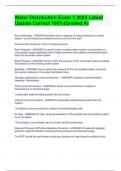
Water Distribution Exam 1 2024 Latest Update Correct 100%(Graded A)
Water Distribution Exam 1 2024 Latest Update Back siphonage - ANSWER backflow due to negative or reduced pressure in water system. occurs during low pressure events such as a line leak Reverse flow caused by a loss of supply pressure Back Pressure - ANSWER Is caused when a potable water system is connected to a non potable supply operating under a higher pressure that pushes contaminated liquid back into the public water system Back Pressure - ANSWER Occurs when the pressure of the connected system exceeds the pressure of the drinking water system Backflow - ANSWER Occurs when the pressure of the non-potable system. Exceeds the positive pressure in the water distribution lines. Diseases attributed to cross-connections: - ANSWER Dysentery• Gastroenteritis• Hepatitis• Salmonellas Direct Cross-Connection - ANSWER A direct cross-connection is subject to backpressure or backsiphonage. Undesirable material being pushed into the system. Indirect Cross-Connection - ANSWER Undesirable material being pulled into the system. An indirect cross-connection is subject to back-siphonage only. Air Gap - ANSWER Air Gap: physical separation of the potable and non-potable system by an air space. The simplest, most reliable way to provide backflow prevention Reduced Pressure (RP) Zone Backflow Preventer - ANSWER Provides the greatest protection against backflow caused by back-pressure and back-siphonage. The RPZ should be used where continuous pressure or high hazard conditions exist, Reduced Pressure (RP) Zone Backflow Preventer - ANSWER Must be tested annually and internal parts replaced every five years. Pressure Vacuum Breakers (PVB) - ANSWER Must be used under continuous pressure. They must be installed at least 12 inches above the usage point to prevent back-siphonage. Atmospheric Vacuum Breakers (AVB) - ANSWER Intended to protect against back-siphonage but not back pressure. Check valve and vent open to atmosphere. Corrosion is the result? - ANSWER Corrosion is the result of an electrochemical reaction Lead and Copper Rule - ANSWER Protect public health by minimizing the amount of lead and/or copper dissolving into tap water. Anode (Galvanic Corrosion) - ANSWER where electrons are lost through the metal. Cathode.(Galvanic Corrosion) - ANSWER : where electrons are gained and then leave the metal Calcium Carbonate - ANSWER Water is considered stable when it is just saturated with calcium carbonate. Used for corrosion protection of pipe by a thin film of CaCo3 on the interior of pipes. Langelier Saturation Index (LSI) - ANSWER LSI values >zero indicate scaling potential (i.e., precipitating). The ideal range for balanced water is -0.3 to +0.3 LSI is a measure of a solution's ability to dissolve or deposit calcium carbonate, is often used as an indicator of the corrosivity of water. pH: As pH decreases? - ANSWER corrosion increases. In most cases, as alkalinity increases, - ANSWER corrosion decreases. Correct 100%(Graded A)

Geschreven voor
- Instelling
- Water Distribution
- Vak
- Water Distribution
Documentinformatie
- Geüpload op
- 28 februari 2024
- Aantal pagina's
- 15
- Geschreven in
- 2023/2024
- Type
- Tentamen (uitwerkingen)
- Bevat
- Vragen en antwoorden
Onderwerpen
-
water distribution
-
water distribution exam 1 2024 latest update corre
-
back siphonage answer backflow due to negative o
-
reverse flow caused by a loss of supply pressure

Ook beschikbaar in voordeelbundel