DN_Lectures:
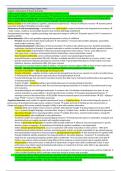
Lecture 1: Neurophysiology & Neuroanatomy
-Brain Organisation = Processing + Storage relevant/NB info is processed simultaneously & stored in different parts of brain
- Regulation: brain controls thoughts/behaviours/emotions (in collaboration w somatic nervous system) + internal body
processes (in collaboration w automatic nervous system)
o E.g. PFC = inhibits impulses, send/receive info via gut-brain axis
o Hypothalamus = regulates stress in collaboration with pituitary & adrenal gland (HPA Axis)
- Integration: brain connects incoming info (sensory input) with already stored info from memory
- Prediction: brain uses prior knowledge to determine future outcomes does not process all info, only what is not
expected (aka prediction error) more efficient processing
- Lateralization: two hemispheres have partially different functions LH = understanding + producing language,
semantic memory RH: processing social + emotional stimuli, visuo-spatial orientation LH/RH control opposite
sides of body
- Cooperation & Competition: some brain parts compete and some cooperate competition = top-down (high>low) vs
bottom-up (low>high) high = frontal cortex / low = primary projection areas, brainstem, limbic system
- Small vs Large Brain Networks: brain is organized both structurally & functionally into complex networks
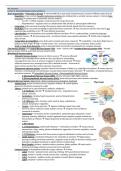
-The Nervous System = the Central Nervous System (CNS – brain + spinal cord) + Peripheral Nervous System (PNS – Somatic
Nervous System (SNS) & Automatic Nervous System (ANS)
Peripheral Nervous system:
- 1)Somatic Nervous System: Sensory & Motor neurons Sensory (afferent)
neurons carry messages from outside to CNS, specialized in transmitting
messages from eyes, ears, & sensory receptors to spinal cord & brain) Motor
(efferent) neurons carry messages from CNS to skeletal muscles – from brain &
spinal cord to muscles that control voluntary movements
- 2)Autonomic Nervous System: regulates internal environment of body (e.g. respiration/circulation) senses internal
functions, controls glands and involuntary muscles (heart, blood vessels, stomach) motivation, emotional behaviour
and stress response Sympathetic Nervous System + Parasympathetic Nervous System
o 2.1)Sympathetic Nervous System (SNS): physical activation fight-flight response
o 2.2)Parasympathetic Nervous System (PNS): slows body processes and maintains relaxation
Central Nervous System: Spinal Cord + Brain (cranial nerves, brainstem, forebrain)
- 1)Spinal Cord: motor & sensory nerves, organizes reflexes central pattern
generators (rhythmic movements: walk)
- 1)Brain: divided into 3 parts (forebrain, midbrain, hindbrain)
o 1.1) Hindbrain: vital life medulla (heart rate + respiration)/ pons
(sleep + arousal)
o Cerebellum: complex/rapid movements, precise timing (motor),
memory & learning
o 1.2) Midbrain: vision, hearing, motor control, sleep, wakefulness,
arousal, temperature regulation
o Tectum = input from eyes/ears Superior Colliculus (input from optic
nerve) & Inferior Colliculus (input auditory nerve) integrate info and directs
command to muscles
o Tegmentum= red nucleus (motor coordination), substantia nigra (dopamine, motor-
planning, learning, addiction), ventral tegmental area (complex synaptic network for
homeostasis & reflexes) largest dopamine-producing area involved in neural reward
system
o 1.3)Forebrain:
o 1.3.1)Hypothalamus: underneath thalamus = motivation & emotion sexual arousal,
temperature, sleep, eating, pleasure-displeasure, aggression, hormone regulation, contact
with pituitary gland)
o 1.3.2)Thalamus: receives info from sensory organs & distributes to other parts of brain
o Limbic System: coordinates behaviours for motivation & emotion hippocampus
(storing/recalling/retrieving memories), cingulate cortex (conflict in decision-making, error
detection), amygdala (response to salient stimuli, emotion/fear)
o Basal Ganglia: striatum, caudate nucleus, putamen, globus pallidus basal nuclei =
learning/controlling voluntary movements (not automatic)
- Cerebral Cortex: 2 hemispheres joined by corpus callosum 4 lobes:
o Lobe1: Frontal = planned motor, planning, thinking, WM, goal-directed behaviour
o Lobe2: Parietal = tactile, somatic sensory info, orienting, associative functions
o Lobe3: Temporal = auditory cortex, perception of social stimuli, language
o Lobe4: Occipital = primary visual cortex
Lecture 1: Neurophysiology & Neuroanatomy
-Brain Organisation = Processing + Storage relevant/NB info is processed simultaneously & stored in different parts of brain
- Regulation: brain controls thoughts/behaviours/emotions (in collaboration w somatic nervous system) + internal body
processes (in collaboration w automatic nervous system)
o E.g. PFC = inhibits impulses, send/receive info via gut-brain axis
o Hypothalamus = regulates stress in collaboration with pituitary & adrenal gland (HPA Axis)
- Integration: brain connects incoming info (sensory input) with already stored info from memory
- Prediction: brain uses prior knowledge to determine future outcomes does not process all info, only what is not
expected (aka prediction error) more efficient processing
- Lateralization: two hemispheres have partially different functions LH = understanding + producing language,
semantic memory RH: processing social + emotional stimuli, visuo-spatial orientation LH/RH control opposite
sides of body
- Cooperation & Competition: some brain parts compete and some cooperate competition = top-down (high>low) vs
bottom-up (low>high) high = frontal cortex / low = primary projection areas, brainstem, limbic system
- Small vs Large Brain Networks: brain is organized both structurally & functionally into complex networks
-The Nervous System = the Central Nervous System (CNS – brain + spinal cord) + Peripheral Nervous System (PNS – Somatic
Nervous System (SNS) & Automatic Nervous System (ANS)
Peripheral Nervous system:
- 1)Somatic Nervous System: Sensory & Motor neurons Sensory (afferent)
neurons carry messages from outside to CNS, specialized in transmitting
messages from eyes, ears, & sensory receptors to spinal cord & brain) Motor
(efferent) neurons carry messages from CNS to skeletal muscles – from brain &
spinal cord to muscles that control voluntary movements
- 2)Autonomic Nervous System: regulates internal environment of body (e.g. respiration/circulation) senses internal
functions, controls glands and involuntary muscles (heart, blood vessels, stomach) motivation, emotional behaviour
and stress response Sympathetic Nervous System + Parasympathetic Nervous System
o 2.1)Sympathetic Nervous System (SNS): physical activation fight-flight response
o 2.2)Parasympathetic Nervous System (PNS): slows body processes and maintains relaxation
Central Nervous System: Spinal Cord + Brain (cranial nerves, brainstem, forebrain)
- 1)Spinal Cord: motor & sensory nerves, organizes reflexes central pattern
generators (rhythmic movements: walk)
- 1)Brain: divided into 3 parts (forebrain, midbrain, hindbrain)
o 1.1) Hindbrain: vital life medulla (heart rate + respiration)/ pons
(sleep + arousal)
o Cerebellum: complex/rapid movements, precise timing (motor),
memory & learning
o 1.2) Midbrain: vision, hearing, motor control, sleep, wakefulness,
arousal, temperature regulation
o Tectum = input from eyes/ears Superior Colliculus (input from optic
nerve) & Inferior Colliculus (input auditory nerve) integrate info and directs
command to muscles
o Tegmentum= red nucleus (motor coordination), substantia nigra (dopamine, motor-
planning, learning, addiction), ventral tegmental area (complex synaptic network for
homeostasis & reflexes) largest dopamine-producing area involved in neural reward
system
o 1.3)Forebrain:
o 1.3.1)Hypothalamus: underneath thalamus = motivation & emotion sexual arousal,
temperature, sleep, eating, pleasure-displeasure, aggression, hormone regulation, contact
with pituitary gland)
o 1.3.2)Thalamus: receives info from sensory organs & distributes to other parts of brain
o Limbic System: coordinates behaviours for motivation & emotion hippocampus
(storing/recalling/retrieving memories), cingulate cortex (conflict in decision-making, error
detection), amygdala (response to salient stimuli, emotion/fear)
o Basal Ganglia: striatum, caudate nucleus, putamen, globus pallidus basal nuclei =
learning/controlling voluntary movements (not automatic)
- Cerebral Cortex: 2 hemispheres joined by corpus callosum 4 lobes:
o Lobe1: Frontal = planned motor, planning, thinking, WM, goal-directed behaviour
o Lobe2: Parietal = tactile, somatic sensory info, orienting, associative functions
o Lobe3: Temporal = auditory cortex, perception of social stimuli, language
o Lobe4: Occipital = primary visual cortex