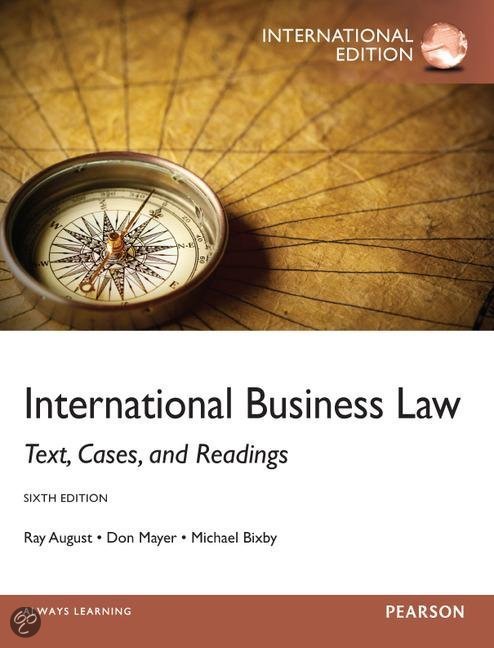
International
Business Law
th
(6 )
INTERNATIONAL EDITION
Ray August, Don Mayer, Michael Bixby
Summary chapters 1…
Author: I.M. Sollie
, International Business Law (6th) International Edition Summary
Information Beforehand
About the Author
Ian Matthew Sollie is a, Dutch, first-year student at The Hague University of Applied Sciences at The
Hague, the Netherlands. He studies International Business and Managements Studies (IBMS) and has
always had a feeling for summarizing and keeping structure in recapitulating. By sharing this he
hopes that he can broaden your knowledge about International Business Law.
Please note that the author is not a native English speaker. In advance, the writer apologizes for any
spelling, grammar, or sentence structure mistake that has been made.
About the Content
The content of the summary is based on content to study for the exam given at the The Hague
University of Applied Sciences. Therefore, not all chapters of International Business Law are covered
in this summary.
Writing Style
Written in Italic: examples/illustrations
Written in Bold + colour of heading: concepts
! Written in Bold + Italic + colour of heading + exclamation points: important sentence !
(= also known as)
→ Followed by explanation or examples (not italic)
=> What happens next / what they do / definition
Option 1 / on this side → …
V.S.
Option 2 / on that side → …
There are no points after a sentence → this is because of the author’s summary style
WARNING: this summary does not guarantee a 100/100
Page 2 of 27
, International Business Law (6th) International Edition Summary
CHAPTER 1:
Intro to International
and Comparative
Law
Pages in book: 21-22; 24-29; 32; 62-63
Page 3 of 27
, International Business Law (6th) International Edition Summary
p. 21 A: What is International Law?
International Law → deals with 3 kinds of international relationships:
1. between states and states
2. between states and persons
3. between persons and persons
Public law = issues between two/more states and legal relationships between states and public
V.S.
Private law = laws governing conduct between people from different states
Comity = practice between states of treating each other with goodwill and civility (= not law)
➢ informal principle
➢ nations extend certain courtesies (= polite behaviour) to other nations
➢ by recognising validity and effect of executives, legislative, and judicial acts
Restatement Section 403:
Even if nation has basis for jurisdiction, the nation may not exercise jurisdiction to prescribe law with
respect to person/activity having connections with another state when exercise of such jurisdiction is
unreasonable
p. 25 B: The Making of International Law
Making of Law
➢ within states
• legislators
• courts
• other agencies of government
➢ international level
• different states function in the roles of both lobbyists and legislators
• consent (= agreement) can be found in state practice (= conduct and practices of
states in dealings)
Multilateral treaties = treaty between more than two states
V.S.
Bilateral treaties = formal binding agreement between two states
Page 4 of 27
, International Business Law (6th) International Edition Summary
p. 25 C: Sources of International Law
The sources that court is permitted to use, in hierarchy (order):
International
conventions
International
custom
General principles of law
Judicial decisions and teachings of
publicists
Treaties and Conventions
Equivalents of legislation → treaties and conventions:
Treaties = legally binding agreements between two/more states
V.S.
Conventions = legal binding agreements between states sponsored by international organisations
Custom
Customary law = rules that have been around for a long time or so generally accepted
Two elements must be established:
➢ usus (= behavioural)
• requires consistent and recurring action by states
• does not mean lengthy nor that it has to be followed by all states
➢ opinio juris sive necesitatis (= psychological)
• states observing custom must regard it as binding
• a practice obligated to follow
General Principles and Jus Cogens
General principle = principle of law common to world’s legal systems
=> courts rely on this when deciding international disputes
Jus cogens = norm of general international law; seen as norm from which no derogation is permitted
Page 5 of 27
, International Business Law (6th) International Edition Summary
p. 28 D: Scope International Law in Actual Practice
The Practice in International Tribunals
Municipal law → regarded as subservient to international law
=> subordinate in capacity or function
=> states have obligation to bring municipal law into compliance with international norms
p. 32 E: International Persons
States = political entities that have territory, population, government
There are three kinds of states:
➢ independent states → free from political control; free to enter into agreements
➢ dependent states → formally surrendered aspect of political and governmental functions
➢ inchoate states → begun, but not completed, states
p. 62 F: Rights of Individuals Under Intern. Law
International law looks upon individuals in two ways:
1. ignores them
• state of responsibility = liability state for injuries that caused to foreign persons
2. treats them as its subject
• human right = right to assert claims on their own behalf
• claims are limited
Page 6 of 27
, International Business Law (6th) International Edition Summary
CHAPTER 3:
Dispute Settlement
Pages in book: 129-130
Page 7 of 27
Business Law
th
(6 )
INTERNATIONAL EDITION
Ray August, Don Mayer, Michael Bixby
Summary chapters 1…
Author: I.M. Sollie
, International Business Law (6th) International Edition Summary
Information Beforehand
About the Author
Ian Matthew Sollie is a, Dutch, first-year student at The Hague University of Applied Sciences at The
Hague, the Netherlands. He studies International Business and Managements Studies (IBMS) and has
always had a feeling for summarizing and keeping structure in recapitulating. By sharing this he
hopes that he can broaden your knowledge about International Business Law.
Please note that the author is not a native English speaker. In advance, the writer apologizes for any
spelling, grammar, or sentence structure mistake that has been made.
About the Content
The content of the summary is based on content to study for the exam given at the The Hague
University of Applied Sciences. Therefore, not all chapters of International Business Law are covered
in this summary.
Writing Style
Written in Italic: examples/illustrations
Written in Bold + colour of heading: concepts
! Written in Bold + Italic + colour of heading + exclamation points: important sentence !
(= also known as)
→ Followed by explanation or examples (not italic)
=> What happens next / what they do / definition
Option 1 / on this side → …
V.S.
Option 2 / on that side → …
There are no points after a sentence → this is because of the author’s summary style
WARNING: this summary does not guarantee a 100/100
Page 2 of 27
, International Business Law (6th) International Edition Summary
CHAPTER 1:
Intro to International
and Comparative
Law
Pages in book: 21-22; 24-29; 32; 62-63
Page 3 of 27
, International Business Law (6th) International Edition Summary
p. 21 A: What is International Law?
International Law → deals with 3 kinds of international relationships:
1. between states and states
2. between states and persons
3. between persons and persons
Public law = issues between two/more states and legal relationships between states and public
V.S.
Private law = laws governing conduct between people from different states
Comity = practice between states of treating each other with goodwill and civility (= not law)
➢ informal principle
➢ nations extend certain courtesies (= polite behaviour) to other nations
➢ by recognising validity and effect of executives, legislative, and judicial acts
Restatement Section 403:
Even if nation has basis for jurisdiction, the nation may not exercise jurisdiction to prescribe law with
respect to person/activity having connections with another state when exercise of such jurisdiction is
unreasonable
p. 25 B: The Making of International Law
Making of Law
➢ within states
• legislators
• courts
• other agencies of government
➢ international level
• different states function in the roles of both lobbyists and legislators
• consent (= agreement) can be found in state practice (= conduct and practices of
states in dealings)
Multilateral treaties = treaty between more than two states
V.S.
Bilateral treaties = formal binding agreement between two states
Page 4 of 27
, International Business Law (6th) International Edition Summary
p. 25 C: Sources of International Law
The sources that court is permitted to use, in hierarchy (order):
International
conventions
International
custom
General principles of law
Judicial decisions and teachings of
publicists
Treaties and Conventions
Equivalents of legislation → treaties and conventions:
Treaties = legally binding agreements between two/more states
V.S.
Conventions = legal binding agreements between states sponsored by international organisations
Custom
Customary law = rules that have been around for a long time or so generally accepted
Two elements must be established:
➢ usus (= behavioural)
• requires consistent and recurring action by states
• does not mean lengthy nor that it has to be followed by all states
➢ opinio juris sive necesitatis (= psychological)
• states observing custom must regard it as binding
• a practice obligated to follow
General Principles and Jus Cogens
General principle = principle of law common to world’s legal systems
=> courts rely on this when deciding international disputes
Jus cogens = norm of general international law; seen as norm from which no derogation is permitted
Page 5 of 27
, International Business Law (6th) International Edition Summary
p. 28 D: Scope International Law in Actual Practice
The Practice in International Tribunals
Municipal law → regarded as subservient to international law
=> subordinate in capacity or function
=> states have obligation to bring municipal law into compliance with international norms
p. 32 E: International Persons
States = political entities that have territory, population, government
There are three kinds of states:
➢ independent states → free from political control; free to enter into agreements
➢ dependent states → formally surrendered aspect of political and governmental functions
➢ inchoate states → begun, but not completed, states
p. 62 F: Rights of Individuals Under Intern. Law
International law looks upon individuals in two ways:
1. ignores them
• state of responsibility = liability state for injuries that caused to foreign persons
2. treats them as its subject
• human right = right to assert claims on their own behalf
• claims are limited
Page 6 of 27
, International Business Law (6th) International Edition Summary
CHAPTER 3:
Dispute Settlement
Pages in book: 129-130
Page 7 of 27